A personal look at the money goals I wrote down when I was younger, from deposits and paying off the car to saving $50 a week and setting up a trading account, and how my idea of financial security changed over time.
Money appears all through my old goal notebooks.
Not in a polished financial-plan kind of way.
It appears in calculations, reminders, small savings targets, things I wanted to pay off, things I wanted to buy, and little steps I thought would make me feel more secure.
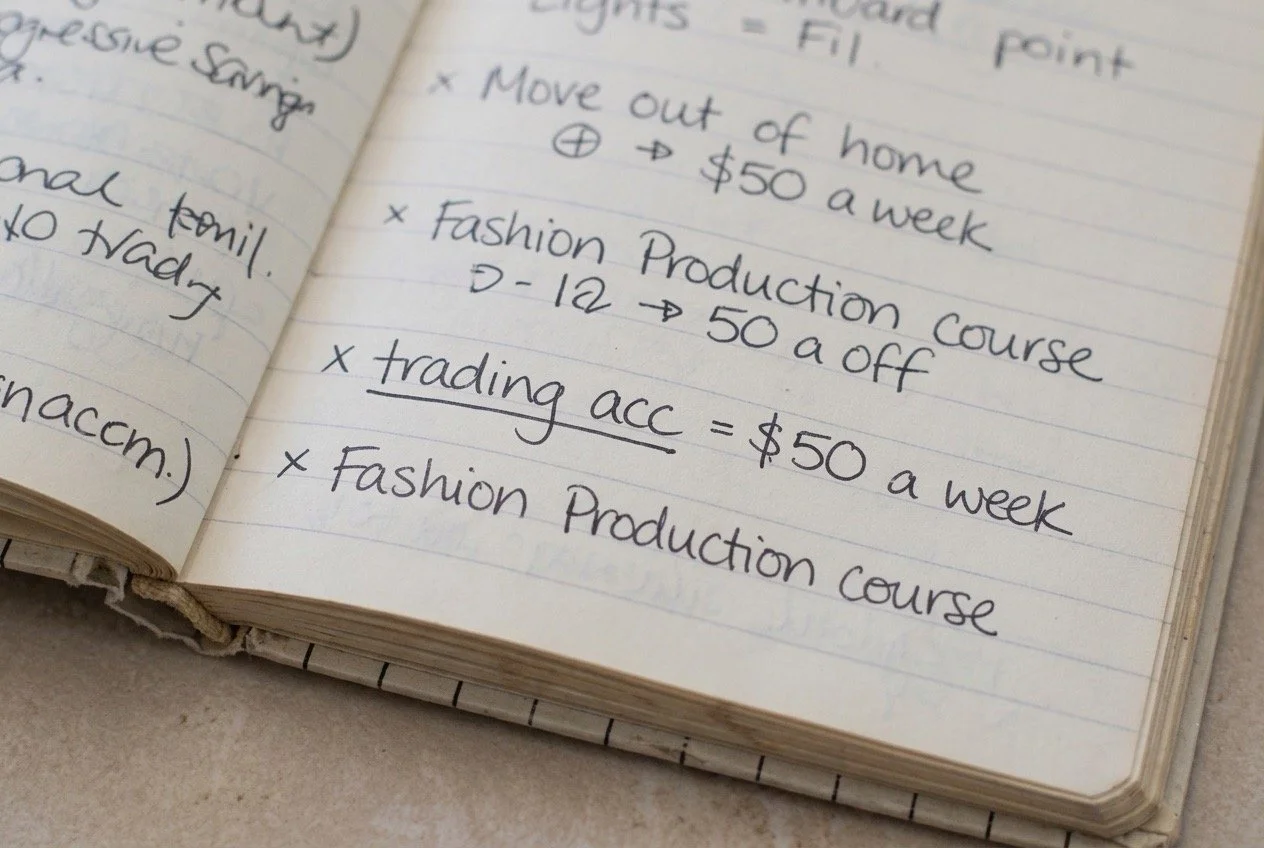
There are notes about working out deposits. Paying off the car. Mortgage and unit calculations. Credit cards. Saving. A trading account. At one point I wrote down that I wanted to save $50 a week into it.
I love looking at those pages now because they are so practical.
The goals are not vague statements about “abundance” or “financial freedom”. They are the kind of things you write when money feels very real and every next step has a number attached to it.
Pay this off. Save this much. Work out whether I can afford that. Get to the next stage.
And underneath all of it, I can see something I probably would not have had the words for then.
I wanted to feel safe.
If you would like to see where those early goals began, I share the actual notebook and the story behind it in The Little Book That Eventually Became A Life in Goals.

When I was younger, money goals were very concrete
When you are younger, financial security can feel like a series of hurdles.
Pay off the car. Save a deposit. Get rid of the credit card. Put money aside. Work out how much you can borrow. Buy the unit. Build the next bit of savings.
There is something reassuring about that because the goal is easy to recognise. You either have the amount or you do not. The loan is either smaller or it is not. The money has either been transferred or it has not.
Those concrete goals gave me something to do when the bigger idea of “being financially secure” felt too large to hold.
I do not think there is anything wrong with that.
Sometimes the most useful money goal is exactly that practical: pay this down, save this much, understand this number, open the account.
The page did not need a philosophy. It needed a figure.
The $50 a week goal makes me smile
One of the entries I particularly like is the decision to save $50 a week into a trading account.
It is not a dramatic number.
That is exactly why I like it.
It shows the way money goals often begin in real life. Not with a huge transformation, but with an amount that feels possible enough to repeat.
At the time, $50 a week represented more than the transfer itself. It was a small way of saying: I want to build something. I want to understand this. I want to have money working towards something rather than simply disappearing into ordinary life.
I did not know then exactly how my interest in trading and investing would develop. I certainly did not know that a trading course I wrote down all those years ago would be something I finally completed much, much later.
But the thread was already there.
That long wait is something I explore in The Goal I Wrote Down That Took Much Longer Than I Expected.
I used to think security would arrive at the next number
Looking back, I can see how easy it was to imagine that security would arrive once I reached the next financial marker.
Once the car was paid off.
Once I had the deposit.
Once I owned the property.
Once there was more saved.
Once the next account existed.
There is always another number available after the first one.
That is one of the things I understand differently now.
Numbers matter. Of course they do. Having savings matters. Paying down debt matters. Understanding what you own, owe and spend matters.
But financial security is not a finish line you cross once and then permanently feel calm.
You can have more money and still feel anxious. You can reach one target and immediately replace it with another. You can be objectively in a stronger position and still behave as though everything might disappear.
The numbers are part of security. They are not the whole feeling of it.
What I wanted money to give me became clearer
The older I get, the more interested I am in what money makes possible rather than what the number looks like on its own.
Choice.
Breathing room.
The ability to handle an unexpected expense without panic.
The ability to say no to something if I need to.
The ability to travel, help family, change direction, work differently, or simply not feel that every decision is being made from financial fear.
That is a much broader idea of financial security than the one in my early notebooks.
It is also harder to reduce to one goal.
“Pay off the car” is wonderfully clear.
“Build enough choice into my life that money does not make every decision for me” is less tidy, but much closer to what financial security means to me now.

The old calculations were never only about the maths
The deposit calculations are interesting to me for the same reason.
On the surface, they are just maths.
How much would I need? What could I borrow? What would the next step be?
But the goal underneath was independence.
Having somewhere of my own. Building something. Feeling as though I was moving forward instead of waiting for life to happen.
That is why old money goals can be surprisingly emotional when you read them years later.
The figures look practical, but they often carry much bigger hopes underneath them.
Safety. Independence. Proof that you are doing okay. A future that feels more under your control.
Some money goals were also symbols of success
My old notebooks did not separate financial security neatly from the things I wanted to buy.
There were goals around property, furniture, the car I wanted, travel and the visible pieces of the adult life I imagined.
When you are younger, those things can become shorthand for “I have made it”.
I understand that now with much more affection than judgement.
There is nothing wrong with wanting a beautiful home, a particular car or a great trip.
But over time I became more interested in whether the money behind those things left me feeling secure or stretched, free or trapped, comfortable or constantly trying to keep up with the next version of success.
The thing itself became less important than the position it left me in.
The trading goal kept changing shape
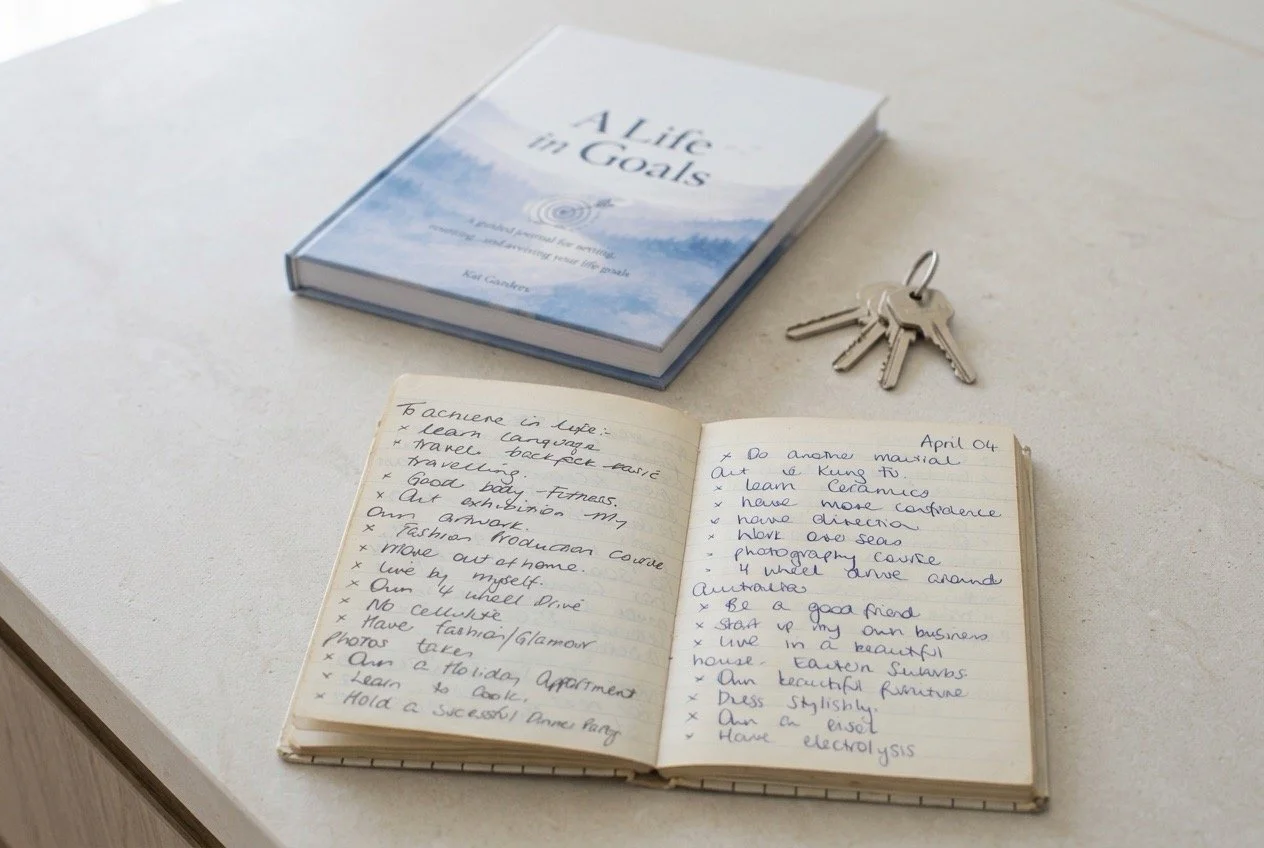
Trading is a particularly good example because it appears as a small money goal long before it became something I seriously returned to.
There was the $50-a-week trading account. There was the idea of doing a trading or stock-exchange course. Then years passed.
Eventually, I completed the trading course last year.
That does not mean the original financial plan unfolded exactly as I imagined it would.
It means an interest survived.
The way I approached it changed. My knowledge changed. My circumstances changed. The reason for wanting to understand it changed.
That is another thing the old goal lists taught me about money: financial goals can evolve just like every other goal.
You do not have to keep the exact strategy simply because the deeper interest is still there.
Financial security is allowed to become more personal
There is a lot of language around money that makes it sound as though everyone should be aiming for the same thing.
A certain income. A certain net worth. A certain retirement number. A certain kind of property or investment strategy.
Those numbers may be useful, but they do not tell you what security means in your life.
For one person, security may mean owning a home outright. For another, it may mean enough savings to leave a job. For someone else, it may mean less debt, more cash available, the ability to travel or simply understanding their finances well enough that they no longer avoid looking at them.
The older I get, the more I think a useful financial goal begins with the question: what do I want money to make easier, safer or more possible?
The number comes after that.
This idea of protecting financial security connects closely to What Are Anchor Goals and What Could Yours Be?
What I would ask now
If I were looking at my money goals today, I would still write practical things down.
I like practical things.
Save this. Pay that off. Understand this. Put money aside for that.
But I would also ask:
What does feeling financially secure actually mean to me now?
What do I want money to give me more choice about?
Where does money currently make me feel constrained?
What would I like to understand better?
What am I saving for beyond the number itself?
What would make me feel calmer?
What kind of financial position would support the life I want rather than simply look successful from the outside?
Those questions are harder to fit neatly into one line in a notebook.
But they lead to much better goals.
If you would like to see how I use the different journal sections to explore goals like these, read How to Use A Life in Goals.

The old numbers still matter to me
I do not look at those old calculations and think they were simplistic.
They were exactly the goals I needed at the time.
Paying off the car mattered. Saving $50 a week mattered. Working out the deposit mattered. Opening the trading account mattered.
Each one helped make a very large idea — financial security — feel a little more concrete.
What changed was my understanding of what I wanted security for.
When I was younger, money goals were often about reaching the next marker.
Now they are much more about what sits behind the marker: freedom, resilience, choice, confidence and the ability to build a life without every decision feeling dictated by money.
The old goal lists did not give me a perfect financial plan.
They gave me something more interesting.
They showed me how my definition of “enough” kept changing.
And perhaps that is one of the most useful money goals to keep revisiting of all.
If you would like to give your own financial goals somewhere to evolve, explore A Life in Goals on Amazon, or visit the dedicated A Life in Goals page to choose your Amazon region.
Kat x
Creator of A Life in Goals