A practical walkthrough using one simple example - “I’d love to spend a month in Italy” - to show how different kinds of goals can sit around the same bigger idea inside the A Life in Goals Goal Ecosystem.
Sometimes the easiest way to understand a system is to stop explaining the system and follow one real idea through it.
So rather than talk about Life Goals, Dream Goals, Anchor Goals, Growth Goals and Everyday Goals as separate categories, I want to take one simple thought and show how it might touch different parts of the A Life in Goals Goal Ecosystem.
The thought is:
I’d love to spend a month in Italy.
It is the kind of thing many of us say long before we have any idea whether it is realistic. Maybe you have been thinking about it for years. Maybe you only thought of it after a holiday, a film, a friend’s trip or a conversation over dinner. Perhaps you are not even sure which part of Italy you would choose.
At the beginning, that does not matter.
The point is not to force the idea into a plan. The point is to give it somewhere to exist, then notice what else in your life might support it, shape it or eventually change it.
And before we go any further, this is important: the example below is not a formula. A goal does not need to appear in every category. It does not need to move through the ecosystem in this order. Some goals will only ever live in one place. Some will connect to several. The purpose of the Goal Ecosystem is not to create more work. It is to help you see the relationships that are already there.
If you want the broader explanation before following this example, read What Is a Goal Ecosystem? And Why Your Goals Don’t Exist in Isolation.
It may begin as a Dream Goal
At first, “spend a month in Italy” may be nothing more than an idea you love.
You are not ready to work out the cost. You have not decided when you would go. You may not know whether you could take that much time away from work, whether your family circumstances would allow it or even whether a month is really the right length of time.
That is exactly why Dream Goals matter.
For a closer look at the difference between a Dream Goal and a Life Goal, see Dream Goals vs Life Goals: What’s the Difference?
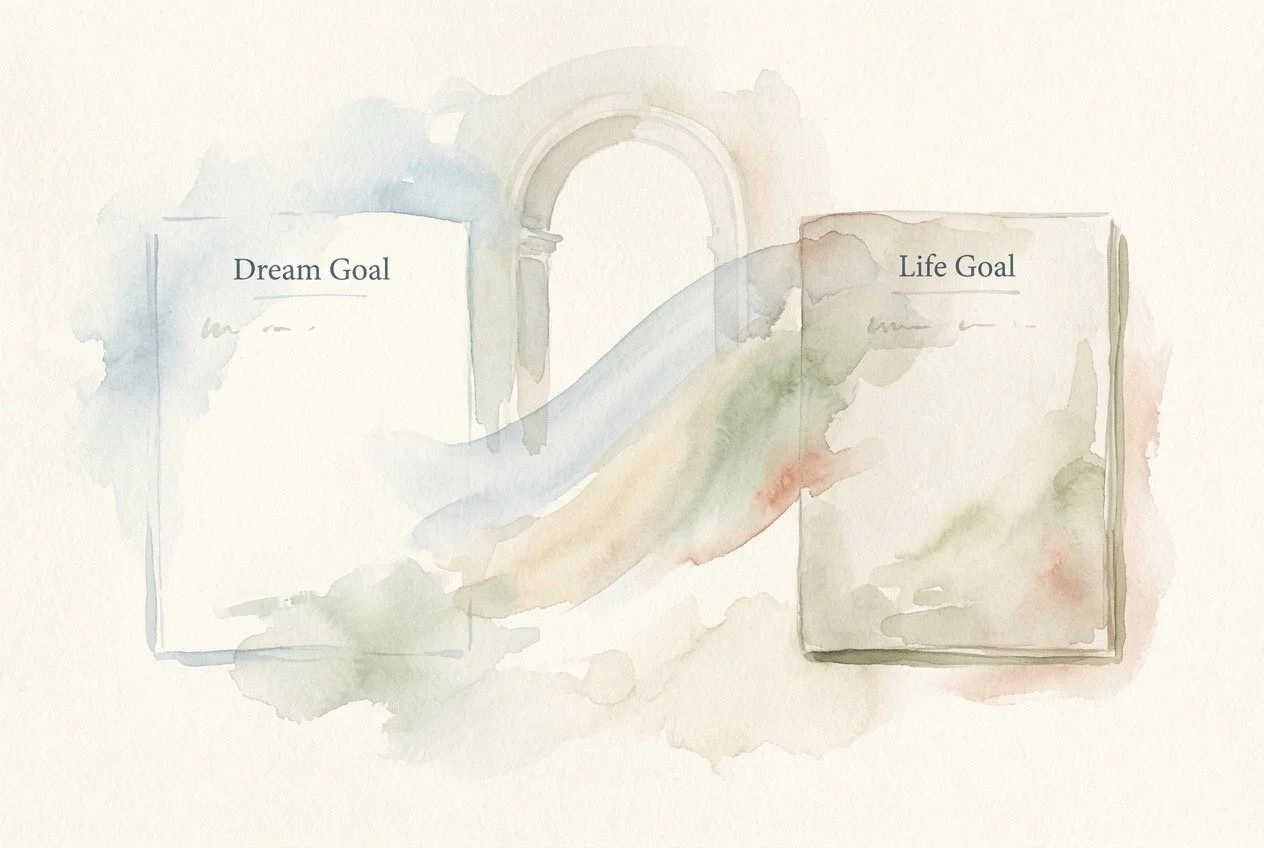
A Dream Goal gives an idea somewhere to live before it has earned a deadline, budget or action plan. You do not have to prove that you are serious about it. You do not need to start saving tomorrow. You can simply write:
Spend a month living in Italy one day.
There is value in that on its own.
The idea is no longer floating around in your head waiting to be forgotten. It is on a page. You can come back to it. It can sit beside other dreams. You might add a note later: somewhere near the coast, or maybe Florence, or I’d love to go in spring.
Some Dream Goals remain exactly like that for years, and there is nothing wrong with that. A dream can be worth keeping even before you are ready to do anything about it.
But sometimes you come back and realise the thought has not gone away.
In fact, you want it more.

At some point, the dream may become a Life Goal
There is a subtle shift that happens when an idea stops feeling like something that would simply be nice and starts feeling like something you genuinely want your life to contain.
You still may not know exactly how it will happen, but the thought has more weight.
Instead of “one day”, you might write:
Spend a month in Italy within the next few years.
That is not a legal contract with yourself. It does not mean you now need to choose a departure date. But you have recognised that the idea matters enough to become part of the bigger picture of your life.
This is how I think about a Life Goal. It is less about turning a dream into a project and more about saying: yes, this belongs in the life I am imagining for myself.
Once that happens, you may start noticing the practical reality around it.
A month away is not only a travel decision. It touches money. Time. Work. Perhaps health. Maybe family responsibilities. The goal has not suddenly become complicated; you are simply seeing more of the life around it.
That is where the ecosystem starts to become useful.
Anchor Goals can protect the foundations underneath it
Now imagine you are genuinely considering a month in Italy.
The exciting part is easy to picture. Where you might stay. Morning coffee. Markets. Trains. Long lunches. Learning enough Italian not to panic when somebody asks you a question.
The less glamorous questions matter too.
Can you afford to go without creating financial stress when you come home? Are there other financial priorities you do not want to compromise? Do you want to be fit and strong enough to walk all day, carry bags, climb stairs and actually enjoy the kind of trip you are imagining?
Those questions can lead to Anchor Goals.
For this example, two anchors might be:
Maintain enough financial security that travel does not leave me anxious about money.
Stay healthy and strong enough to keep travelling comfortably.
Neither of those goals exists only because of Italy. They may support many parts of life. That is what makes them anchors.
The financial buffer gives you choices beyond this trip. Strength and health matter beyond travel. They are foundations that support the bigger idea without being subordinate to it.
This is an important distinction in the Goal Ecosystem. The Anchor Goal is not just another task created by the dream. It is something worth protecting in its own right.
If you want to go deeper on this foundation layer, read What Are Anchor Goals? And What Could Yours Be?
And sometimes strengthening the anchor is the most useful thing you can do before taking any action on the dream itself.

A Growth Goal can make the experience richer
Then there are the things you might want to learn or develop because they would change the experience itself.
Perhaps you have always wanted to speak another language, and the idea of spending a month in Italy gives that old interest a new reason to matter.
Your Growth Goal might become:
Learn enough conversational Italian to feel confident getting around, ordering food and having simple conversations.
That goal does not need to be about fluency. It does not need to prove anything. It is simply a piece of learning that expands what becomes possible.
This is one of the things I like about Growth Goals. They do not have to be self-improvement for the sake of self-improvement. They can grow naturally out of the life you want to live.
You may find that you love the language even if the trip is delayed. The Growth Goal can develop a life of its own.
That is another reason the ecosystem is not a rigid chain. The Growth Goal can support the Italy dream, but it is also allowed to become something valuable independently.

Everyday Goals are where the bigger idea starts touching real life
A month in Italy can sit happily as a Dream Goal or Life Goal for quite a while, but if you reach the point where you want to move it closer, the Everyday Goals are often where that begins.
These do not need to look dramatic.
Research which part of Italy would actually suit a month-long stay.
Work out a realistic cost.
Put money into a travel account regularly.
Try an Italian lesson.
Look at what taking four weeks away from work could realistically involve.
Read about staying in one place rather than trying to turn the month into a four-week sightseeing marathon.
Some of these are actions. Some are simply questions worth answering.
This matters because the gap between a dream and reality often feels enormous only when we insist on seeing the whole gap at once.
An Everyday Goal does not have to get you to Italy. It might simply make Italy ten per cent more real.
And not every one of those smaller goals needs to happen at the same time. Perhaps this year you only work out the cost and start saving. The language comes later. The work arrangements cannot be explored until circumstances change.
The ecosystem can hold that unevenness.
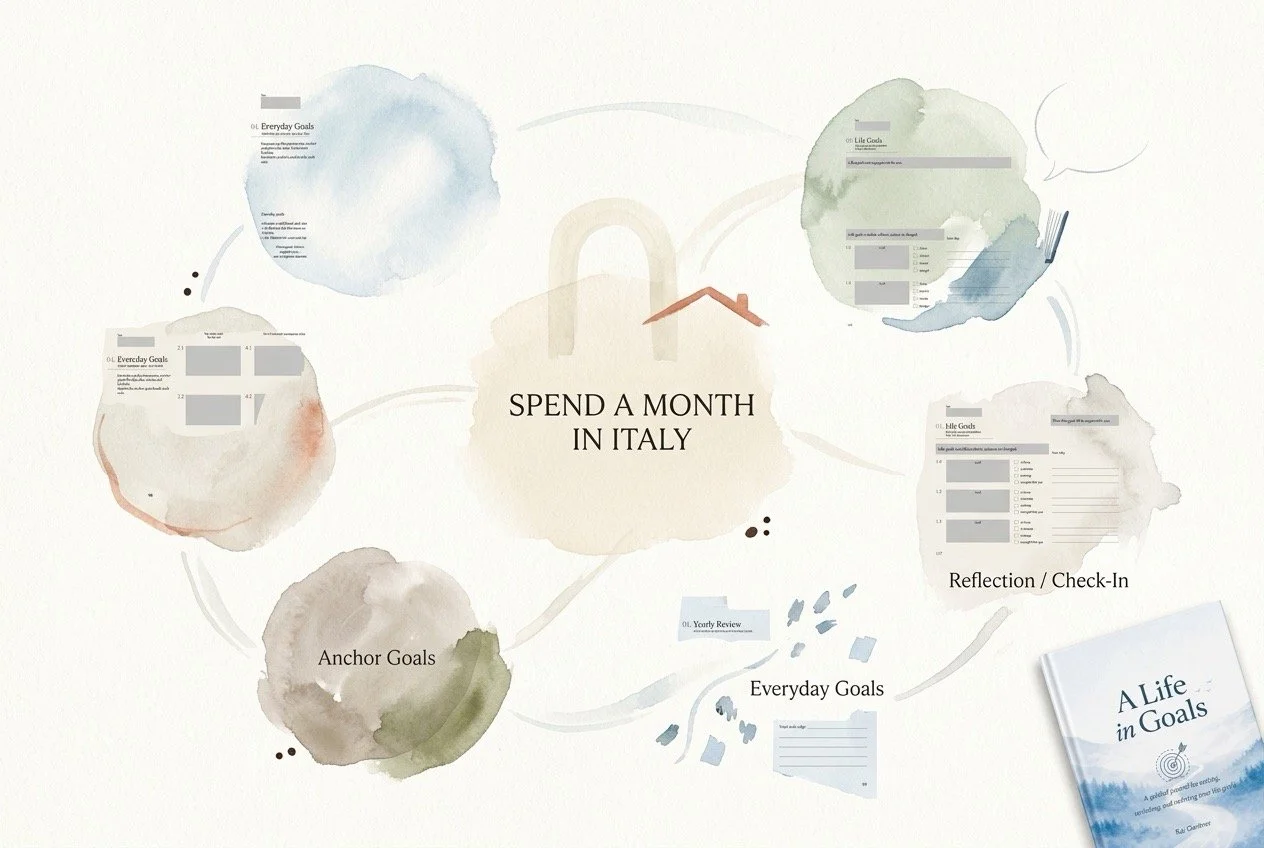
The ecosystem at a glance
If we put the Italy example side by side, you can see how the same larger idea might show up in different ways without becoming five versions of the same goal.
Then life happens
This is the part I think matters most.
You can build a lovely Goal Ecosystem around Italy and still have life change it.
Maybe you start saving and then another financial priority becomes more important. Perhaps work changes and a month away is no longer realistic. You may discover that you do not actually want to spend four weeks in one place. Three weeks feels better. Or ten days every year starts to appeal more than one long trip.
Perhaps you still want the month away, just not yet.
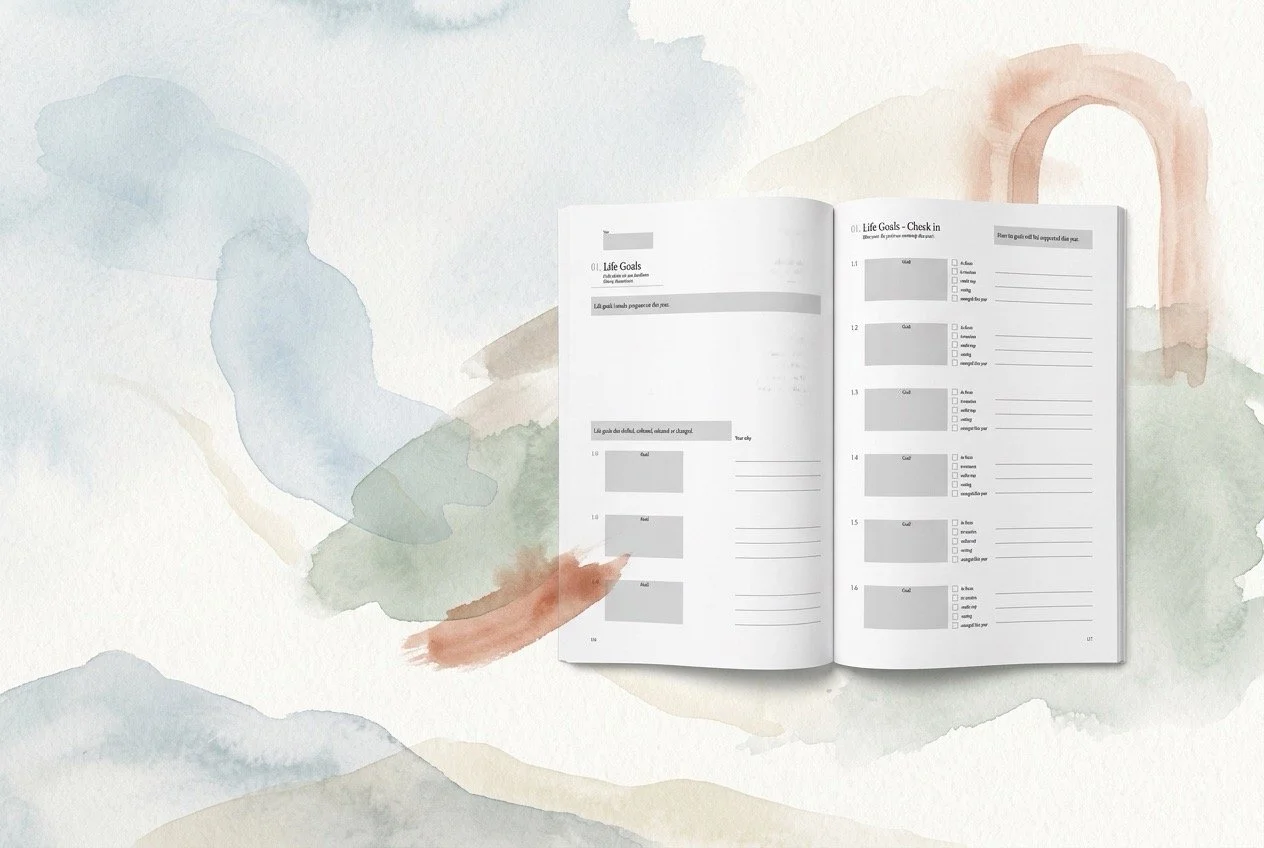
The Check-in is where you get to acknowledge that without treating the original goal as a failure.
You might write:
Still want this. Timing is not right yet.
Or:
Changed this to three weeks. That feels much more realistic.
Or perhaps you come back and realise that learning Italian became the part you loved most, while the month-long stay no longer matters much at all.
That is not the ecosystem breaking down.
That is the ecosystem doing exactly what it is supposed to do: giving you somewhere to see what changed
The same goal does not need every part of the ecosystem
The Italy example happens to touch every part of the ecosystem quite naturally, which makes it useful for explaining the idea.
Real life will not always look this tidy.
You may have a Dream Goal that needs no Anchor Goal, no Growth Goal and no Everyday action because you are perfectly happy letting it remain a dream.
You might have an Anchor Goal around your relationships that stands completely on its own.
An Everyday Goal might simply make ordinary life nicer and never lead anywhere bigger.
A Growth Goal might exist because you love learning, not because it supports a particular Life Goal.
So please do not read this example and think you now need to take every goal you have and manufacture five related goals around it.
That would defeat the point.
The ecosystem should help you notice connections, not force them.
For the wider overview of all five goal types, see The 5 Types of Goals in A Life in Goals - And Why You Need More Than One Kind.
What the Italy example shows
When you look at the whole example together, the original idea has not become more impressive.
It has become more visible.
You can see the dream itself.
You can see when it starts to become something you genuinely want your life to contain.
You can see the foundations that protect it.
You can see the growth that might enrich it.
You can see the small ordinary choices that could bring it closer.
And you can see that the whole thing is allowed to change.
That is the difference between treating a goal as one line on a list and seeing it inside an ecosystem.
The first version says:
Spend a month in Italy.
The ecosystem asks a richer set of questions.
What is this goal really asking for?
What supports it?
What do I want to protect while I move towards it?
Is there anything I would like to learn along the way?
What small piece could become real now?
And when I come back later, does this still look like the life I want?
That is how the book starts working as a whole
This is one of the things I wanted A Life in Goals to make possible.
The pages are not separate little exercises that you complete and forget.
A Dream Goal can sit quietly for years. A Life Goal can become clearer. An Anchor Goal can protect something underneath it. A Growth Goal can open a new possibility. An Everyday Goal can make a tiny piece of the bigger idea real. Then the check-in pages give you somewhere to return when life has inevitably changed.
You can move backwards and forwards between them.
You can ignore a category that does not matter to this goal.
You can change the goal completely.
You can let the dream wait.
And you can come back years later and see not only whether you got to Italy, but what happened to the life around the idea.
That is why I think of it as an ecosystem rather than a plan.
The point is not to control every step between where you are now and where you think you want to go.
It is to see how the different parts of your life can support one another while you are moving.
Sometimes one goal is enough to show you the whole picture.
If you want to see how this works across your own goals
This is exactly the kind of thinking A Life in Goals was designed to support. You do not need every goal to fit every category, and you do not need to map the whole ecosystem in one sitting. The journal simply gives Dream, Life, Anchor, Growth and Everyday Goals somewhere to sit beside one another so the connections can become visible over time.
If you want a guided journal that helps you see how different parts of your life can support the same bigger idea, you can explore A Life in Goals on Amazon.
Kat x
Creator of A Life in Goals