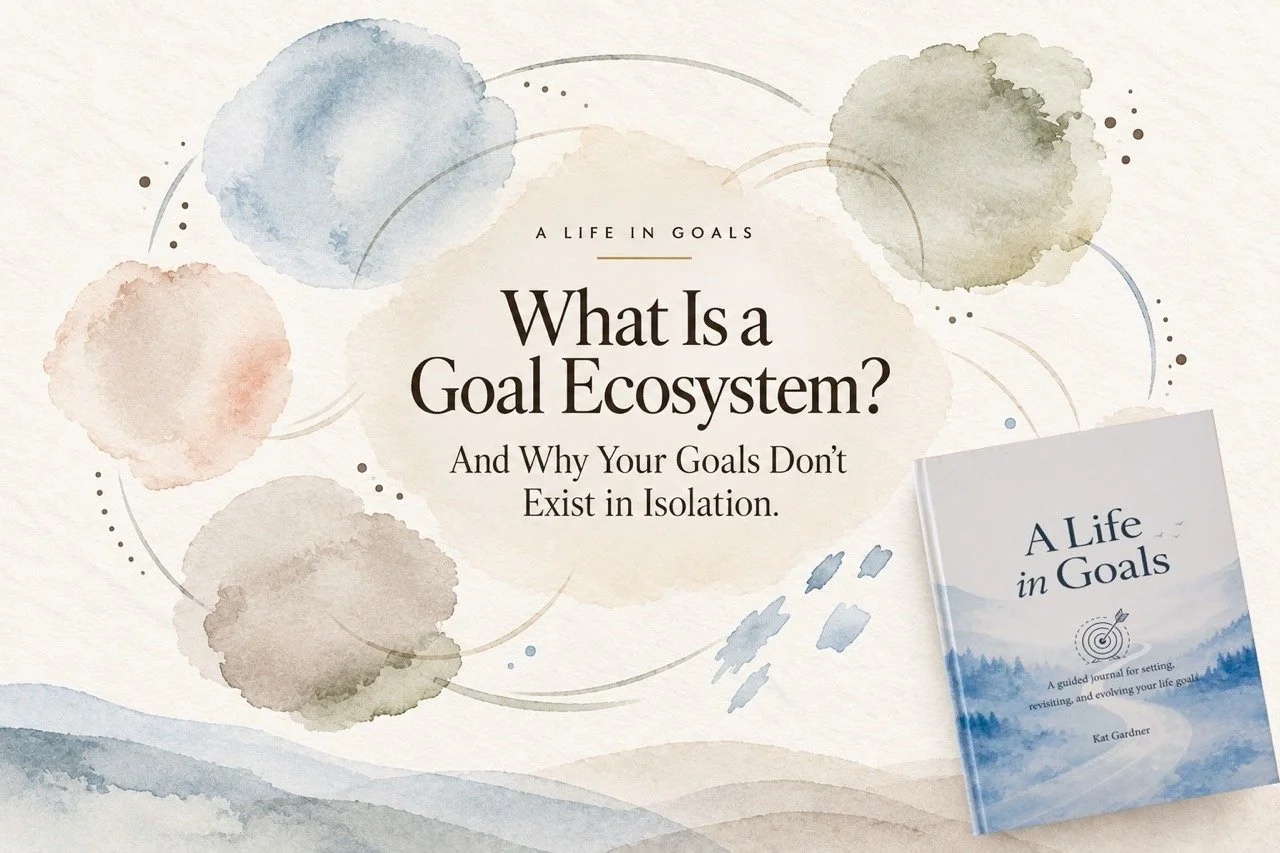
What Is a Goal Ecosystem? And Why Your Goals Don’t Exist in Isolation
The cornerstone explanation of the A Life in Goals Goal Ecosystem: how different kinds of goals can support, influence and protect one another without becoming a rigid system.
Most goal-setting advice starts by asking you to make a list.
Career goals. Money goals. Travel goals. Health goals. Personal goals. Write them down, choose the most important ones and start working through them.
There is nothing wrong with that approach, but I have never thought our goals behave quite that neatly.
A goal rarely sits in one little box completely separate from the rest of life. Wanting to change the way you work may affect money, time, confidence and family life. Wanting to travel more may connect to financial security, health, learning or the way you organise your ordinary weeks. A dream about starting something of your own might need a stronger financial foundation underneath it and a few smaller everyday choices before it is ready to become anything more.
The goals themselves are different, but they influence one another.
That is what I mean when I talk about a Goal Ecosystem.
It is simply a way of looking at your goals as part of the same life rather than as a collection of unrelated tasks.
Some goals pull you forward. Some protect the foundations underneath you. Some help you grow into something you want to be able to do. Some make ordinary life better. And some are allowed to remain dreams for a while without any pressure to become plans.
They do not all need to be active at once. They do not all need deadlines. And one goal does not need to appear in every category.
The value of the ecosystem is not in creating more goals. It is in seeing the relationships that are already there.
A flat goal list can hide what is really going on
Imagine you write three things on a goal list: travel more, save more money and get fitter.
On paper they look like three separate goals.
But perhaps the reason you want to get fitter is because you would love to do a walking holiday. Perhaps saving more money matters partly because you want the freedom to take longer trips without worrying about what they cost. Suddenly the three goals are not competing items on a list. They are connected.
The same thing can happen in less obvious ways. You may think your goal is to leave your job, but once you spend some time with it you realise the deeper goal is having more control over your time. That might connect to a financial goal that gives you more choices, a growth goal around learning something new, and an everyday goal around protecting one evening a week for something that matters outside work.
Nothing about that needs to become complicated. You are simply noticing that one part of life rarely changes without touching another.
This is also useful because a goal can look stuck when you are only looking at the goal itself. Perhaps you have been saying for years that you want to change careers but never move. The problem may not be motivation. The thing holding the goal still could be money, confidence, knowledge or the fact that your current life does not leave enough space to explore anything else.
The ecosystem helps you look around the goal rather than only staring directly at it.
Different goals can do different jobs
One of the ideas behind A Life in Goals is that not every goal needs to do the same job.
That sounds simple, but it changes the way you look at a goal list.
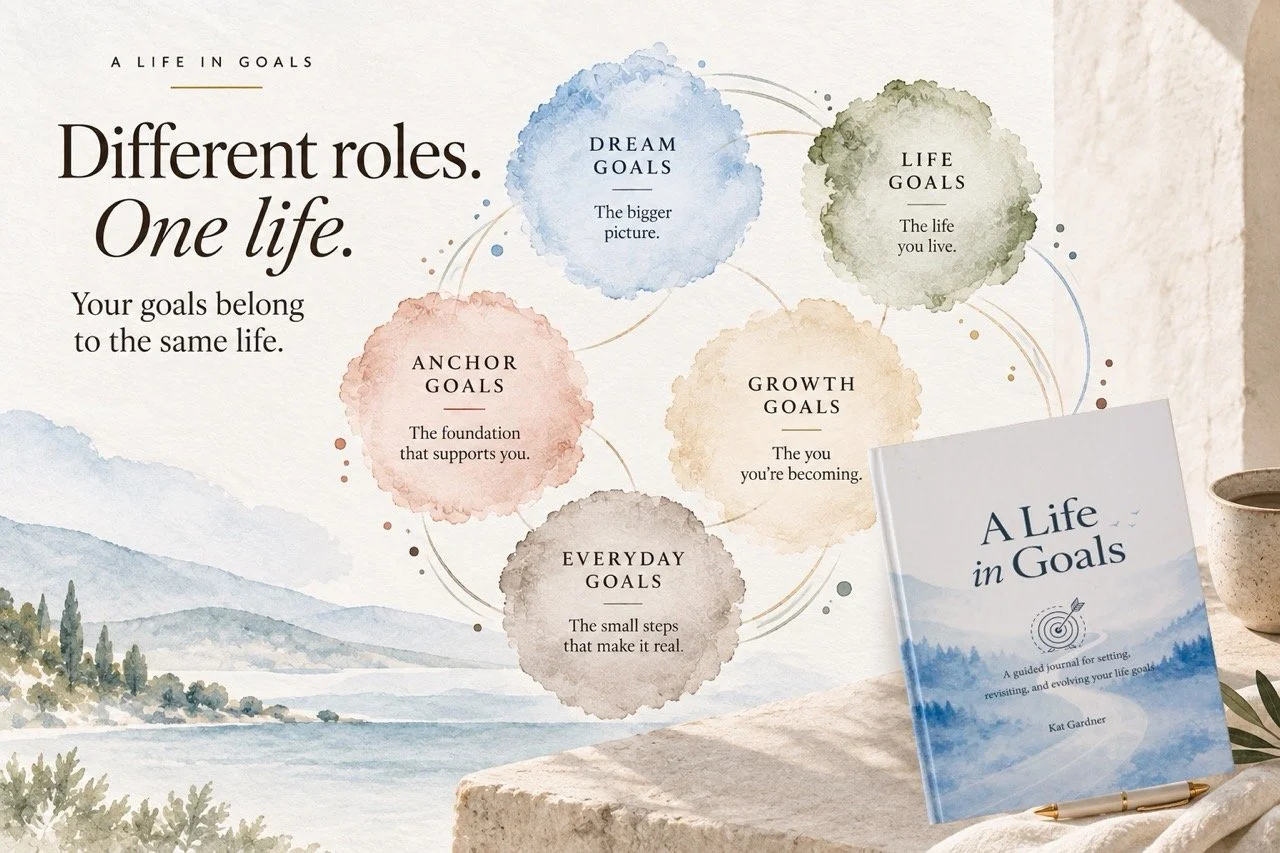
Some goals are bigger-picture Life Goals. These are the things you genuinely want your life to contain: the places you would love to go, the kind of work you want, the financial position you would like to reach, the experiences, relationships, home, health or way of living that matter to you over time.
Some are Dream Goals. These are ideas and possibilities that deserve somewhere to exist before you decide whether you are ready to act on them. You can write down the dream of living overseas, starting a business, writing a book or learning to sail without immediately turning it into a project plan.
Growth Goals are about learning, becoming and developing. They may support another goal, or they may matter completely on their own. Learning a language, becoming more confident with money, improving your strength, learning photography or developing a new professional skill can all belong here.
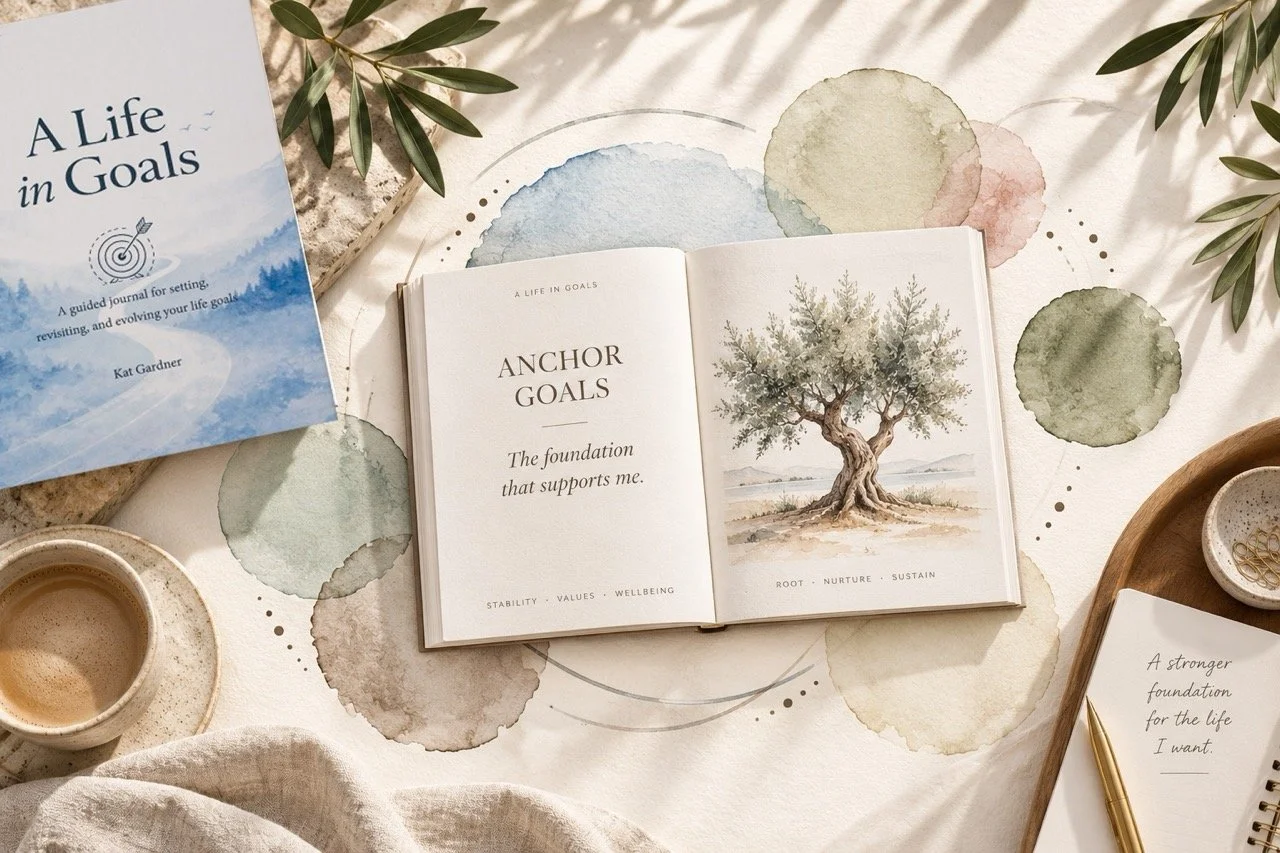
Anchor Goals are different again. They are the foundations you want to protect or strengthen: financial stability, health, relationships, time, home, freedom, or whatever keeps you grounded when other parts of life are changing.
Then there are Everyday Goals. These are the smaller choices and gentle actions that shape ordinary life. They may help a larger goal move, but they can also simply make the week you are living now feel better.
The point of having different types is not to create five times as many goals.
It is to recognise that a dream, a foundation, a piece of growth and a small everyday action are not interchangeable. They can all matter without needing to be treated in exactly the same way.
A Goal Ecosystem is not a five-step process
This part matters because it would be very easy to turn the idea of a Goal Ecosystem into another system you are supposed to follow correctly.
That is not what I mean.
A Dream Goal does not have to become a Life Goal, then a Growth Goal, then an Everyday Goal, as though you are moving a token around a board.
Some dreams will stay dreams for years. Some may never become active goals at all, and they can still be worth writing down.
An Anchor Goal may have absolutely nothing to do with a particular dream. You may simply know that maintaining close friendships is one of the things that keeps your life feeling good, regardless of what else you are working towards.
A Growth Goal can exist because you enjoy learning something, not because it needs to serve a larger achievement.
And an Everyday Goal may be something wonderfully ordinary that improves your actual Tuesday without leading to anything bigger.
The ecosystem is not a sequence. It is a way of seeing how different parts of your life sit beside one another.
Sometimes you will find a strong connection. Sometimes there will not be one.
Both are fine.
One bigger goal may have support around it
Where the ecosystem becomes particularly useful is when you have a bigger goal that feels exciting but slightly distant.
Say you would love to spend more time travelling.
That may be a Life Goal in its own right. But around it there could be an Anchor Goal around financial security because you do not want travel to leave you stressed about money. There might be a Growth Goal around learning a language or becoming more confident travelling independently. An Everyday Goal could be putting a small amount into a travel account each payday or making space to research one trip you genuinely want to take.
There may also be Dream Goals sitting nearby that are much less developed: a month in Italy one day, a long train journey, a walking holiday, somewhere you heard about last week and do not know enough about yet.
You do not need all of those pieces.
But seeing them together can make the larger desire feel less isolated. Instead of telling yourself, 'I want to travel more and I never seem to do it', you begin to see what is already supporting the goal, what is missing and what is allowed to wait.
This is where I think a Goal Ecosystem becomes much more useful than a long list of things to achieve.

Sometimes an Anchor Goal protects the dream
I particularly like the relationship between bigger goals and Anchor Goals because it is easy to overlook.
When we are excited about something new, the foundations can feel boring by comparison.
You want to start the business. The exciting part is the idea, the name, the product, the possibility of doing something for yourself. The less exciting part might be making sure you have enough financial breathing room to take the risk without turning the dream into a source of panic.
You want to travel extensively. The exciting part is where you will go. The anchor might be staying physically strong enough to enjoy it, or protecting enough financial security that the trip feels like freedom rather than worry.
You want to reduce the amount you work. The dream is more time. The anchor may be knowing what income you actually need and making sure the numbers support the life you want.
The anchor does not make the bigger goal less exciting.
It can make it more sustainable.
And sometimes the best thing you can do for a dream is not work directly on the dream at all. It is strengthen the foundation underneath it.
Growth Goals can expand what becomes possible
Growth Goals play a different role because they are about capability, curiosity and becoming.
Sometimes we want a life that requires something we do not know how to do yet.
You may want financial freedom but feel completely uncomfortable with money. Learning how to understand your finances becomes part of the ecosystem around that larger goal.
You may want to travel for longer periods but feel nervous going somewhere you do not speak the language. Learning enough to feel more confident can change what becomes possible.
You might dream about a creative project but have not made anything in twenty years. A class, a practice or simply becoming comfortable being a beginner again may be the growth that sits around it.
But growth does not always need to justify itself by supporting a larger goal either.
You are allowed to learn something because you are curious.
That can be part of the ecosystem too. A life is not only made from efficient steps towards outcomes. Sometimes learning itself is one of the things that makes life interesting.
Everyday Goals bring the ecosystem back to real life
The bigger categories are useful, but I think Everyday Goals are what stop the Goal Ecosystem becoming too theoretical.
Life is lived in small pieces.
You can have a Life Goal to feel financially secure, but the actual week may contain something as ordinary as transferring money on payday.
You may want stronger relationships, while the everyday version is finally putting dinner with a friend into the calendar rather than saying you should catch up.
A bigger goal around health may be supported by walking more often, going to bed earlier or protecting the appointment you keep cancelling.
And some Everyday Goals may not connect to a bigger ambition at all. You may simply want a calmer morning, more reading, a regular Sunday lunch, less time on your phone or one evening a week that does not disappear into work.
That still belongs.
One of the reasons I like thinking in an ecosystem is that it gives ordinary life as much permission to matter as the spectacular goals.

The ecosystem changes when life changes
No Goal Ecosystem stays fixed because no life stays fixed.
The goal that sits in the centre of your attention this year may barely matter three years from now. An Anchor Goal may become more important during a difficult period. A Dream Goal may suddenly become possible. A Life Goal may shrink, grow or change direction entirely.
That is where the reflection and check-in parts of A Life in Goals matter.
You can come back and see what still belongs.
Maybe the career goal changed because work stopped being the most important thing. Perhaps the travel dream became more important once the children were older. A financial goal might move because your circumstances changed. Something you thought was a major Life Goal may turn out to have been a temporary idea.
The ecosystem is allowed to rearrange itself.
You are not supposed to keep every goal in exactly the place you first put it.
In fact, revisiting the relationships between your goals can be just as useful as measuring progress towards any one of them.

You do not need more goals. You need to see the ones you have more clearly
I think this is the most important part.
The Goal Ecosystem is not an invitation to fill every page with more things to achieve.
It is almost the opposite.
When you can see how your goals relate to one another, you may realise you do not need as many active goals as you thought.
One strong Life Goal may already be supported by a few ordinary choices you are making. A Dream Goal can be safely left alone because the timing is not right. An Anchor Goal may deserve more attention because it is carrying several other parts of your life. A Growth Goal may become the most useful place to focus for a while.
The ecosystem can help you decide what matters now without deciding that everything matters now.
It can also show you where goals are competing. Perhaps the goal to grow the business quickly is sitting beside an equally important desire to work less. Maybe the financial target and the travel goal are asking for the same money. Seeing that tension does not mean one of the goals is wrong. It simply gives you something more honest to think about.
That is what I want the different goal types in A Life in Goals to do.
Not categorise your life perfectly.
Help you see it.
Your goals belong to the same life
A career goal does not stop being connected to the rest of you because you wrote it on a work page.
A financial goal can create freedom somewhere else. A relationship can be an anchor. Learning something can open a door you had not considered. A tiny everyday choice can quietly support something much larger. And a dream can simply sit there, reminding you that there are still possibilities ahead.
That is the Goal Ecosystem.
Not a formula.
Not a sequence.
Not another system to complete correctly.
Just a way of remembering that your goals are part of a whole life.
And sometimes the most useful thing is not asking, 'What goal should I add next?'
It is looking at the goals you already have and asking:
What is supporting this?
What is getting in the way?
What needs protecting?
What am I growing towards?
And what can simply wait?
When you start seeing your goals that way, the list becomes something much more interesting.
It becomes a picture of how the life you want might actually fit together.