What Do You Want When You’ve Already Achieved the Things You Were Supposed to Want?
A reflection on the strange space that can appear when many of the milestones you once worked towards are already behind you, and the next question is no longer what you should want, but what you actually want now.
For a lot of life, the next goal is fairly easy to recognise. Finish school. Get the job. Build a career. Find somewhere to live. Save some money. Travel. Buy the house. Build a relationship. Raise a family. Become more secure. Become more established. Not everybody wants those things, and life certainly does not unfold in that order for everyone, but they are familiar milestones. They are the things we absorb very early as evidence that life is progressing.
When you are younger, there is often a natural sense of movement built into life. You are becoming independent, starting things, learning things and making decisions for the first time. Even when you feel unsure of yourself, the future is full of obvious nexts. Then, at some point, you can look around and realise that quite a few of the things you once wrote down as goals have happened. You have the job, or at least the career history. You have lived independently. You have travelled. You have bought things you once thought represented adulthood. Perhaps the children are older. Maybe the mortgage is well underway. You know how to look after yourself and you know how to organise a life.
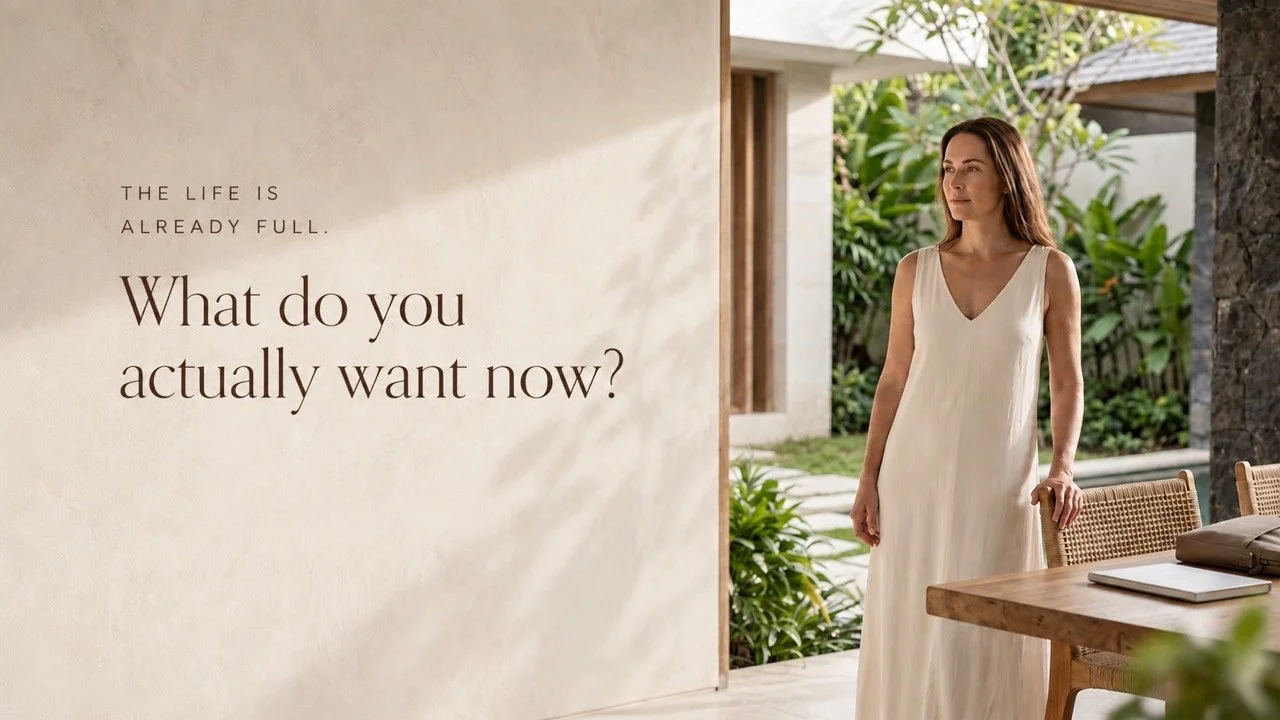
And the strange question becomes: what now? Not because your life is empty. Quite the opposite. Sometimes the question appears because your life is already very full, and the things that used to tell you what came next no longer have quite the same hold.
The old goals had a script around them
One of the reasons earlier goals can feel easier is that there is usually a script around them. Nobody needs to explain why you want a good job, a home, financial security or a holiday. Those goals make immediate sense to other people and they are easy to say out loud. There is also a certain amount of external momentum pushing you towards them: work has promotions and new roles, property has deposits and mortgages, children have school years and milestones, money has obvious markers, and even travel can become a list of places you have not yet been.
But once many of those markers are behind you, there is less automatic structure. You may still want to earn more, travel more or improve your home, but the motivation can feel different because you are no longer trying to establish that you are an adult or prove that you can build a life. You have built one. There is a big difference between asking, “What should I do next?” and asking, “What do I actually want from here?” The first question can be answered from a template. The second usually cannot.
Achievement does not automatically create direction
We often talk about goals as if each one naturally reveals the next: achieve something, feel satisfied, set a bigger goal and keep climbing. But life does not always work that way. Sometimes achieving a long-held goal creates clarity. Sometimes it simply creates space. You reach the position you wanted and realise you do not want the next promotion. You finally have the home you worked towards and discover that making it bigger is not especially interesting. You become financially more secure and realise the thing you want most is not another purchase but more control over your time.
There can be an uncomfortable moment in that because we are very used to recognising ambition when it looks like more: more responsibility, more income, a bigger house, a more impressive title, a longer list of achievements. It can be harder to recognise ambition when it looks like less rushing, more flexibility, a creative project, a stronger body, deeper friendships, a month away, learning something for no practical reason, or simply having enough room in your week to notice your own life. Those wants can be every bit as real, and sometimes they are more honest because they are less connected to what you were told a successful life should look like.

You may need to separate what you still want from what you once wanted
Some goals have been with us for so long that we stop asking whether we still want them. Perhaps you spent twenty years believing you should reach a particular level in your career. Maybe you always imagined you would own a larger home one day. You assumed you would keep working harder, travelling further, earning more or accumulating the next version of whatever you already had. Then you get close enough to the goal to see it properly, and it turns out you do not want it anymore.
That can feel oddly confronting because the younger version of you may have been very certain. But an old goal does not become a permanent instruction simply because you once cared about it. You are allowed to look at something you spent years moving towards and say: that was right for me then, but it is not what I want now. You are also allowed to realise that you do still want something, but for completely different reasons. Maybe you still want financial security, but now it represents freedom rather than status. You still want to travel, but you would rather spend three weeks in one place than race through five countries. You still care about work, but the goal is interesting work rather than the highest possible position. The shape of the goal changes because you have changed.
The next chapter does not need to be a reinvention
There is a lot of language around midlife that suggests the answer must be dramatic: reinvent yourself, start over, find your purpose, make the big change. Sometimes that is exactly what somebody wants, but it is not the only interesting answer. You may not want a new career; you may simply want your current one to take up less room. You may not want to move overseas; you may want to spend longer there when you travel. You may not want to sell everything and start again; you may want to make the home you already have feel calmer and easier.
You may not need to discover your one great purpose either. You might want to read more, get stronger, learn to paint, spend more time with friends, help your adult children without organising their lives, save enough to give yourself choices, and stop filling every empty hour with something useful. A next chapter can be made from adjustments as much as transformations. There is no requirement for your future to be dramatically different in order for it to feel more like yours.

Maybe the better question is: what do I want more of?
If you have already achieved many of the things you were supposed to want, asking for another list of achievements can be the wrong starting point. Try asking what you want more of instead. Maybe it is more time, more energy, more financial breathing room, more freedom in your week, more travel, more strength, more creativity, more interesting conversations, more time outdoors, more confidence saying no, more evenings that do not disappear into work, more things to look forward to, or simply more of the people who make you feel like yourself.
The answer can reveal a direction long before it reveals a traditional goal. If you want more freedom, perhaps the goal eventually becomes working four days a week, paying down debt, changing roles or building a financial buffer. If you want more creativity, perhaps it becomes taking a class, returning to photography, writing something, making art or simply giving yourself two hours a week that do not have to produce anything useful. If you want more connection, the goal might be as ordinary as being the person who actually organises dinner instead of waiting for everybody to become less busy. A life goal can grow from wanting more of a feeling, not just wanting another accomplishment.
You may also want less
This is the part that traditional goal setting often misses. Sometimes you know what you want by noticing what you want less of: less rushing, less work coming home with you, less financial pressure, less clutter, less obligation, less time with people who leave you depleted, less pretending that you care about things you have outgrown, and less living by a version of success that made more sense twenty years ago.
A goal can come from subtraction, and that does not make it negative. Wanting a quieter life may lead to a financial goal. Wanting less work may lead to a career decision. Wanting less clutter may change what you buy, where you live or how you use your home. Wanting fewer obligations may force you to become more deliberate about what receives your time. Sometimes “less” is the thing that creates enough space for something new to appear.

There is a difference between being grateful and being finished
Another reason this question can feel uncomfortable is that wanting something new can seem ungrateful when life is already good. But you can be deeply grateful for the life you have and still be curious about what else you want. You can love your family and want more time that belongs only to you. You can appreciate your job and want work to have less control over your week. You can be thankful for your home and still imagine living somewhere different one day. You can feel lucky and still have goals.
Gratitude does not require you to stop imagining, and having a future does not mean rejecting the present. I think this becomes particularly important as we get older because there can be a subtle expectation that once you have enough, you should simply maintain it: maintain the career, the house, the relationships, the body and the finances. There is nothing wrong with maintenance. Some of the most important goals in life are Anchor Goals that protect exactly those foundations. But maintenance is not the same thing as being finished. There are still things you have not thought of yet.
Your goals can become more personal because fewer people need to understand them
One of the quieter freedoms of this stage of life is that your goals can become much more specific to you. When you are younger, there can be a strong temptation to choose goals that are easy to explain: the job everybody recognises as a promotion, the house that looks like progress, the trip that sounds impressive, the milestone people know how to congratulate. Later, you may care much less whether a goal makes sense from the outside.
You might want to become excellent at making pasta, learn to draw, grow a ridiculous garden, spend a month every year somewhere warm, become confident swimming in the ocean, or have enough money invested that you can stop worrying about every work decision. You might want your weekends back. You might want to be the kind of grandmother who travels with her grandchildren. You might want to write something nobody knows you are writing. None of these goals needs to impress anybody. The fact that it matters to you is enough.

Not knowing immediately is allowed
Of course, you may ask yourself what you want now and hear absolutely nothing back. That is allowed too. When life has been organised around obvious responsibilities for years, it can take time to hear your own preferences again. You may know what everybody else needs, what the job requires, what the family calendar looks like and what has to be paid, arranged, fixed, booked, remembered and followed up. Knowing what you want can be a much quieter signal.
It may begin as envy: you see somebody taking a long trip and realise the thing you envy is not the destination but the freedom. It may begin as irritation: another Sunday spent preparing for Monday makes you realise you do not want work to take up that much space anymore. It may begin as curiosity because you keep looking at a course, a place, a hobby or a completely different way of living. Or it may simply be the thought, “I would love to…” You do not have to turn it into a goal immediately. You can write it down and let it sit there. Sometimes direction arrives slowly.
You are not starting again from nothing
There is also something very different about setting goals later in life: you are not beginning with a blank page in the same way you did at twenty. You have evidence. You know what you enjoy more than you used to. You know what you are capable of. You know the kinds of environments that bring out the best in you and the ones that flatten you. You have survived decisions that once felt enormous, changed your mind, made mistakes, recovered from things, and probably achieved goals you once thought were a very long way away.
That history does not remove uncertainty, but it gives you information. You can look backwards and ask which parts of your life have made you happiest, what you have repeatedly wanted more of, what you have worked very hard to create that you now want to protect, which things you chased because you genuinely wanted them, and which ones mattered mostly because you thought they were what came next. You can also ask what you are still curious about. Those questions can be much more useful than asking yourself to produce five impressive new goals by Friday.

You are allowed to want a future that looks like you
There is no point in life when you have to stop wanting things. But the things you want are allowed to become quieter, stranger, more specific and more personal. They are allowed to have nothing to do with moving up. They are allowed to protect what you already love, change the shape of ordinary life rather than transform it completely, be ambitious, be small, or make absolutely no sense to anybody else.
And if you have already achieved many of the things you were once supposed to want, perhaps that is not the end of goal setting. Perhaps it is the point where it becomes much more interesting, because now you can stop asking what a successful life is supposed to look like and begin asking a better question: what do I want my life to look like from here?
Not what should come next. Not what would look impressive. Not what the younger version of you assumed you would always want. Just: what do I want now? You do not need to know immediately. But it is a very good question to keep somewhere you can come back to.