What Happened to the Goals I Wrote Down in My 20s?
A look back at the tiny handwritten goal book I kept in my 20s, and what became of the things I once thought I wanted: the goals that happened, the ones that changed shape, the ones I released, and the themes that are somehow still with me.
There is something slightly confronting about reading a list of things you wanted more than 25 years ago in your own handwriting.
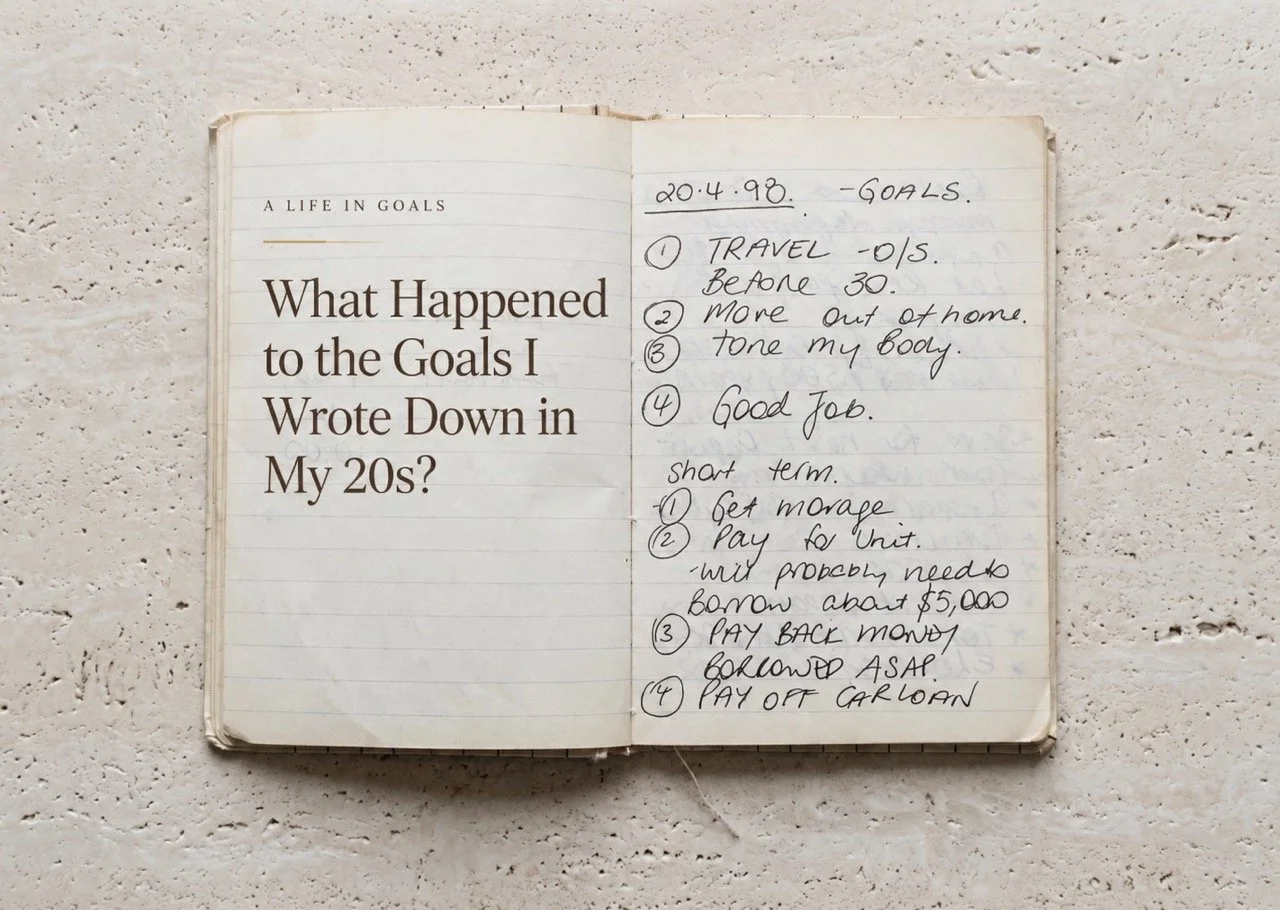
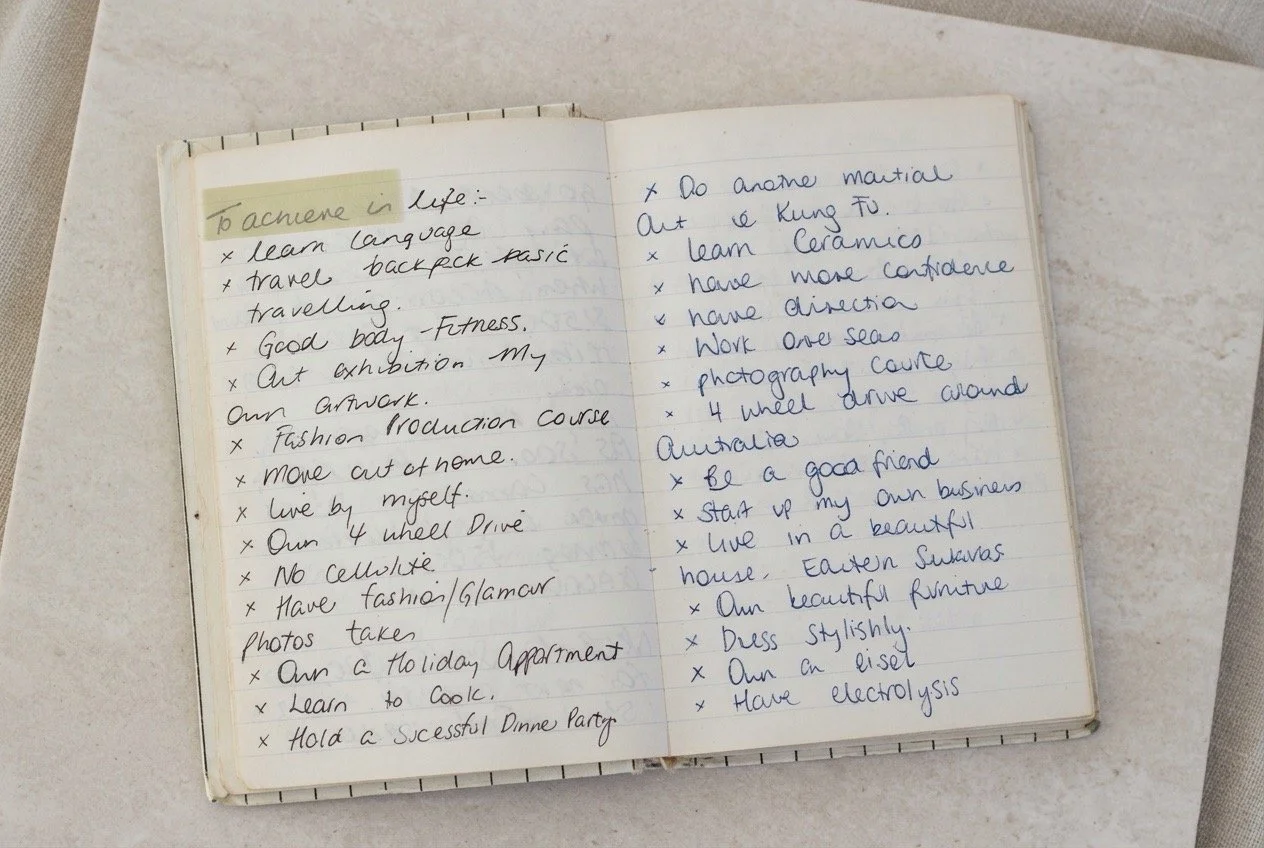
Not because the goals are dramatic. Most of mine are not. It is the opposite. They are so ordinary and so specific that I can almost remember the version of me who sat down and wrote them. Travel overseas before 30. Move out of home. Get a good job. Tone my body. Have more confidence. Learn a language. Do a photography course. Buy beautiful furniture. Start my own business. Own a four-wheel drive. Have a beautiful house. Learn to cook. Hold a successful dinner party. And, in one particularly unforgiving moment of my 20s, apparently: no cellulite.
There are pages about money, property, work, travel and courses I wanted to take. There are also wonderfully small rules for the person I thought I should become: have my hair done every six weeks, keep the house clean in case someone drops in, always have something decent on. Some of it makes me laugh now. Some of it feels surprisingly tender. And some of it sounds much more like me than I expected.
When I first wrote those lists, I thought I was recording the future. Looking at them now, I can see that I was also recording myself.
And one of the most interesting things is that the answer to 'Did I achieve my goals?' is nowhere near as simple as yes or no.
Some goals were really markers of becoming an adult
A lot of the goals I wrote in my early 20s make perfect sense when I remember the stage of life I was in. Move out of home. Get a good job. Pay off the car. Save money. Work out what I could borrow. Think about a mortgage. Live alone. Build a life that felt independent.
At the time, those things felt enormous. They were not background details. They were the future. Moving out was not simply a change of address; it represented independence. A good job was not just employment; it was proof that I was heading somewhere. Saving money was tied up with the idea of being capable, responsible and able to create choices for myself.
Some of those goals eventually became ordinary parts of adult life. That is one of the strange things about looking backwards. A goal that once took up half a page can later become something you barely think about because you have been living on the other side of it for decades.
I find that reassuring. We often imagine that achieving a goal should produce a permanent sense of arrival, but usually life just keeps moving. The thing that once felt huge becomes normal, and your attention shifts somewhere else.
Some of the goals happened, but not in the way I pictured them
Other goals are harder to put into an achieved or not achieved column because life changed their shape.
I wrote about having direction. I wrote about work overseas, starting my own business, having an exciting career, doing courses in fashion production, photography, life drawing and even learning to draw in Florence. There was clearly a version of me trying to work out not only what job I wanted, but what kind of life might feel interesting.
Looking at those pages now, what stands out is less the exact form of each goal and more the theme underneath them. I wanted creativity. I wanted independence. I wanted to make things, learn things and feel that work was taking me somewhere. The exact picture did not necessarily happen the way I wrote it in a little notebook, but those interests did not disappear.
That is one of the reasons I am wary of treating goals too literally. Sometimes we think the goal is 'do this exact thing', when the deeper goal is actually a feeling, a direction or a type of life we are trying to create.
A goal can be fulfilled in a form you did not know how to imagine when you first wrote it.
Some goals evolved because I did
There are goals on those old pages that I can still recognise, but the reason I want them has changed.
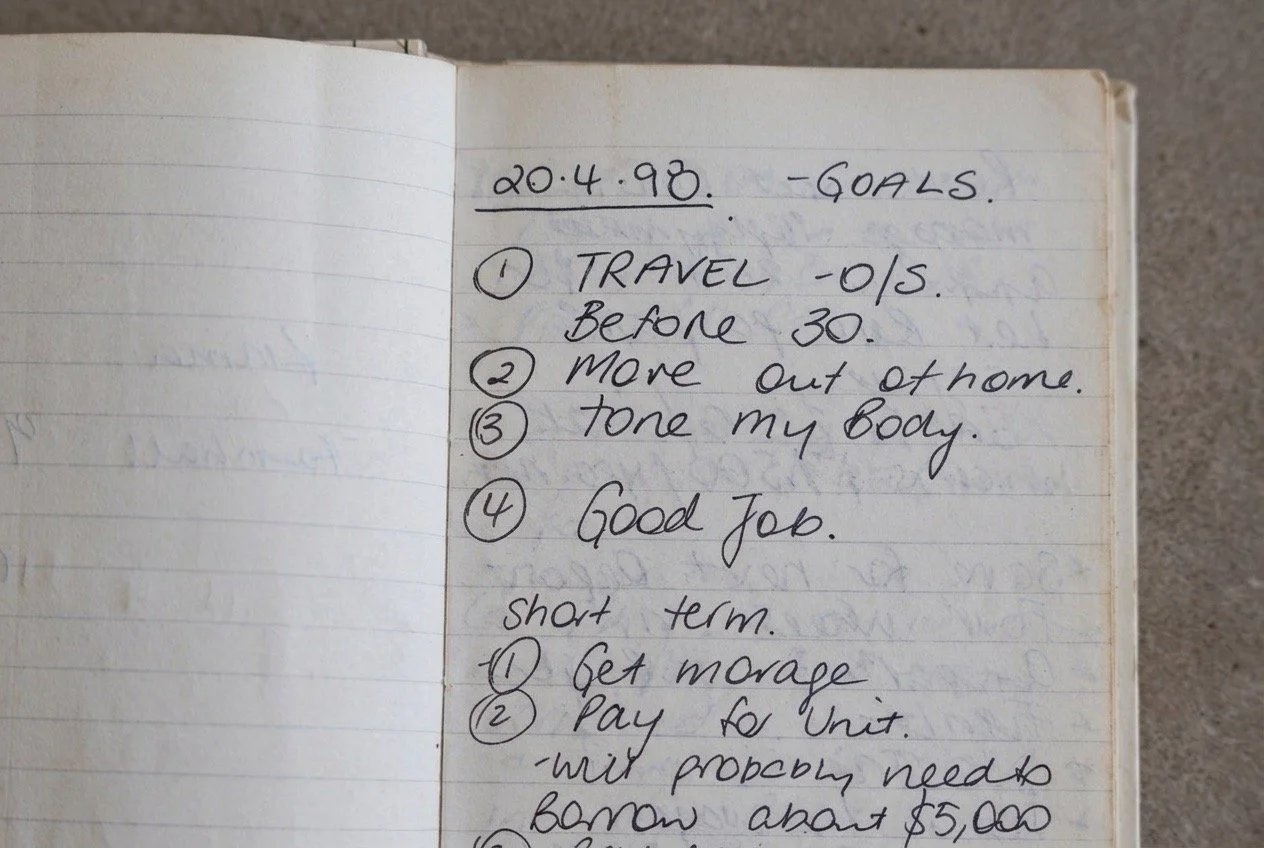
Travel is a good example. In my 20s, travel had a strong sense of escape and possibility around it. I wrote about travelling overseas before 30, backpacking, working overseas and driving around Australia. The excitement was partly about seeing places, but it was also about becoming someone more adventurous, more confident and more independent.
The desire to travel can stay with you while the way you want to travel changes completely. The younger version of you may want to fit in as much as possible. The older version may care more about time, comfort, staying longer, going deeper, or simply having enough freedom in life to be able to leave for a while.
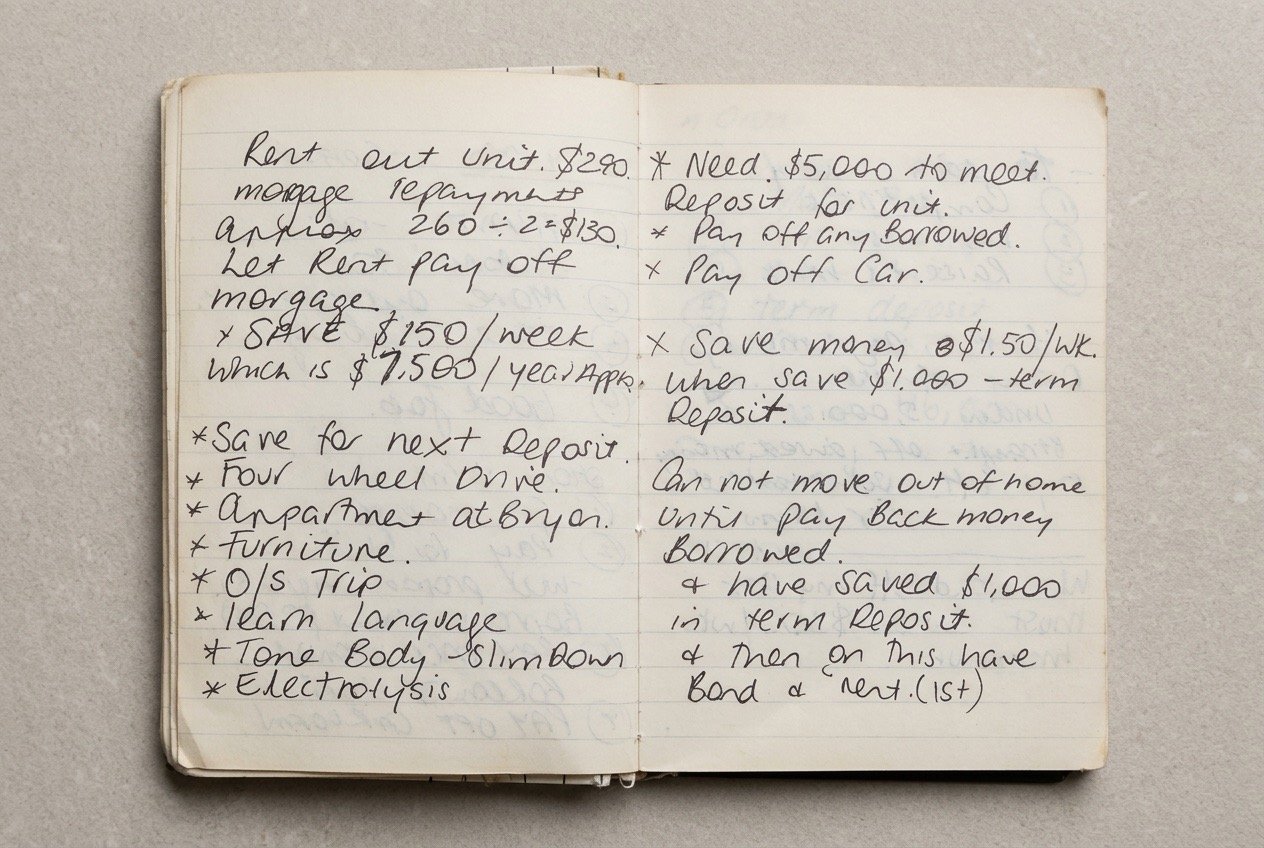
Money changes in the same way. My old notebook contains calculations, property thoughts, savings plans, paying off credit cards, putting money aside each week and even learning a trading system. Those pages are very practical, but underneath them is a theme I understand much better now: money represented security and choice.
The number changes. The strategy changes. The things you spend money on change. But the deeper goal of having enough control over your finances to make choices can stay remarkably consistent.
Some goals I am very happy to release
Then there are the goals that deserve to be left exactly where they are: in an old notebook.
No cellulite is one of them.
So is the idea that the house should always be perfectly clean in case somebody unexpectedly drops in, and that I should always have something decent on. I can see what I was trying to do. I was building an image of a capable, polished adult woman and writing down the rules I thought would get me there.
The funny thing is that some of our old goals are not really our goals at all. They are ideas about how we think we should look, behave or appear to other people.
That does not mean I judge the younger version of me for writing them. I actually find those entries quite endearing. They tell me what I was worried about, what I admired, and what I thought adulthood looked like from where I was standing.
But I do not need to carry every old instruction forward.
There is a lovely freedom in being able to say: that mattered to me then, and it does not matter to me now.
Some very ordinary goals still make me smile
I also love the goals that sit somewhere between serious and funny because they remind me how much of a life is made from ordinary things.
Apparently, at one point, holding a successful dinner party mattered enough to write down as a goal.
I wanted to learn to cook. I wanted beautiful furniture. I wanted my house to look a certain way. I wanted to dress stylishly. I wanted regular facials and manicures. There are lists involving dining chairs, lounges, a buffet and other things that must have felt extremely important at the time.
None of those goals will ever make a list of great life achievements, but I am glad they are there.
They remind me that goals are not only about major milestones. Sometimes a goal is simply an idea about how you want ordinary life to feel. You want to become someone who can invite people over without panicking. You want your home to feel beautiful. You want to learn how to cook something properly. You want to look put together. You want small rituals of care.
Those things may later seem trivial, but they can be very real when you are living them.
Some themes have followed me for decades
The part I find most interesting is not the individual goals that survived. It is the themes that keep reappearing.
Travel is there again and again. Learning is there. Creativity is there. Work and independence are there. Money and security are there. Home is there. Friendship is there. There is also a repeated desire for direction.
I wrote 'have direction' as though it were a perfectly reasonable goal, and perhaps it was.
That line says a lot about the kind of uncertainty I was trying to manage. I did not always know the destination. Sometimes I simply wanted to feel that I was moving towards something that belonged to me.
I still think that is one of the most useful things a goal can do. It does not always need to give you a finish line. Sometimes it gives you a direction of travel.
The specific goals around those themes have changed many times, but the themes themselves are surprisingly consistent. When you keep written goals for long enough, you begin to see those patterns.
That is probably the part I could never have understood when I was 22.
A goal can do its job even if you never achieve it
There are also goals in the notebook that did not happen, or at least did not happen in the form I wrote down.
I do not think that automatically makes them failed goals.
Some goals get you moving even if you eventually turn in another direction. Some make you research, save, learn or try something that changes what you want next. Some are really placeholders for a desire you do not yet understand. Some belong to a particular version of you and become unnecessary when that version changes.
If I had treated every goal in that notebook as a promise I had made to myself, looking back would feel like an audit. I could mark them off, calculate a success rate and feel bad about the unfinished ones.
That would miss almost everything interesting about the pages.
What matters now is seeing what each goal was telling me at the time and what happened afterwards. Did the desire continue? Did it change shape? Did something else become more important? Did I discover that I never wanted it as much as I thought I did?
Those are much better questions than simply asking whether I completed the list.
The goals I would write now have more context around them
One of the biggest differences between the goals I wrote in my 20s and the way I think about goals now is that I would want to know more than the goal itself.
If I could sit beside the younger version of me while she wrote 'good job', I would want to ask what a good job meant. Was it money? Creativity? Security? Status? Interesting people? Travel? Freedom? If she wrote 'beautiful house', I would want to know what she imagined feeling when she walked through the door. If she wrote 'have confidence', I would ask where she felt she was holding herself back.
The old notebook gives me the headline, but often not the thought behind it.
That is one of the reasons reflection matters so much to me now. A goal is more useful when you understand why you wrote it, what you hoped it would change and what was happening in your life at the time.
Years later, that context can be just as meaningful as whether the goal happened.
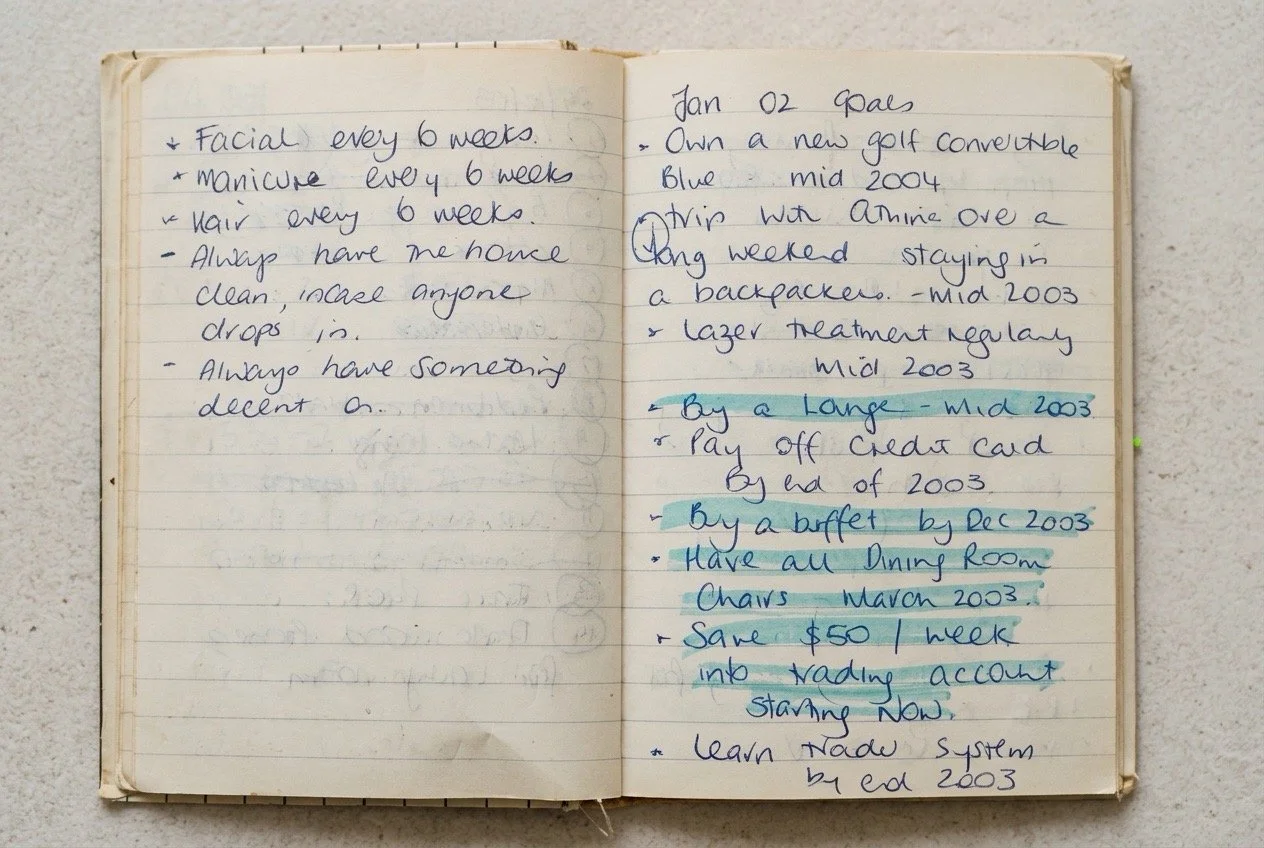
At 20, I thought I was writing the future
I think this is why I feel differently about those pages now than I did when I first wrote them.
At 20, you write goals because you are looking forward. You want the notebook to tell you where you are going.
At 54, you realise it also tells you where you have been.
The handwriting, the priorities, the little calculations, the things you were certain would matter, the things you were worried about, the things you thought would make you happy: all of it becomes a record.
I thought I was writing down where I wanted to go. I did not realise I was also recording who I was.
And perhaps that is why I am glad I did not throw the notebook away when so many of the individual goals stopped being relevant.
It is not valuable because every goal came true.
It is valuable because the pages let me see change.
Achieved, evolved, released and still with me
If I had to describe what happened to the goals I wrote in my 20s, I would not divide them into achieved and failed.
I would divide them differently.
Some were achieved, then became so normal I almost forgot they had once been goals.
Some evolved. The exact picture changed, but the desire underneath it stayed.
Some I released because they belonged to a younger version of me, or to an idea of who I thought I was supposed to become.
And some are still with me, not necessarily as identical goals, but as recurring themes: direction, creativity, learning, freedom, security, home, people I care about, places I still want to see, and the desire to keep having something in front of me to look forward to.
That, more than anything, is what those old pages have taught me about goal setting.
Your goals are not a contract with your future self.
They are a record of what mattered to you at a particular point in time.
Some will become part of your life. Some will lead somewhere unexpected. Some will make you laugh. Some will quietly disappear. And a few may keep resurfacing for decades in different forms.
All of that belongs in the story.
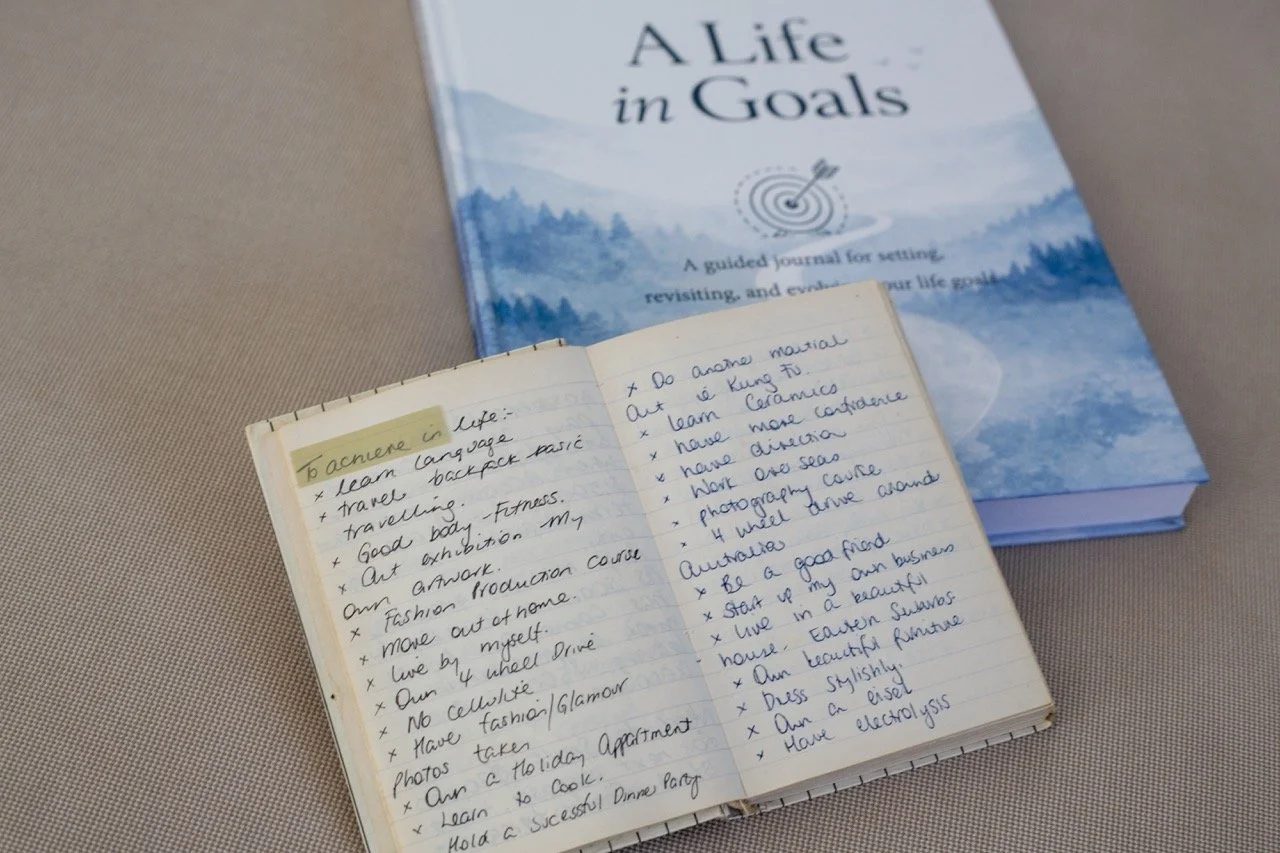
What would your old goal list tell you?
If you have an old notebook, diary, list or scrap of paper somewhere with goals you wrote years ago, I would love you to find it.
Do not look at it as a scorecard.
Look at it as evidence.
What happened? What changed? What no longer matters? What theme keeps appearing? What did you once think would make you happy? Which goals make you laugh? Which ones surprise you because, underneath all the changes, you still want something very similar today?
You may discover that you achieved more than you remember.
You may discover that some of the goals you did not achieve were right to leave behind.
And you may find a small piece of your younger self sitting there on the page, reminding you of something you still have not quite finished wanting.