The 5 Types of Goals in A Life in Goals - And Why You Need More Than One Kind
A clear guide to the five goal types in A Life in Goals: Life Goals, Dream Goals, Growth Goals, Anchor Goals and Everyday Goals, and why different kinds of goals deserve different kinds of attention.
When people talk about goals, they are often treated as though they are all the same thing.
Choose a goal. Make a plan. Break it into steps. Put a date on it. Work towards it.
That can be useful for some goals, but it is a very narrow way to think about what we want from life.
A dream to live in another country one day does not need the same treatment as a goal to build an emergency savings buffer. A wish to learn ceramics does not need the same urgency as rebuilding your strength after a busy period. A goal to protect more time with people you love is doing a completely different job from a goal to change career.
That is why A Life in Goals uses five different kinds of goals: Life Goals, Dream Goals, Growth Goals, Anchor Goals and Everyday Goals.
They are not five stages you work through. They are not a system where every goal needs to appear in every category. And you do not need an equal number of each.
They are simply different ways of holding the things you want, because not everything in a life should carry the same pressure.
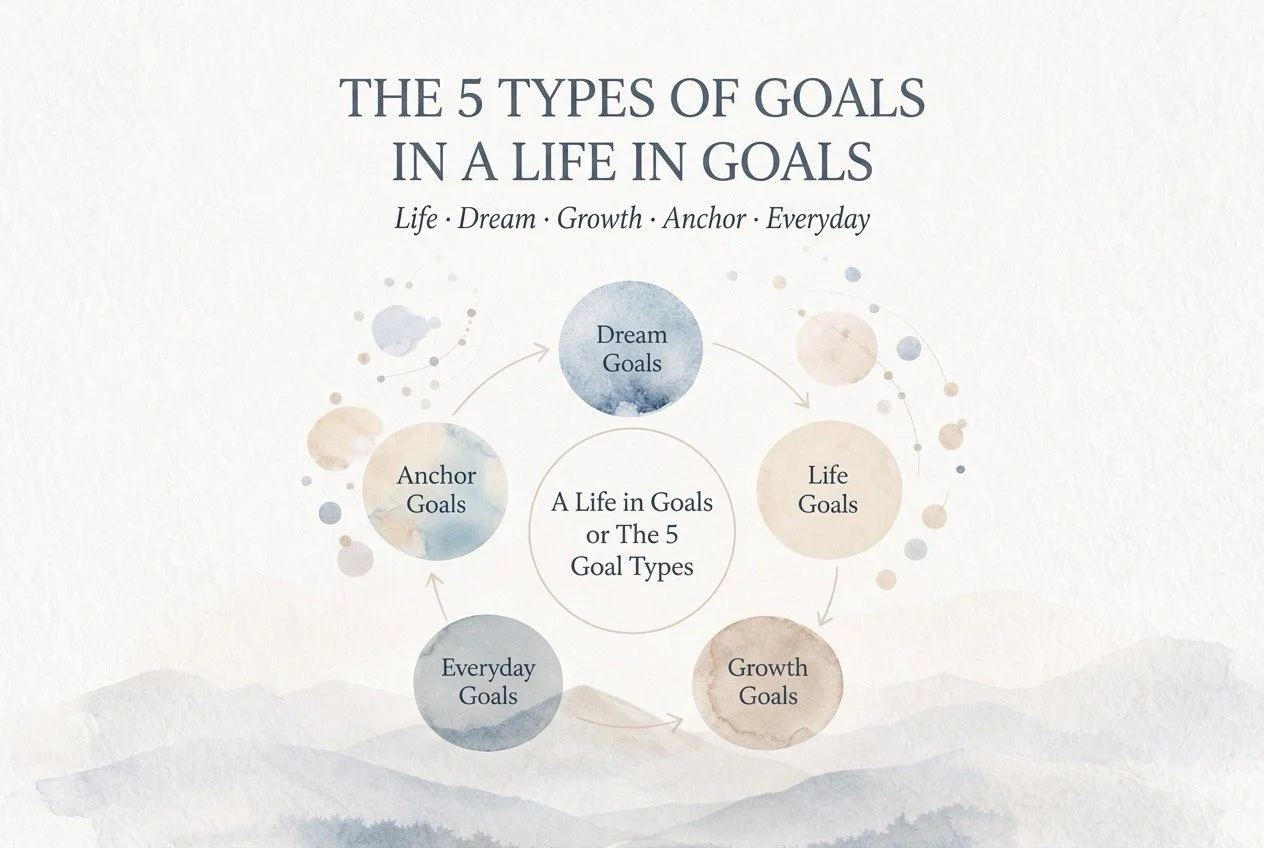
1. Life Goals: the bigger-picture things you want your life to contain
Life Goals are the broader directions, experiences and priorities you genuinely want your life to include over time.
They might be about work, money, travel, home, relationships, health, family, creativity, learning or something much more personal. You might want to build a business, live overseas for a period, become financially secure, write a book, own a home, travel regularly, change the way you work or create a life with more freedom in it.
A Life Goal does not need to be enormous or dramatic. It simply has enough importance that you can imagine it shaping the direction of your life.
Some Life Goals will have clear outcomes. Others may be less tidy. 'Have more financial freedom' can be a Life Goal even though it is not one single event. So can 'create a way of working that gives me more time'.
The useful question is not whether the goal sounds impressive. It is whether it belongs in the bigger picture of the life you want.
2. Dream Goals: somewhere for 'one day' to live
Dream Goals are for possibility.
They are the ideas you would love to keep somewhere even when you are not ready, able or certain enough to act on them.
Spend a month in Italy. Learn to sail. Live somewhere else for a year. Have an art exhibition. Write a novel. Take a long train journey. Study something completely unrelated to work.
The value of a Dream Goal is that it does not need to become a project immediately.
You do not need the budget, the timing, the next step or the plan. You do not even need to know whether you will still want it in five years.
You are simply giving the idea somewhere to exist.
Some Dream Goals eventually become Life Goals because the desire grows stronger and the timing becomes possible. Others stay as dreams for years. Some fade away completely. None of those outcomes means the page was wasted.
3. Growth Goals: the things you want to learn, develop or become
Growth Goals are about learning, becoming and evolving.
They are not about fixing everything you think is wrong with you.
A Growth Goal might be learning a language, becoming more confident with money, developing a creative skill, getting stronger, learning to draw, becoming more comfortable speaking in public, improving your cooking, studying something new or building the confidence to make a change you already know you want.
Sometimes a Growth Goal stands completely on its own because learning the thing is the point.
Other times it supports something bigger. Learning conversational Italian might support a future Dream Goal to spend time living in Italy. Becoming more confident with finances might support a Life Goal around financial freedom. Building strength might support a long-term travel goal.
Growth Goals are useful because they recognise that some goals are not destinations. They are about expanding what you are able to do, understand or imagine.
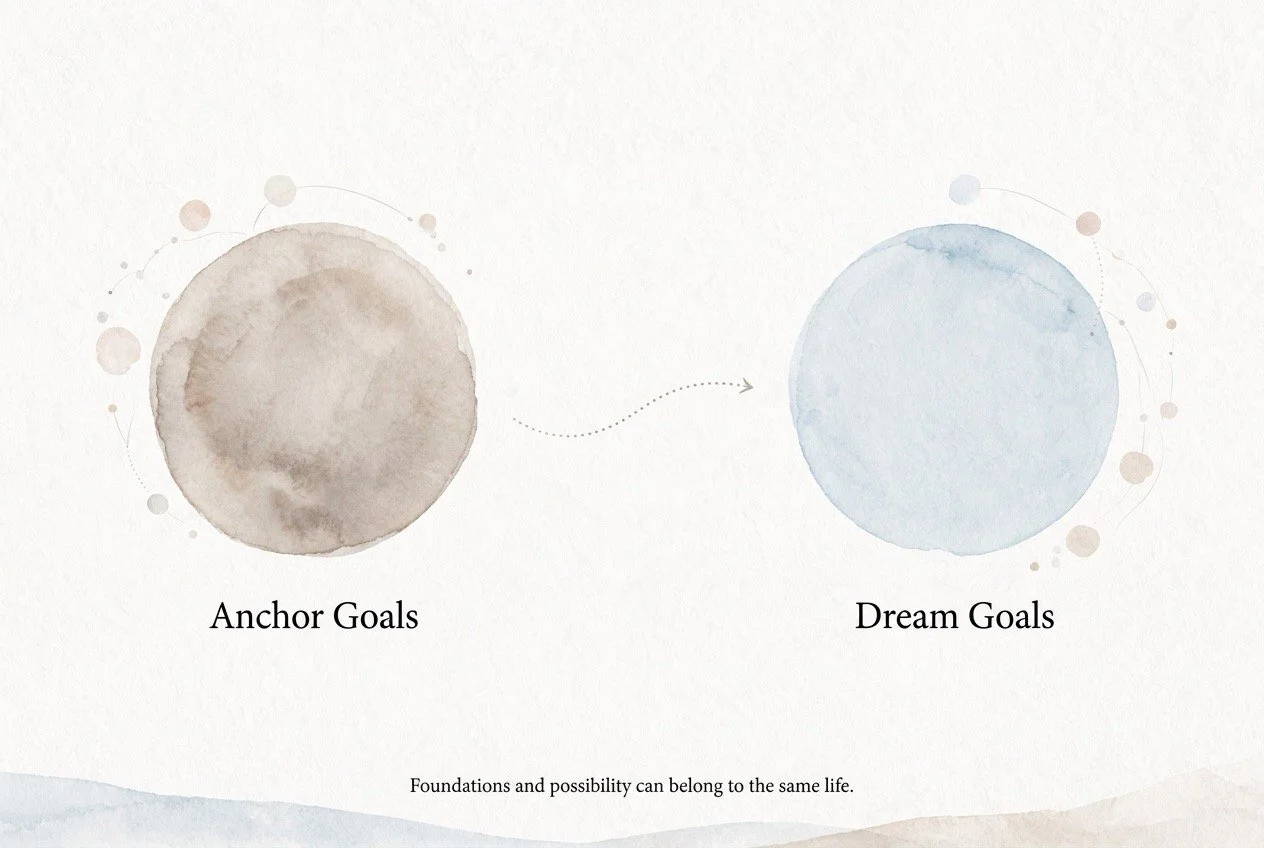
4. Anchor Goals: the foundations underneath everything else
Anchor Goals are different because they are often less about reaching somewhere new and more about protecting what keeps your life steady.
Financial security can be an Anchor Goal. So can maintaining your health and strength, protecting time with your partner or family, keeping strong friendships, having enough free time, creating a calm home or building enough financial flexibility that one unexpected event does not knock everything sideways.
These goals can look quiet beside the exciting ones.
But they often make the exciting ones possible.
A Dream Goal to travel more is easier to enjoy when there is financial security underneath it. A big career move may feel more possible when your health and relationships are not being neglected. A creative goal may need an Anchor Goal around protecting time.
Anchor Goals remind us that a life is not built only from things we are chasing. It is also built from the things we want to keep strong while everything else moves.
5. Everyday Goals: the small choices that shape ordinary life
Everyday Goals are the smaller actions, habits and choices that shape the life you are actually living now.
They may support a bigger goal, but they do not have to.
An Everyday Goal could be putting a small amount into savings regularly, taking one walk during the week, making time to call a friend, cooking at home more often, booking one language lesson, reading before bed, protecting one afternoon for yourself or finally researching something you have been thinking about.
What makes them useful is their scale.
A Life Goal can feel distant. A Dream Goal can deliberately remain distant. An Everyday Goal brings attention back to something you can touch in ordinary life.
But even here, the idea is not to fill your days with an endless list of self-improvement tasks.
A small goal should make your life feel more aligned, not more crowded.
Why you need more than one kind of goal
If every goal is treated like a Life Goal, your list can become heavy very quickly. Everything feels important. Everything seems to need a strategy. Everything appears to be waiting for you to make progress.
If every goal is treated like an Everyday Goal, the opposite problem appears. Life can become a collection of small tasks without much connection to the bigger things you actually want.
The five goal types create room for both.
You can have something big you are moving towards, something you are dreaming about with no pressure attached, something you are learning, something you are protecting and one small thing you can do now.
That gives a much fuller picture of a life than a flat list of achievements.
The five goal types are not a five-step process
This is important.
You do not take a Dream Goal, turn it into a Life Goal, add a Growth Goal, create an Anchor Goal and then finish with an Everyday Goal every time.
Some goals may connect in exactly that way. Many will not.
You may have a Life Goal that needs no Growth Goal at all. You may have an Anchor Goal that exists simply because it matters. You may have Everyday Goals that are not attached to anything bigger. You may have ten Dream Goals and no intention of activating any of them this year.
The categories are there to help you see what kind of attention a goal needs, not to manufacture more goals around it.
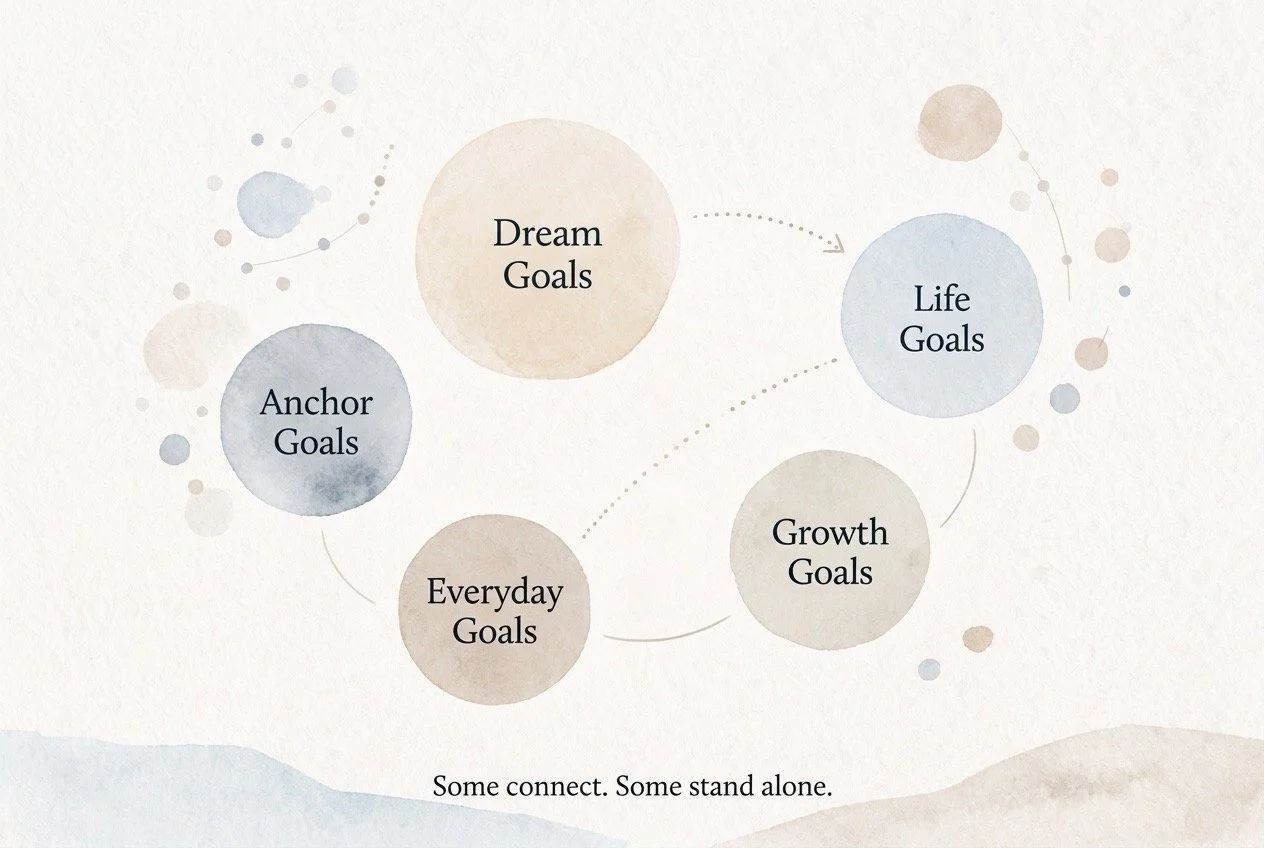
How the five goal types can work together
Sometimes, however, the relationships between different goal types become very useful.
Imagine the thought: 'I'd love to spend a month in Italy one day.'
At first, that may simply be a Dream Goal. It can sit there for years.
Later, the idea becomes more real and you decide you genuinely want to do it within the next few years. It now feels like a Life Goal.
Financial security and staying healthy enough to travel may sit underneath it as Anchor Goals. Learning conversational Italian could become a Growth Goal. Researching areas, understanding the cost or putting money aside regularly might become Everyday Goals.
That does not mean the original dream needed five separate goals to be valid.
It simply shows how one idea can connect to different parts of the same life once you begin moving towards it.
You do not need one of each
There is no balanced-goal scorecard inside A Life in Goals.
You do not need five Life Goals, five Dream Goals, five Growth Goals, five Anchor Goals and five Everyday Goals.
At one stage of life, your Anchor Goals may matter most because stability needs attention. At another, you may have a page full of Dream Goals because you are curious about what comes next. During a period of change, Growth Goals may become more important. When life is very full, one Everyday Goal may be more than enough.
The mix should reflect your life, not a formula.
That is also why the categories can change. A Dream Goal can become a Life Goal. A Life Goal can move back into the background. A Growth Goal can be completed and disappear. An Everyday Goal can become so normal you stop thinking of it as a goal at all.
Which type of goal should you start with?
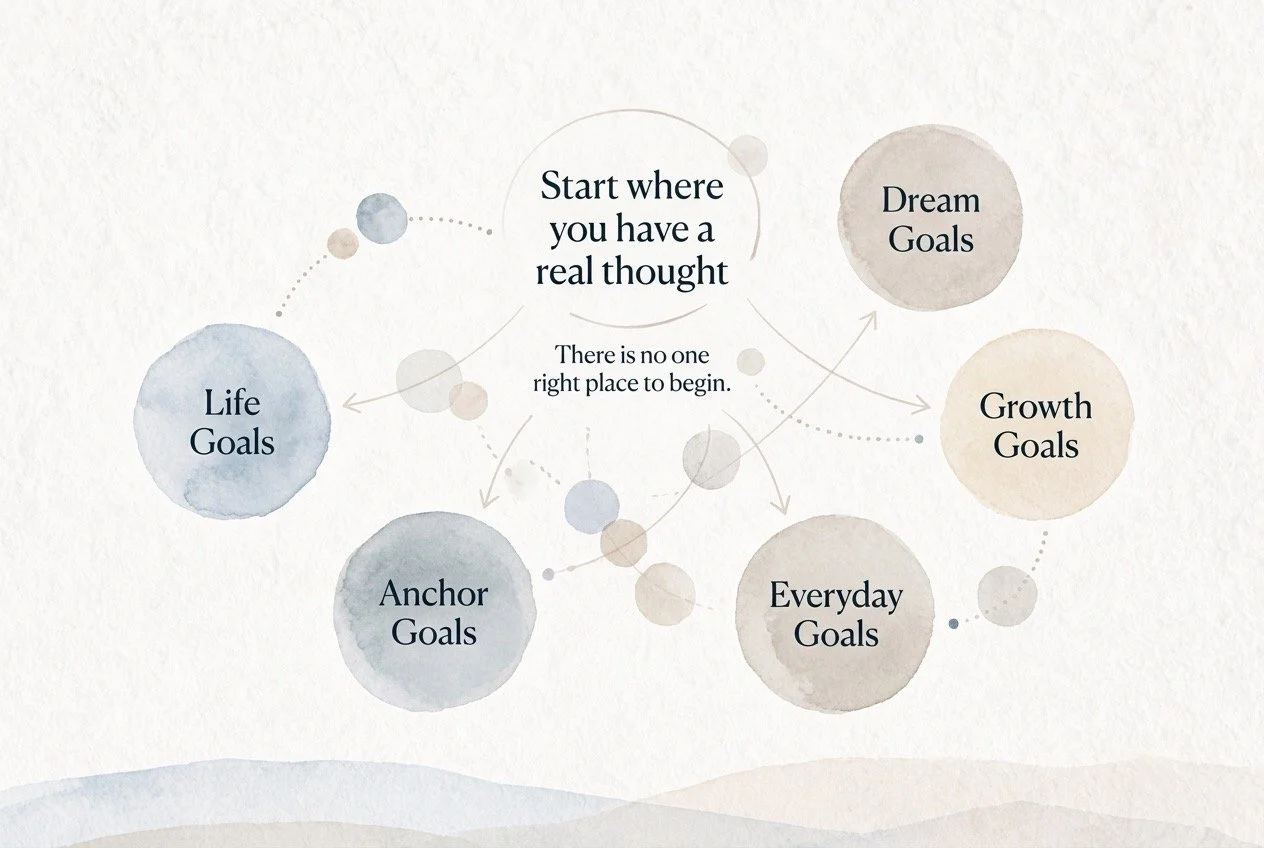
Start with whichever one gives you a real thought.
If you already know something important you want from your future, write the Life Goal.
If you have no clear plan but lots of 'one day' ideas, start with Dream Goals.
If you keep thinking about something you want to learn or become better at, start with Growth.
If life feels unstable or too full, an Anchor Goal may matter more than another new ambition.
If you already know the bigger direction and simply need something small you can do now, begin with an Everyday Goal.
There is no correct entry point.
The point is to use the category that helps you describe what is actually true.
Your goals belong to the same life
The five types of goals are useful because they make room for more than achievement.
They make room for direction and possibility, learning and foundations, long-term ideas and small ordinary choices.
They also make it easier to stop asking every goal to perform the same job.
A Dream Goal can dream. An Anchor Goal can protect. A Growth Goal can expand you. An Everyday Goal can bring something into today. A Life Goal can help point towards the bigger picture.
Some will connect. Some will stand alone. Some will be active. Some will wait.
That is exactly the point.
You may not need more goals.
You may simply need a clearer way to see the different ones you already have.