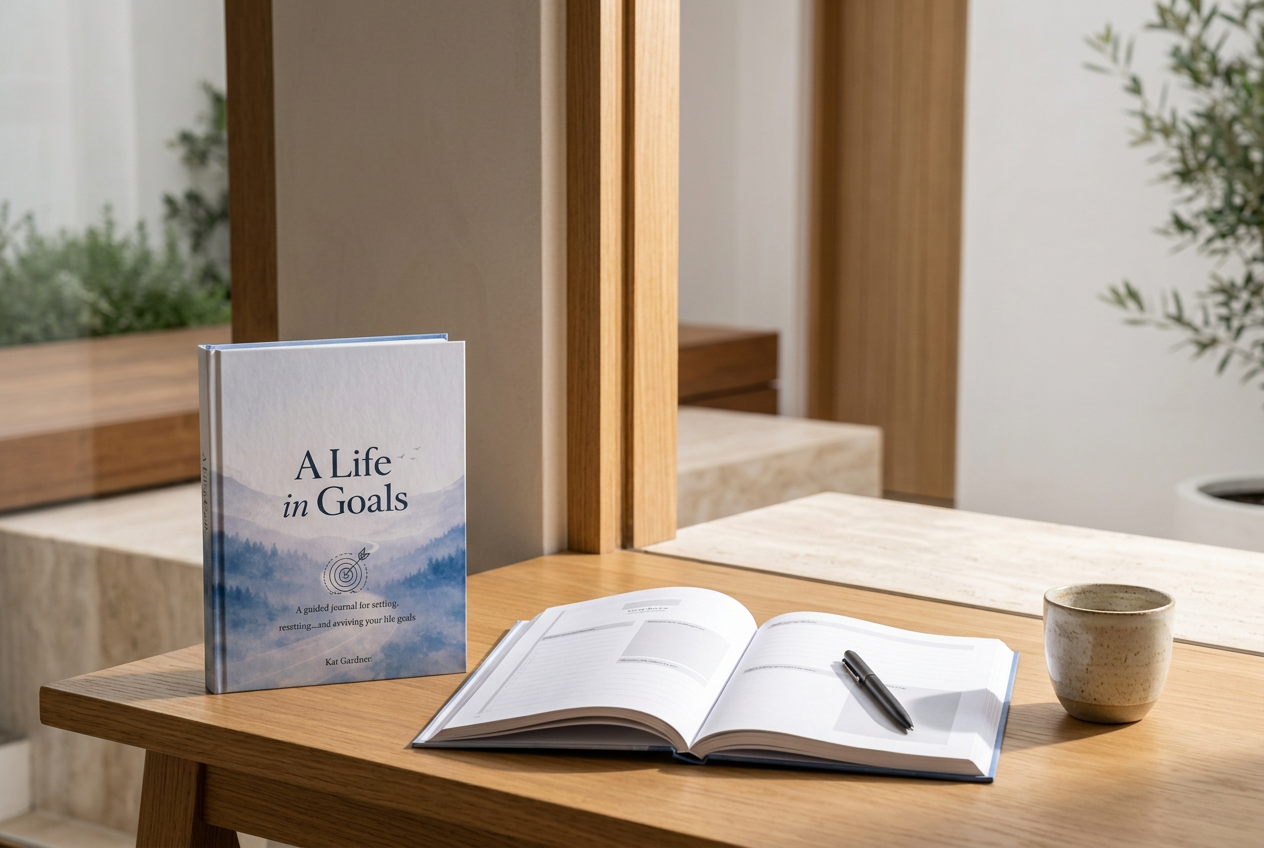
How to Use A Life in Goals
The definitive guide to using A Life in Goals: where to begin, how the different goal types work, how to use the Goal Ecosystem, how to revisit what you write, and why the journal is designed to grow with you rather than be completed in one year.
If you have just opened A Life in Goals, the first thing I want you to know is that you do not need to know all your goals before you begin.
You do not need to sit down for an entire weekend and fill the book from front to back. You do not need a perfectly balanced list covering every area of life. You do not need to give every dream a deadline, turn every idea into an action plan or create a new version of yourself before you are allowed to close the cover.
A Life in Goals is not a yearly planner. It is a guided journal for thinking about the life you are living, the life you may still want, and the goals, dreams, foundations and small everyday choices that sit inside it.
That means the best way to use it is slowly enough that what you write still feels true.
You may spend a long afternoon with the book when you first get it. You may fill three pages and leave it alone for a month. You may suddenly return because work has changed, the children are older, you have come home from a trip with a new idea, or something in your life no longer feels quite right. You may use one section heavily and barely touch another until much later.
All of that is using the book properly.
The journal is designed to be kept, revisited and changed as your life changes. The point is not to finish it. The point is to have somewhere worth coming back to.
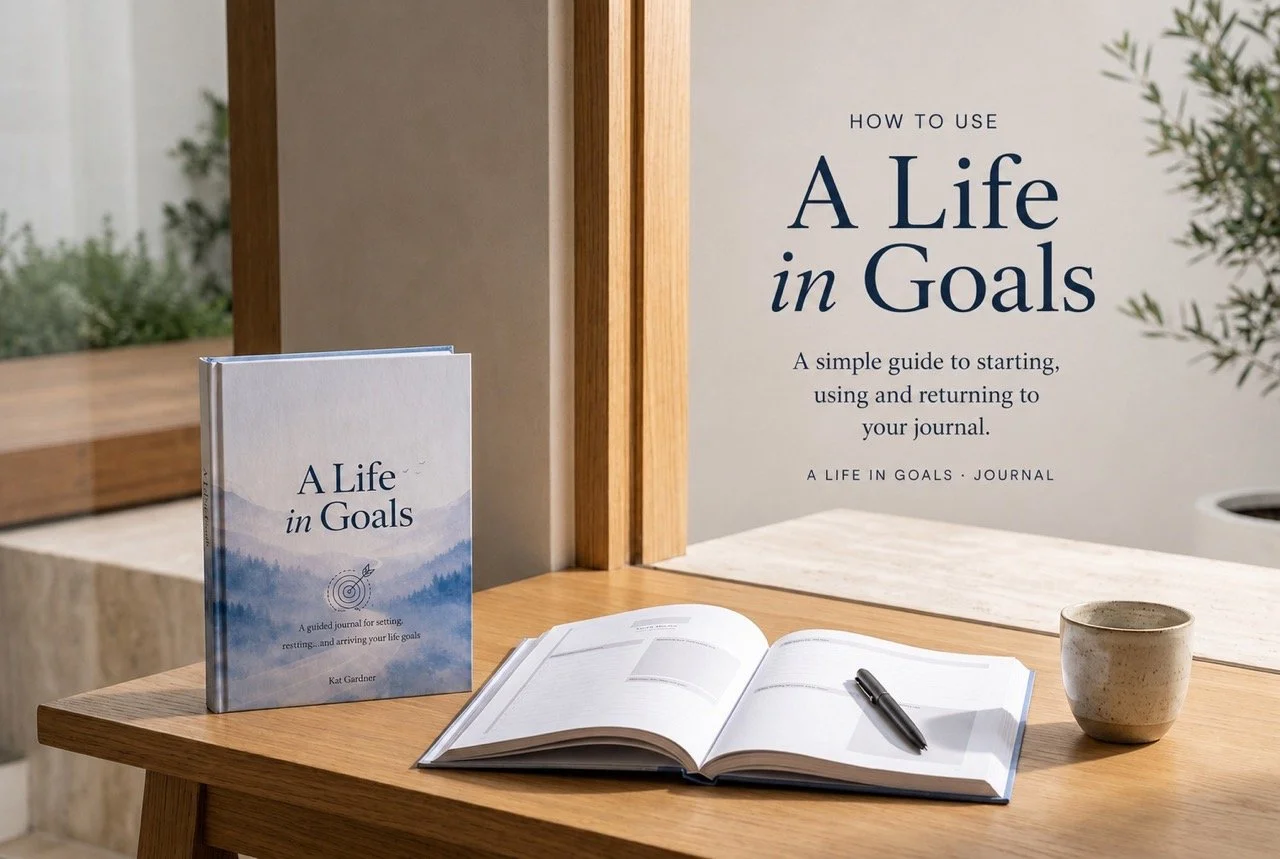
Begin by looking before you start filling
When a new guided journal arrives, there is a temptation to treat page one as an instruction: start here and keep going until you reach the back.
I would do something different with A Life in Goals.
Flick through it first.
Look at the kinds of questions it asks. Notice the pages that immediately make you think of something. Notice the sections that feel relevant now and the ones that do not. You may find yourself drawn to a page about what matters most, a Life Goals page, a Dream Goal, a question about growth, an Anchor Goal, or simply a space that makes you think, I have something to say there.
Start with the page that gives you a real thought.
There is no benefit in forcing an answer onto an earlier page simply because it comes first. Your life is not unfolding in book order, so the journal does not need to either.
If you prefer structure, you can absolutely work through more systematically. But think of the structure as support rather than a rule. The book should help you think, not make you perform the act of goal setting correctly.
Start with where you are, not only where you want to go
Before setting more goals, it can be useful to notice the life you are already living.
Pages that ask what matters most now, or help you look across different areas of your life, are there for exactly that reason. They create a little distance from the automatic answer that says you should simply achieve more.
You may realise that work is going well but taking too much energy. You may feel financially secure but miss having anything creative in your week. Home might feel settled while travel has disappeared. You may be happy in several areas of life and still know that one part needs attention.
This is awareness rather than assessment. You are not grading yourself.
The purpose is to understand the whole picture before deciding what deserves more of your attention. Sometimes that process reveals a clear goal. Sometimes it reveals that the thing you need most is not a new achievement at all, but more time, less rushing, stronger foundations or permission to let something wait.

Let ideas exist before you decide what they are
If you are not sure what your goals are, do not begin by demanding finished goals from yourself.
Begin with possibilities.
Write the things you keep thinking about. The things you miss. The things you are curious about. The things you catch yourself saying “one day” or “I’d love to” about.
I’d love to spend a month in Italy. I’d love to feel really confident with money. I’d love to work four days a week. I’d love to learn ceramics. I’d love to get stronger. I’d love to have a home people enjoy coming to. I’d love to write something. I’d love to take my daughter somewhere special.
Do not worry yet about whether the idea is sensible, affordable, achievable or urgent.
Some will eventually become active goals. Some will stay as dreams. Some will change completely once you understand what sits underneath them. Some may stop appealing to you after a few months.
The first job is simply to give the thought somewhere to live.
Use the different goal types for different kinds of wants
One of the ideas behind A Life in Goals is that not every goal should be treated in exactly the same way.
Life Goals are for the bigger-picture directions and things you genuinely want your life to hold over time. They may relate to work, money, home, travel, relationships, health, experiences or something entirely personal.
Dream Goals are for possibility. They give “one day” ideas somewhere to exist without forcing you to act on them immediately.
Growth Goals are about learning, becoming and evolving. That could mean learning a language, building confidence with money, becoming stronger, developing a creative skill or changing something in yourself that matters to the life you want to live.
Anchor Goals are the foundations: stability, what keeps you grounded, what matters most and what you want to protect while other parts of life change.
Everyday Goals are the small steps, ordinary choices and gentle actions that shape the life you are actually living now.
These categories are not levels of importance. A Dream Goal is not less serious than a Life Goal. An Everyday Goal is not a tiny inferior version of a big goal. They simply do different jobs.
You also do not need an equal number of each. Use the pages that match the things you genuinely want to think about.

Think in a Goal Ecosystem rather than a flat list
Once you have a few goals and ideas on the page, you may begin to notice that they are connected.
That is what I mean by the Goal Ecosystem.
A desire to travel more might connect to a financial Anchor Goal, a Growth Goal around learning a language, and an Everyday Goal around putting money aside regularly. A goal to change the way you work may connect to money, confidence, time and the kind of ordinary week you want to create.
The point is not to take every goal and manufacture a related goal in every category. The Goal Ecosystem is not a five-step process.
It is simply a way of seeing that your goals belong to the same life.
Sometimes one big idea will have several forms of support around it. Sometimes a goal stands completely on its own. Both are fine.
If something feels stuck, looking around the goal can be especially useful. Perhaps the dream itself is still right, but the financial foundation is not ready. Perhaps the goal needs knowledge, time or confidence before action makes sense. Perhaps another part of life is competing with it.
Seeing those relationships can give you much more useful information than simply telling yourself to try harder.
Choose what needs attention now
One of the quickest ways to make a life-goals journal feel overwhelming is to assume that everything you write down has now become an active project.
It has not.
You can have ten things you would love to do and only one that needs your attention now.
A Dream Goal can wait. A Life Goal can remain long term. An Anchor Goal may quietly be doing its job in the background. An Everyday Goal may be the only thing you actively change this month.
When you look back over what you have written, notice which ideas have energy around them. Which ones keep returning when you are away from the page? Which are possible in your current circumstances? Which matter enough to deserve a little space now?
Then choose lightly.
You do not need a twenty-goal action list. One or two active areas can be plenty.
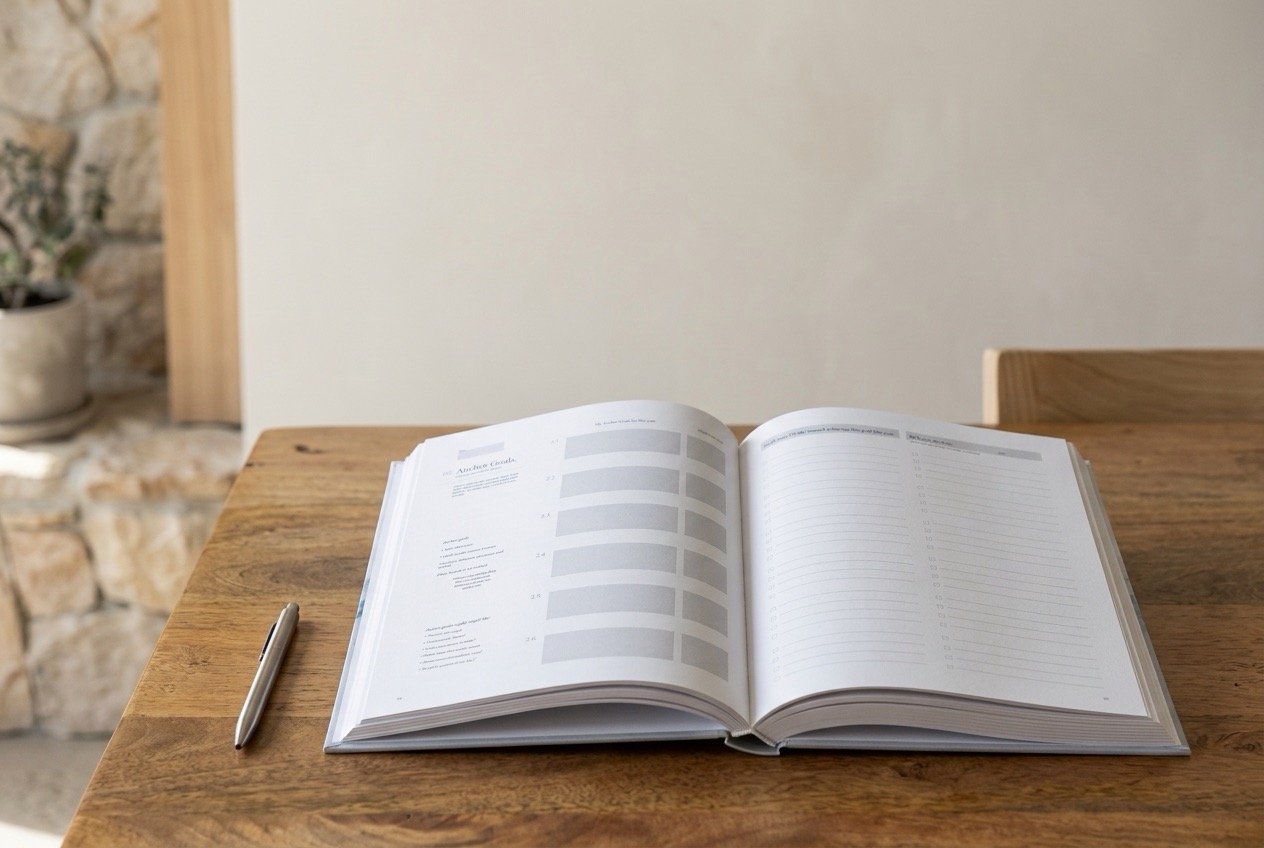
Turn a bigger goal into something you can actually touch
When a goal is active, the next question is not “How do I finish this as quickly as possible?”
It is “What would make this a little more real?”
If you want to change careers, perhaps you speak to somebody already doing the work. If you want to travel for a month, you work out what a month would actually cost. If you want to learn Italian, you try one lesson. If you want to feel financially secure, you decide what financial security would mean in numbers rather than leaving it as a vague feeling.
This is where Everyday Goals and smaller steps become useful. They bring a bigger idea into ordinary life without turning it into a forty-seven-step project plan.
The small step can be exploratory. You do not need to commit to the whole journey in order to find out whether you want it.
And if nothing can happen yet, that is useful to know too. “Not now” is not the same as “never”.
Leave blank pages blank
There will almost certainly be sections you cannot answer.
Leave them blank.
A blank page is not evidence that you are doing the journal badly. It may simply mean that particular part of life is not asking anything of you yet.
Six months later, the question may suddenly make complete sense. A job change, a trip, a relationship, a financial shift, a new interest or a change in family life can make an old blank page feel completely different.
I would much rather you leave room for a future thought than fill the book with goals you do not genuinely mean because you wanted every space to look complete.
The book should become fuller because your life becomes fuller, not because you rushed to finish it.
Write on old pages again
A Life in Goals is designed to be revisited, so do not treat a written page as finished.
Come back and add a date. Change a word. Circle something. Cross something out. Add a note beside a goal. Write what happened. Record that the timing changed. Add a new idea underneath an old one.
You may discover that the goal happened so gradually you did not notice. You may realise you still want it but have done nothing about it. You may decide that the original goal no longer sounds like you at all.
All of that belongs on the page.
A journal that grows with you should show movement. The handwriting does not need to match. The page does not need to stay pristine. In fact, the marks you add later may eventually become the most meaningful part.
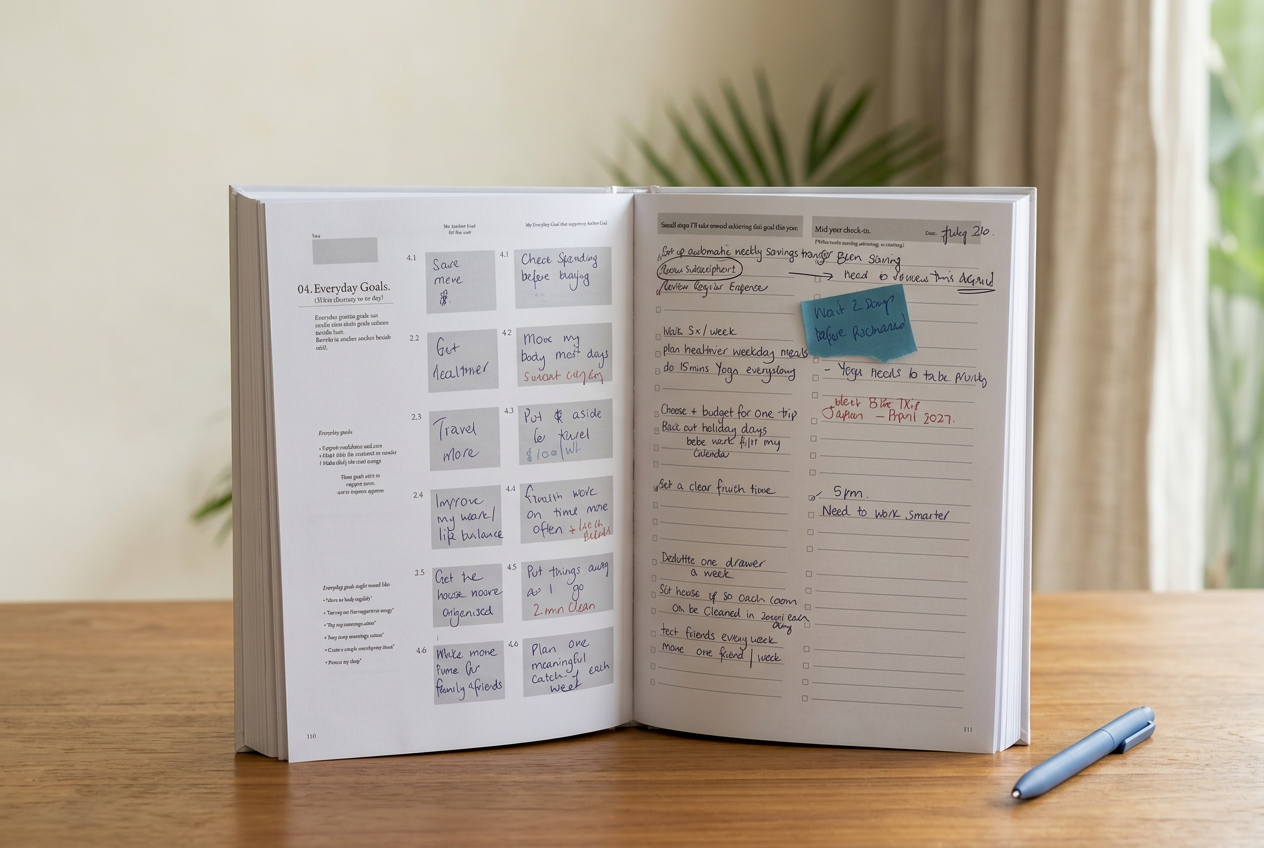
Use the check-ins to notice, not judge
When you revisit your goals, try not to turn the check-in into an audit.
The question is not only “Did I achieve this?”
Ask whether you still want it. Whether the reason has changed. Whether the timing still makes sense. Whether something around the goal is getting in the way. Whether you have made progress without recognising it. Whether the goal is more important, less important or simply resting.
You may want to take a small step. You may want to leave it exactly where it is. You may want to change it completely.
Reflection creates clarity because it gives the current version of you a chance to answer the person who originally wrote the goal.
That is very different from holding yourself accountable to an old instruction.
Come back at natural moments, not only on January 1
You can use A Life in Goals at the beginning of a new year, but the journal does not belong to January.
Birthdays can be reflective. Coming home from a trip can change what you want. A new job, a difficult period, the children getting older, a financial change or a feeling that life has become too busy can all be good reasons to open the book again.
You may also return for no dramatic reason at all. Sometimes you simply feel like thinking.
There is no compulsory monthly review. Different goals need different rhythms. An active goal may need attention regularly. A long-term goal may only need a few thoughtful check-ins across a year. A Dream Goal can stay untouched for much longer.
The aim is to stay connected without making the journal another routine you can fail to maintain.
Use reflection pages to see what changed
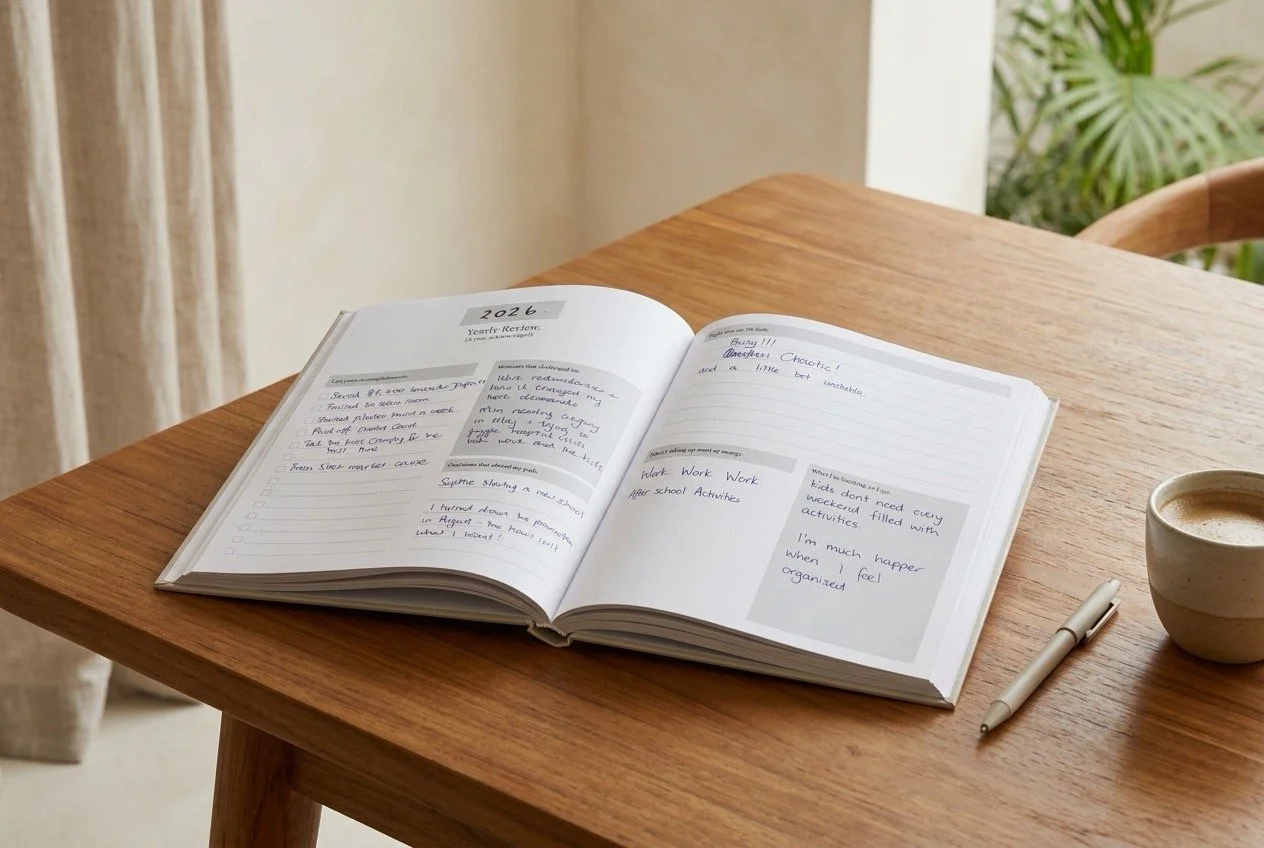
The reflection and yearly review pages are not there only to celebrate completed goals.
Use them to look back at what actually happened.
What changed? What challenged you? What moved forward? What became less important? What did you learn about yourself? What do you want to carry forward? What are you ready to release?
A year can matter even when none of the headline goals were completed. Perhaps you became clearer. Perhaps a relationship became stronger. Perhaps you protected your health or financial stability during a difficult period. Perhaps you changed direction before spending years on a goal that no longer suited you.
Reflection gives those things somewhere to count.
Do not wait until you have enough time to do it perfectly
You also do not need a beautiful three-hour ritual every time you use the book.
There will be times when you sit down properly, make a drink, put your phone away and spend an hour thinking. Those sessions can be lovely.
There will also be times when you open the book for five minutes because an idea occurred to you. Write it down.
You might add one sentence before bed, a note after a conversation, a goal after a holiday or a thought on a Sunday morning. The journal is allowed to live inside normal life.
The more formal you make the conditions for using it, the easier it becomes to postpone. A meaningful journal does not require perfect lighting, a clear diary and the right pen.
It only needs you to come back.
You do not have to finish A Life in Goals
This is worth saying again because so much of the way we use books and planners is built around completion.
There is no prize for reaching the final page first.
A Life in Goals is not a workbook you pass by completing every exercise. It is a place to hold a long conversation with yourself about what matters, what you want, what you are building, what you are protecting and what has changed.
Some pages may remain blank for years. Some may become heavily written on. You may outgrow a goal and cross it out. You may return to another after a long gap.
That is not an unfinished book.
That is a used one.
A simple way to use A Life in Goals when you first open it
If you want a very simple starting point, I would use the book like this.
First, flick through it. Let yourself see the whole journal before trying to complete anything.
Then pause on the pages that help you notice where you are now. What matters? What feels good? What feels crowded, neglected or unresolved?
Next, brainstorm without editing yourself. Write a few “I’d love to” ideas, recurring thoughts or things you want more or less of.
Choose the goal type that best fits the thought, if a category is useful. Let a dream stay a dream. Let a foundation be an Anchor Goal. Let a small real-life change be an Everyday Goal.
Then notice whether one or two goals need attention now. If they do, ask for the smallest useful next step rather than the whole plan.
Close the book.
Live your life.
Come back when there is something new to say.
The book should become more meaningful with time
The first time you use A Life in Goals, the value is in the questions and the space they give you to think.
Years later, the value can become something else.
You begin to see patterns. You notice the goals that keep returning. You see what became part of your life without fanfare. You see the things you once wanted that no longer fit. You remember ideas you had forgotten. You see different handwriting, different priorities and different versions of yourself on the same pages.
That is why I think of A Life in Goals as a keepsake guided journal rather than another planner.
A planner is usually useful because of what you need to do next.
A book like this can become useful because of what you once thought, what you think now, and what happened in between.
Use it in the way that helps you hear your own life more clearly
There is no single perfect way to use A Life in Goals.
You can begin at the front or jump ahead. You can write a lot or very little. You can set big Life Goals, hold quiet Dream Goals, work on Growth Goals, protect Anchor Goals and make small Everyday Goals. You can revisit something every month or leave it untouched for two years.
What matters is that the book remains useful to you.
Use it to think before you rush into another goal. Use it to collect ideas before you are ready to act. Use it to notice what keeps coming back. Use it to see how your goals connect. Use it to record what changed. Use it to remember that “not now” and “not anymore” are both valid answers.
And use it to leave yourself a record.
The goal is not to create a perfect life on paper.
It is to give yourself somewhere to keep asking what you want from the life you are actually living, and the one still ahead of you.