Setting Goals in Your 50s: Why There Is Still So Much to Look Forward To
A long-form article for women in their 50s about setting life goals without feeling as though the interesting part of life is behind them.
There is something strange that can happen when you reach your 50s.
On one hand, life can feel fuller than ever. You have lived enough to know yourself better. You have stories, experience, people you love, things you have built and probably a much clearer sense of what matters than you did when you were younger.
On the other hand, there can be a subtle feeling that the big decisions have already been made.
You have chosen the career, or at least spent decades in one. You may have raised children, bought and sold homes, travelled, changed jobs, built relationships, lost people, started again, made mistakes, made money, spent money and learned things you could not possibly have known at 25.
So when somebody talks about setting goals in your 50s, it can sound slightly odd. Goals are often presented as something for the beginning of adult life, when everything is still being decided.
But I do not think that is true at all.
If anything, your 50s can be one of the most interesting times to think about life goals because you are no longer starting with a blank page. You have evidence. You know what worked, what did not, what you still care about, what you are tired of and what you want more of.
And perhaps most importantly, there is still a lot of life ahead.
Goals in your 50s do not have to look like goals in your 20s
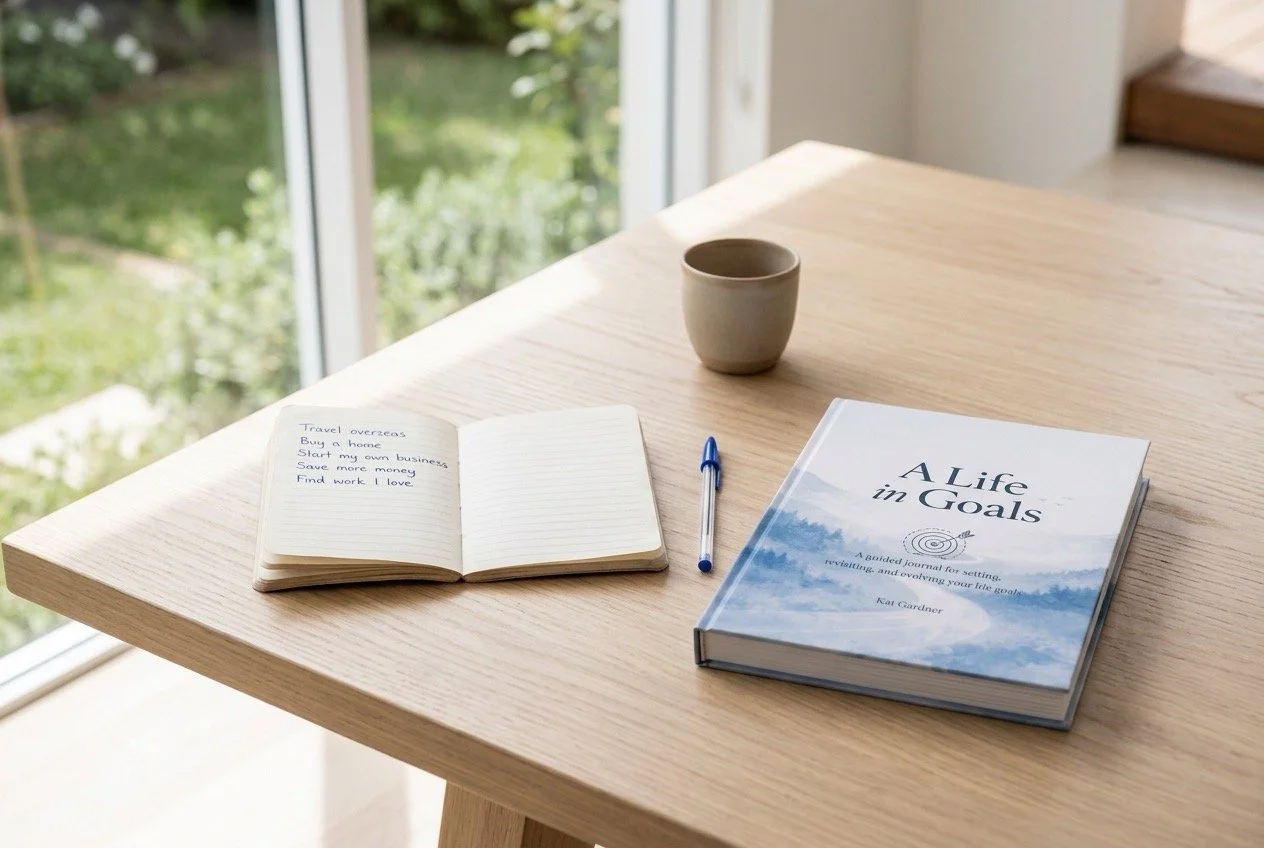
When I look back at the goals I wrote down when I was younger, they are full of beginnings. Move out of home. Travel overseas. Find a good job. Learn things. Buy property. Start my own business. Have more confidence. Have direction.
That makes sense. In your 20s, so much of life is about building the foundations. You are trying to work out who you are, where you belong, what kind of work you want, where you want to live and what sort of life might suit you.
By your 50s, the questions are different.
You may still want to change careers, travel somewhere new or start something of your own. But the goal often comes with more context. You know what a demanding job costs in time. You understand what financial security feels like. You know whether you like being busy or whether you have had enough of it. You may value flexibility more than status, time more than a bigger title, or experiences more than another thing for the house.
That does not mean your goals have become smaller. It means they have become more informed.
The goal is no longer simply about what sounds exciting. It is also about what fits the life you actually want to live.
You know more now, and that changes what you want
There is a kind of freedom in setting goals when you have enough life behind you to know what does not suit you.
At 25, you may have wanted a certain job because it looked successful. At 55, you know whether the day-to-day reality of that kind of work would actually make you happy. You may once have dreamed of a large house and now want something easier to maintain. You may have thought travelling constantly would be ideal and now realise you love having a home base. Or perhaps the opposite is true and you finally want to spend less time tied to one place.
Experience gives you better information.
It also gives you permission to be less impressed by other people's definitions of success. The goal does not need to sound ambitious at dinner. It does not need to look impressive on social media. It does not need to justify the years ahead.
You might want to work four days a week. Learn to paint. Save enough money that work feels optional one day. Spend a month somewhere every year. Get stronger. Build a closer relationship with your adult children. Start a small business that never becomes enormous. Have a garden. Write something. Volunteer. Learn a language. See more of your friends.
These can all be serious life goals.
The fact that they do not sound like the goals you were encouraged to have at 25 does not make them less important.
There is still time for big goals too
I also think we need to be careful not to turn the idea of age-appropriate goals into another limitation.
You do not have to become sensible simply because you are in your 50s.
There can still be enormous goals. Start the company. Write the book. Move countries. Buy the place you have dreamed about. Go back to university. Build something from scratch. Learn something difficult. Take the year away. Begin again.
Not every big goal needs twenty years to become worthwhile. And even when it does, there may still be twenty years available to give it.
We often underestimate what can happen in a decade. Think about how different your life was ten years ago. The work you were doing. The people around you. Your home. Your priorities. What you knew about yourself.
Ten years from now you may be living a life you cannot picture clearly today.
That is not a reason to panic about time. It is a reason to leave room for possibility.

Some goals only become possible later
Age does close some doors. It would be ridiculous to pretend otherwise.
But it opens others.
There are things you may have wanted in your 30s or 40s that were simply difficult to fit around young children, mortgages, full-time work and the relentless logistics of family life. By your 50s, some of those pressures may begin to shift.
Perhaps the children need you differently. Maybe you have more financial breathing room. You may have more annual leave, more confidence, a stronger professional network or simply less interest in asking permission.
You also have experience you can use.
Starting a business at 52 is not the same as starting one at 22. You may understand customers, money, people and your own strengths much better. Going back to study at 56 is not the same as studying at 18. You know why you are there. Travelling later can be completely different because you know how you like to travel and what you are willing to spend money on.
Some dreams are not late.
They are simply arriving at the stage of life when you are better equipped to enjoy them.
Your goals can include making ordinary life better
One of the biggest shifts in my own thinking about goals is that I no longer believe they all need to lead somewhere dramatic.
At this stage of life, improving the ordinary week can be just as meaningful as planning the enormous milestone.
You might want more mornings without rushing. A home that feels calmer. Regular dinners with friends. More walking. Less time spent doing work you resent. A better relationship with money. A yearly holiday you genuinely look forward to. Time to read. A creative interest. More confidence saying no.
Those goals matter because most of life is ordinary.
The big trip is wonderful, but it lasts three weeks. The way you spend Monday to Friday matters too.
When you are younger, it is easy to think a good future will arrive through a sequence of major achievements. Later, I think you start to understand how much the quality of life depends on the smaller things that happen repeatedly.
So setting goals in your 50s can include asking not only what you still want to achieve, but how you want the next decade to feel.

You do not need a five-year plan for the rest of your life
This is where I think goal setting becomes much kinder.
You do not need to decide what the rest of your life will look like.
You can have direction without having the whole map.
Perhaps you know you want more freedom in the next few years but do not yet know whether that means reducing work, changing roles, moving or building another source of income. Maybe you know you want more adventure but have not decided what kind. You might feel ready for a new chapter without knowing exactly what belongs in it.
That is enough to begin with.
Some goals will become specific as you explore them. Others will stay broad for a long time. You can write 'I want work to take up less of my life' before you know how you will make that happen. You can write 'I would love to spend more time overseas' before you have picked the destination.
The useful thing is noticing the direction.
You are not behind because you cannot produce a perfectly organised plan for the next ten years.
Be careful with the feeling that it is ‘too late’
I think this thought deserves to be challenged whenever it appears.
Sometimes something genuinely is no longer practical, and there is wisdom in recognising that. But 'too late' can also become a convenient sentence we use without testing whether it is actually true.
Too late to study? Too late to change jobs? Too late to become stronger? Too late to travel alone? Too late to make new friends? Too late to create something? Too late to learn an instrument? Too late to start a business?
Often the real question is not whether it is too late. It is whether you are willing to be a beginner again.
That can feel uncomfortable in your 50s because you have probably spent years becoming competent. You know how to do your job. You know how your life works. Starting something new can put you back into the awkward position of not knowing.
But there is something very alive about that too.
You are allowed to be new at something.

Think about what you want more of, not only what you want to achieve
If you sit down to set goals in your 50s and nothing obvious comes to mind, I would not force yourself to create a grand list.
Start with a different question.
What would you like more of?
More time. More freedom. More strength. More money in reserve. More travel. More creativity. More connection. More quiet. More laughter. More interesting work. More weekends away. More confidence. More time outside.
Then ask what might create a little more of that.
This approach often produces goals that feel much more personal because you are not starting with what sounds like a proper goal. You are starting with the life you actually want.
And sometimes the answer is not something new at all. It is less of something that has been taking up too much room.
You can change the goals you inherited from your younger self
By your 50s, you may also be carrying goals you have had for decades.
Some of them will still belong to you. Others may have become habits of thought.
Perhaps you always assumed you would own a particular kind of home, reach a certain career level, retire in a certain place or live a certain way. The idea may have started so long ago that you have stopped asking whether it still fits.
This is one of the things I find fascinating about looking back at old written goals. You can see what mattered to you then without automatically making it a requirement now.
The younger version of you was allowed to want it.
The current version of you is allowed to change it.
That might mean letting something go completely. Or it might mean finding a new version. The dream of a huge career could become a small business you control. The big house could become a beautiful smaller home. The long-term travel dream could become one month away every year.
Changing the goal does not erase the person who first wrote it. It simply acknowledges the life that happened in between.
Your 50s can be a beginning, not just a continuation
There is a tendency to describe midlife as though the main task is maintaining what you already built.
Keep the career going. Keep the finances on track. Keep healthy. Keep the house running. Keep everybody okay.
Maintenance matters, of course. But I would hate to think that was all.
There can still be beginnings.
A new friendship. A new place. A new kind of work. A new interest. A new way of living. A new goal you could not have imagined ten years ago.
You may even find that the things you start now feel more like you because you are less interested in doing them for approval.
That is one of the gifts of getting older. You have more history, but you can also have more honesty.
There is still so much to look forward to
I am in my 50s now, and when I look at the little notebook where I wrote goals in my 20s, I do not feel as though that younger version of me owned all the possibility.
She had more unknowns, certainly. She was writing into a much larger blank space.
But I have something she did not have.
I know now that life rarely unfolds exactly as we imagine it. Some goals happen. Some take decades. Some disappear. Some turn into something better. And some of the most important parts of life are things we never thought to write down at all.
That makes me less interested in predicting the future perfectly and more interested in staying open to it.
There are still places I have not been. Things I have not learned. Work I have not done. Ideas I have not had. People I have not met. Ordinary days I have not lived yet.
That is enough reason to keep making plans.
Setting goals in your 50s is not about proving you are still ambitious. It is not about racing against age or squeezing every possible achievement into the years ahead.
It is simply a way of remembering that your future still belongs to you.
You are allowed to want things from it.