A practical comparison of different goal-journal formats for people whose goals do not fit neatly inside a calendar year, from long-term life direction to structured quarterly execution and everyday reflection.
If you have ever bought a goal journal in January and quietly stopped using it a few months later, the problem may not have been you.
It may have been the timeframe.
A lot of goal-setting journals are designed around a year, a quarter, a month or even a day. That makes complete sense when the goal itself belongs to that timeframe. If you are launching a project in the next 13 weeks, training for something, trying to build a habit or working towards a clear annual target, structure can be extremely helpful.
But many life goals do not behave like that.
You may want to travel for a month one day, build more financial freedom, change careers, learn a language, start something of your own, become stronger as you get older, create more room for friendship or simply work out what you want the next chapter of your life to contain.
Those goals can take years. They can change shape. They can wait while another part of life needs your attention. Some may never need a deadline at all.
So the best goal journal is not necessarily the one with the most trackers, the most detailed action plans or the most pages.
It is the one whose structure matches the kind of goal you are actually trying to hold.
First, decide what you actually need a goal journal to do
Before comparing journals, I would start here because the word 'goal journal' can describe very different products.
Do you want something that helps you think about the bigger direction of your life? Do you already know the goal and need help turning it into weekly action? Do you want a structured annual system? A short focused sprint? Daily gratitude and reflection? Or simply a blank place to think without anybody telling you what belongs on the page?
Those are different jobs.
A journal that is excellent for daily accountability may be a poor fit for a dream that is five years away. A journal designed for long-term reflection may frustrate somebody who wants every goal broken into weekly milestones.
For a closer look at why longer ambitions often need a different timeframe, see Long-Term Goals: How to Think Beyond the Next 12 Months.
That is why I would choose by purpose rather than trying to find one universal 'best' journal.
A note before the list
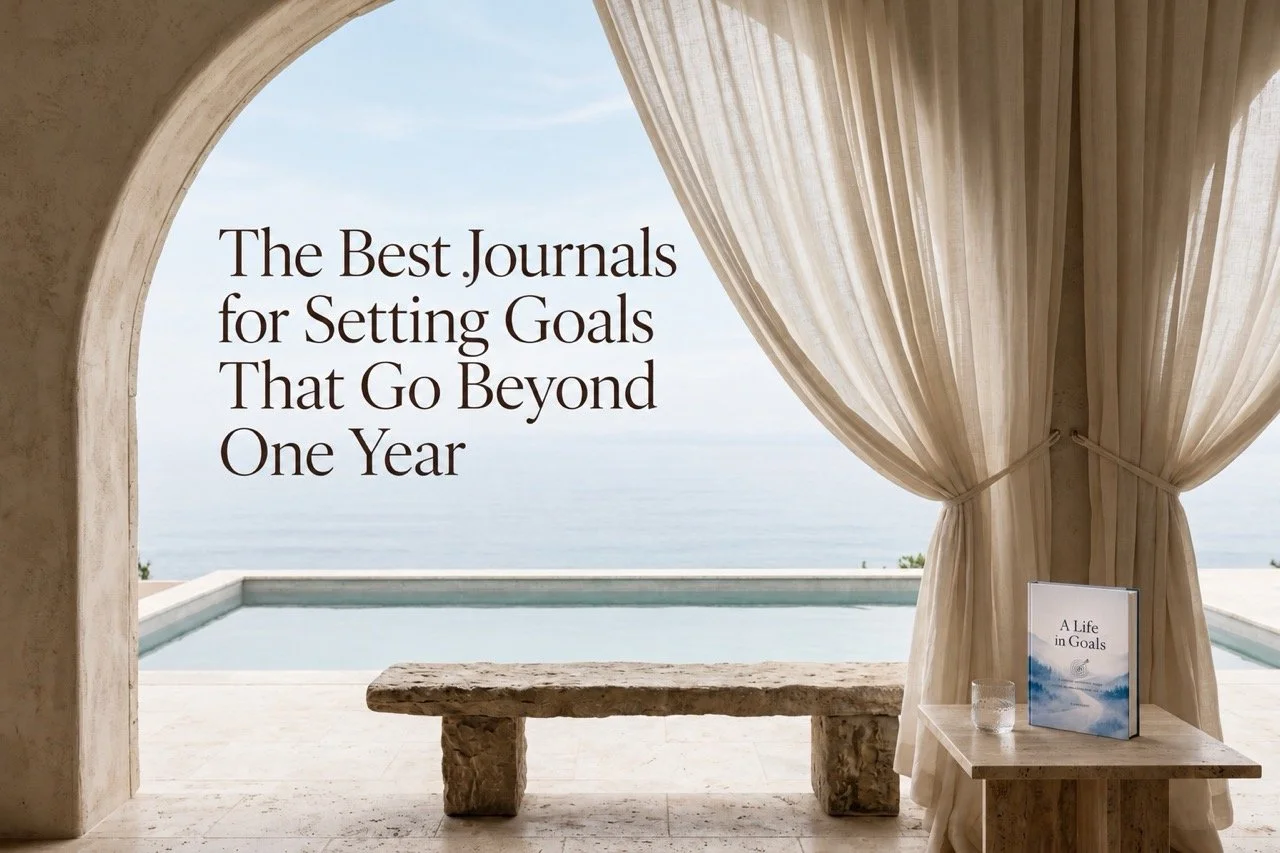
A Life in Goals is my own journal, so I am obviously not a completely neutral reviewer.
I have included it because long-term goals that do not fit neatly into one year are exactly the reason I created it. But I have also included other approaches because they genuinely suit different people and different kinds of goals.
If you want a detailed daily productivity system, I would not tell you A Life in Goals is the best tool for that. It is not designed to run your calendar or tell you what to do every morning.
Equally, if what you really want is somewhere to keep a dream for years without turning it into this quarter's project, a 13-week execution journal may be far more structure than you need.
The useful question is not 'Which journal is objectively best?'
It is 'Which journal is best for the way I want to think about my goals?'
Best for long-term life goals: A Life in Goals
A Life in Goals is the strongest fit if your starting point is the bigger picture: what you want your life to contain across work, money, travel, relationships, home, health, learning, creativity and experiences.
It is deliberately not organised around one calendar year. The idea is that you can keep the book, return to it and allow different goals to move at different speeds.
Some might be Life Goals that give you a larger direction. Some may be Dream Goals that simply need somewhere to live for now. Growth Goals can hold things you want to learn or become more capable of. Anchor Goals can protect the foundations underneath your life. Everyday Goals can make ordinary life a little better.
The five types are not a five-step process, and you do not need to manufacture one of each. They are there because not every goal should be treated as the same kind of project.
The journal also leaves room to revisit goals as life changes rather than treating the first version you wrote down as a contract.
Best for: women who want to think about long-term direction, life goals, dreams, changing priorities and a journal they can keep rather than replace at the end of December.
Probably not the best fit if: you want hourly scheduling, daily task lists, habit streaks or a highly structured productivity system.

Best for structured annual and quarterly execution: Full Focus Planner
The Full Focus Planner sits much closer to the structured planning end of the spectrum.
Its current system is built around annual goals, quarterly focus, weekly review and daily priorities. The Full Focus approach recommends defining a limited set of annual goals, assigning a smaller number to each quarter and connecting them to weekly and daily action.
That makes it a strong choice when you already know what you want to achieve and want a system that keeps those goals visible while you plan your time.
It is much more execution-focused than A Life in Goals. That is not a criticism; it is simply a different job.
If your goal is 'complete this project this year', 'grow this part of the business', 'train for this event' or 'make measurable progress on a defined annual target', the extra structure may be exactly what you want.
Best for: people who like annual goals, quarterly focus, weekly reviews and a strong connection between goals and daily priorities.
Probably not the best fit if: you dislike frequent planning, do not want your goals tied closely to productivity, or mainly need somewhere to hold long-term dreams and evolving life direction.
Best for a focused 13-week goal: BestSelf Co. Self Journal
The Self Journal by BestSelf Co. is built around a much shorter window: 13 weeks.
Its strength is focus. The journal takes goals for that period and connects them to weekly milestones and daily action. That can be very useful when a goal is already clear and the challenge is actually moving it.
Thirteen weeks is also short enough to feel concrete. You are not trying to predict an entire year, and you can focus attention on a project or priority without pretending every part of your life needs changing at once.
For a long-term life goal, I would think of this kind of journal as a possible execution companion rather than the place where the whole goal has to live.
For example, 'I want to change careers' may be a multi-year Life Goal. A 13-week journal could be useful later for one defined phase: researching roles, building a portfolio, completing a course or applying for positions.
Best for: one or a small number of clearly defined goals that need concentrated action over roughly three months.
Probably not the best fit if: you are still working out what you want, or your goal needs to stay open and pressure-free for a while.

Best for goals integrated into weekly life: Clever Fox PRO Weekly
Clever Fox offers a large range of planners, but its PRO Weekly format is a useful example of the all-in-one approach.
It combines broader vision and goal-setting work with monthly and weekly planning, reviews, habits and practical life organisation. The undated PRO versions remove some of the pressure of wasting dated pages if you stop for a while.
This style can suit someone who wants goals, finances, weekly priorities and everyday organisation living in the same place.
The trade-off is that there is naturally more structure to maintain. If you enjoy filling in weekly pages and seeing goals translated into regular priorities, that may feel supportive. If you find planners become another thing to keep up with, it may feel like too much.
Best for: people who want life goals connected to monthly and weekly planning and like an all-in-one paper system.
Probably not the best fit if: you want a keepsake-style journal you can return to irregularly over many years rather than a planner built to organise a defined period.
Best for daily gratitude and reflection: The Five Minute Journal
The Five Minute Journal by Intelligent Change belongs in a different category again.
It is not primarily a long-term goal journal. Its focus is guided daily reflection, gratitude and self-growth through a small set of recurring prompts.
That can make it very useful if what you want is a simple journalling habit rather than a place to map life goals.
The current version is undated and designed around six months of daily use, so the commitment is about returning regularly rather than building a multi-year goal record.
For some people, daily reflection is exactly the missing piece. It can help you notice what is good, what you are learning and how your thinking is changing.
For somebody looking specifically for a place to hold a goal like 'work overseas one day' or 'build enough financial security to reduce work in five years', it is solving a different problem.
Best for: a short daily gratitude and reflection practice with very little decision-making about what to write.
Probably not the best fit if: your main need is long-term life-goal exploration, goal relationships or keeping dreams visible across years.

Best for complete flexibility: a plain notebook or bullet journal
There is also a perfectly good argument for buying none of the above.
A plain notebook has no system to maintain and no opinion about how long a goal should take.
You can write a five-year dream on one page, a shopping list on the next, work through a difficult decision, leave six months blank and return without being behind.
That freedom is its biggest advantage.
It is also its limitation.
If a completely blank page is the reason you never start, a guided journal can give you enough structure to get underneath the obvious answer. Prompts can help you separate a goal you actually want from one you think you should want, notice the supporting parts of life around it, and come back to it more intentionally.
Best for: confident journal writers who want total freedom and are happy creating their own structure.
Probably not the best fit if: you stare at a blank page and immediately think, 'I have no idea what to write.'
So which type of goal journal should you choose?
I would choose based on the question you are trying to answer.
If the question is, 'What do I want my life to contain over the next five, ten or twenty years?' choose something designed for life direction and long-term reflection.
If it is, 'How do I achieve these annual goals and connect them to my weeks?' choose a structured yearly or quarterly planner.
If it is, 'How do I get this one project moving over the next three months?' a 13-week goal journal may be ideal.
If it is, 'How do I keep my goals connected to my weekly life?' an undated weekly goal planner may suit you.
If it is, 'How do I build a simple daily reflection habit?' choose a daily guided journal.
And if the answer is, 'Please just give me paper and leave me alone,' buy the beautiful blank notebook.
The format should reduce friction, not create another obligation.

What to look for if your goals genuinely go beyond one year
If long-term goals are the priority, there are a few features I would pay particular attention to.
First, avoid a structure that makes the book feel obsolete when the calendar changes. An undated format helps, but the deeper question is whether the journal itself assumes every meaningful goal belongs to the same year.
Second, look for room to change your mind. A long-term goal written at 42 may look different at 47. You want to be able to revise the version without feeling as though you failed the original one.
You can also explore the practical side of revisiting goals in How to Use A Life in Goals, including the reflection and check-in sections.
Third, consider whether the journal allows dreams to exist before they are ready for an action plan. Not every desire needs a deadline the moment you write it down.
Fourth, look for a way to connect a big goal to the rest of your life without turning every connection into another task. A travel dream may involve money, health, time and learning, but that does not mean you need four new active goals this week.
And finally, ask whether you would want to keep the book.
A long-term goal journal can become interesting precisely because time passes. The old version of the goal, the note you added three years later, the thing that finally happened and the dream you changed your mind about become part of the record.
A goal journal can be a tool, or it can become a record
This is probably the biggest difference for me.
Some journals are designed to do a job for a defined period and then be replaced. That is useful. A 13-week journal should help with those 13 weeks. A yearly planner should help you organise that year.
But there is another kind of value in a journal that stays.
I still have a tiny notebook containing goals I wrote in my 20s. Some happened. Some did not. Some took much longer than I expected. Some make me laugh now. Some of the deeper wants underneath them still feel remarkably familiar.
What makes that notebook valuable now is not that it was the world's best productivity system.
It is that I kept it.
I can see who I was, what I wanted and how the direction changed.
I wrote more about the surprises in those old pages in The Goals My 20-Something Self Wrote That Make Me Laugh Now.
That is the role I wanted A Life in Goals to play: useful enough to help you think now, but open enough to become more interesting later.

The best journal is the one that matches the life of the goal
There is no single paper system that is best for every goal.
A short-term project benefits from different structure than a ten-year dream.
A daily reflection practice asks something different from a career change.
An annual business goal and the question 'What do I want from the next chapter of my life?' do not need to live in identical books.
So before choosing the journal, choose the job.
Do you need execution?
Planning?
Reflection?
Direction?
Possibility?
Or simply somewhere to keep a thought long enough to see what it becomes?
The best goal journal for goals that go beyond one year is the one that gives those goals enough structure to stay visible, without forcing them to move faster than the life around them.
If you are looking for a place to hold goals that may take years to unfold, A Life in Goals was created for that kind of thinking. Explore A Life in Goals on Amazon.
Kat x
Creator of A Life in Goals