The Little Book That Eventually Became A Life in Goals
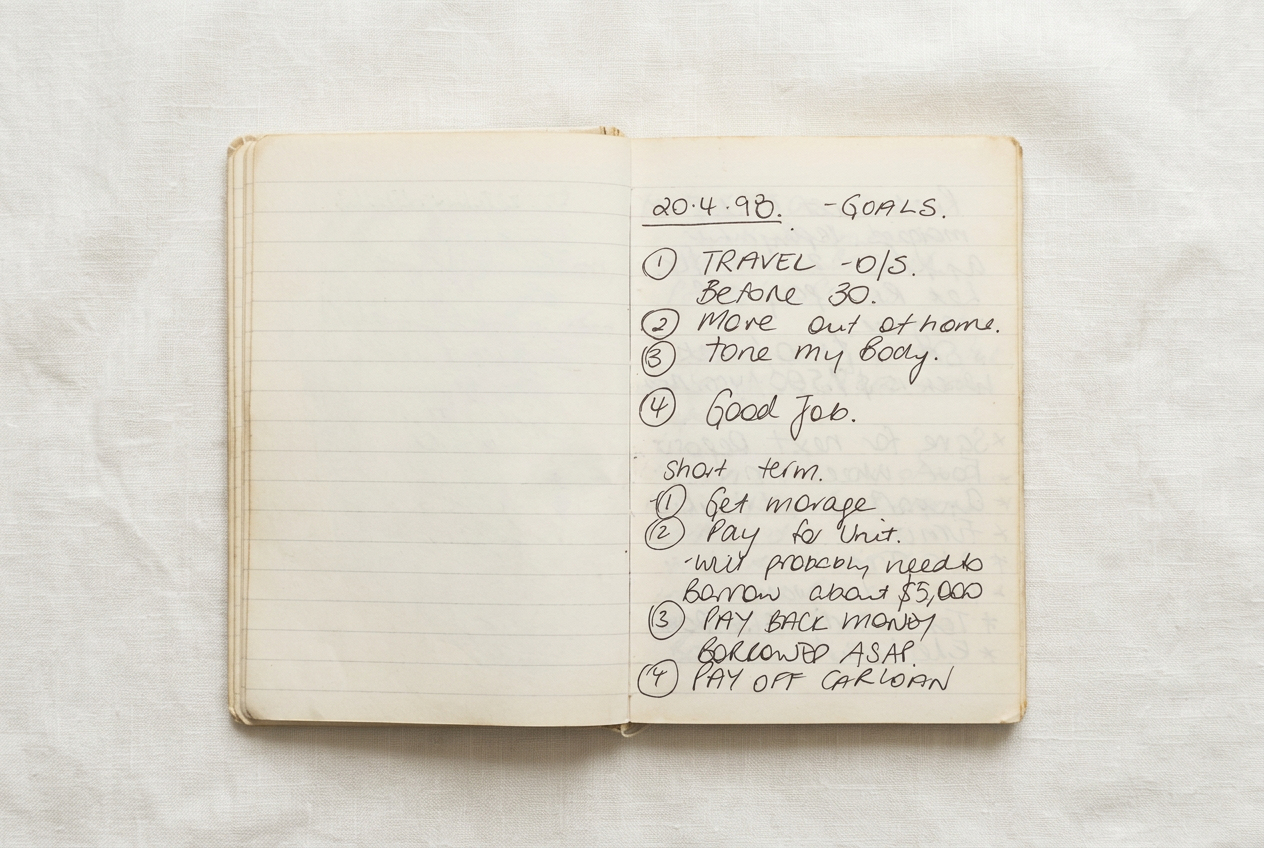
In April 1998, I sat down with a little black-and-white notebook and wrote four goals: travel overseas before I turned 30, move out of home, tone my body and get a good job.
Underneath those four goals, I started working out some of the practical things I needed to do to make them happen. I needed to get a mortgage, pay for the unit, pay back money I had borrowed and pay off my car. On other pages there are calculations about deposits, savings and repayments, alongside lists of things I needed before moving out of home.
I still have that little book.
I'm 54 now, and looking through it more than 28 years later is fascinating. Not because I achieved everything I wrote down, because I certainly didn't, and not because all of my goals were particularly profound. Some of them make me laugh now. What I love is that these slightly messy handwritten pages have become a record of a much younger version of me and what she imagined her life might look like.
At the time, I thought I was writing down where I wanted to go. I didn't realise I was also recording who I was.
I was trying to work out where my life was going
I wish I could say I had a wonderfully organised goal-setting system in my twenties, but I didn’t. Sometimes I would sit down at the beginning of a new year and think about what I wanted for the year ahead, but I also seemed to reach for my little book at times when life felt uncertain.
Maybe things weren’t going particularly well at work, or I was questioning what I wanted to do next. Sometimes I simply had that feeling that I wasn’t quite sure where my life was heading.
I remember being single and sitting in my room at night with the book, probably with a glass of red wine beside me, particularly in my later twenties. I’d sit there and write down the things I wanted to do, change, experience or work towards.
There was no five-year strategic plan and I wasn’t following a goal-setting method. I wasn’t thinking about productivity or trying to optimise my life. I was really just having a conversation with myself about where I was, where I wanted to be and what might make my life feel better or more interesting.
Looking back, I think that’s an important distinction. I wasn’t always writing goals because I had a clear direction. Quite often, I was writing them because I was looking for one.
Writing things down seemed to help. A vague feeling of wanting something different became more tangible once it was on paper. I could see what I was thinking, and sometimes I could start working out what I might actually need to do about it.
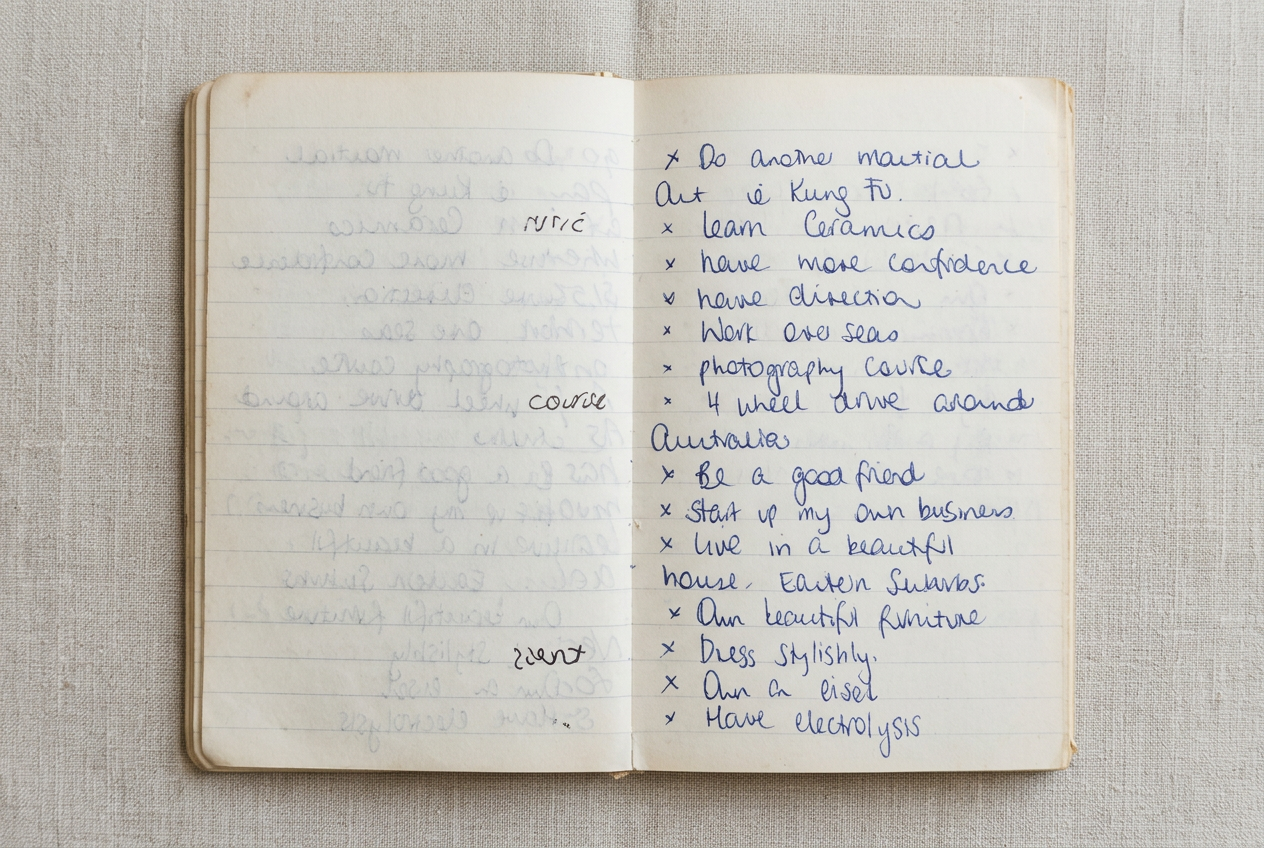
There is one line in the book that feels particularly significant to me now. Amongst all the other things I wanted to do, I simply wrote: “Have direction.”
More than 25 years later, that feels like a pretty good explanation of why I kept coming back to the book.
The goals were about everything
Looking through the pages now, what really strikes me is how broad my idea of a goal was. I wasn’t only thinking about career or money or the big milestones we’re often told we’re supposed to work towards. Everything was mixed together.
I wanted to travel overseas before I turned 30, move out of home, eventually live by myself and have a good job. I wanted to work overseas and start my own business. I wanted to learn a language, learn ceramics, take a photography course and have an exhibition of my own artwork. At one stage I wanted to four-wheel-drive around Australia.
I wanted to live in a beautiful house, own beautiful furniture, dress stylishly and own an easel. I wanted to have more confidence, have direction and be a good friend.
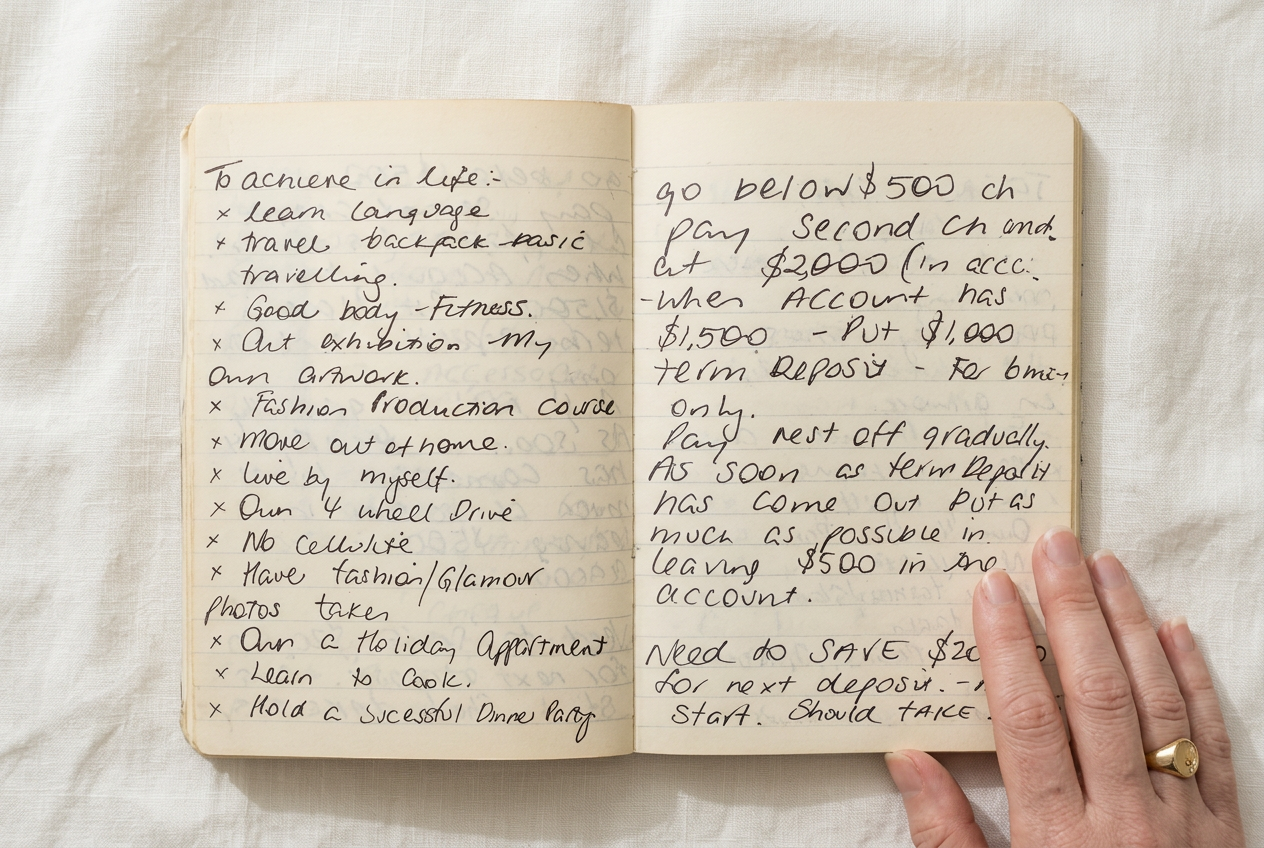
Then there were the goals that make me smile now. I wanted to have fashion and glamour photographs taken, learn to cook and hold a successful dinner party. I wanted regular facials, manicures and hair appointments. At one point I wrote that I wanted to “always have the house clean in case anyone drops in” and “always have something decent on”.
And, amongst all of this, I wrote down that I wanted to have “no cellulite”.
It was the 1990s, after all.
I could leave those things out now and only share the goals that sound impressive or meaningful with the benefit of hindsight, but I don’t want to. In fact, I think the slightly ridiculous ones might be some of the most important.
They remind me that our goals are a reflection of the person we are when we write them. They capture our age, our circumstances, our insecurities, our priorities and even the culture we’re living in at the time.
We don’t have to agree with our younger selves forever.
Some things that felt incredibly important to me then don’t matter to me now. Other things are surprisingly familiar. There are things on those pages that are still very much part of who I am, and others that belong completely to that younger woman.
That’s what makes the book so interesting to me now. I’m not simply reading an old list of things I wanted to achieve. I’m getting a glimpse of myself at a particular point in my life.
The big dreams sat beside the very ordinary ones
One of the things I’ve come to appreciate about those pages is that I never seemed to have a hierarchy for what was worthy of becoming a goal.
A plan to start my own business could sit beside buying a lounge. A desire to travel could be followed by a reminder to get the carpets cleaned. A life drawing course, tennis lessons, buying dining room chairs, doing a stock exchange course, going to Thailand and getting fitter could all appear within a few pages of each other.
At various points I wanted to buy another property, take cooking classes, read more, have personal training sessions, create my own label and learn to draw at a school in Florence. I wanted to buy a blue Golf convertible and go on a Tasmanian walk with a friend. I wanted to hold dinner parties once a month and buy a cupboard for all my books.
There is something wonderfully ordinary about it when I read it now.
We often talk about goals as though they need to be significant enough to qualify. They need to be ambitious or measurable, something we can announce that we’re working towards and eventually tick off as an achievement.
But our actual lives aren’t made up only of big achievements.
They’re made up of the homes we create, the things we learn, the friendships we maintain, the experiences we have, the financial decisions we make and all the little things we do simply because they make life more enjoyable.
A goal doesn’t need to impress anyone else to be worth writing down.
It can be something that changes your entire life, or it can be something that would simply make a Saturday afternoon better.
I didn’t have the words for that in my twenties, but looking through my old book now, I can see that I instinctively treated both as important.
Writing the goal was often only the beginning
Another thing I’d forgotten until I opened the book again was how often I tried to work out what needed to happen next.
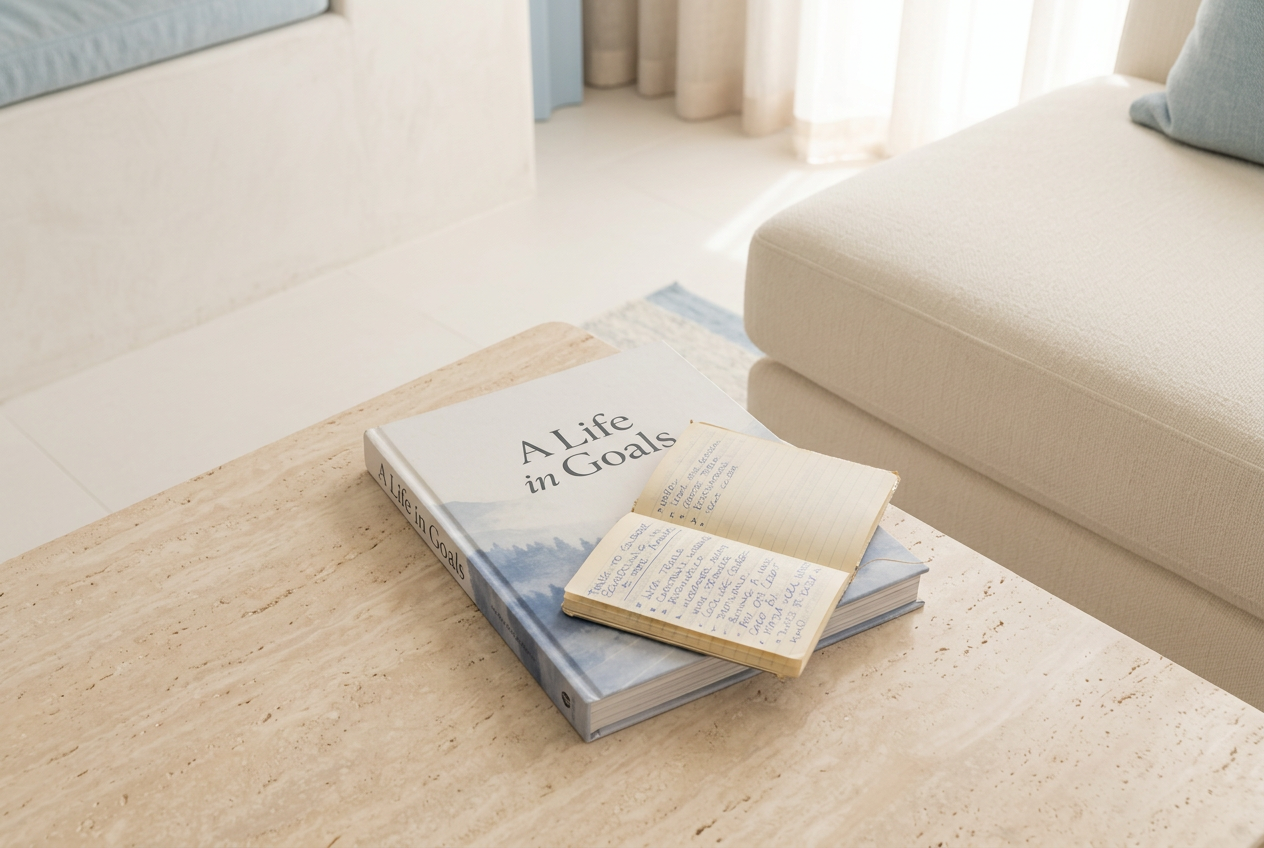
When I wanted to move out of home, I didn’t just write “move out of home”. There are pages of numbers and calculations. I worked out what I had saved, how much I would need for a deposit, what repayments might look like and what I could afford to save each week.
On one page, I wrote that I needed $5,000 for a deposit on a unit. There are notes about paying back borrowed money and paying off my car. On another page, I listed what I had before moving out: a $1,000 term deposit, approximately $5,000 in an account, bed sheets and other accessories. My aim was February 1999.
Looking at those numbers now is like looking through a little window into my life at the time.
Today, $5,000 written on a page is simply a number. Back then, it represented independence. It was part of the bridge between living at home and having a place of my own.
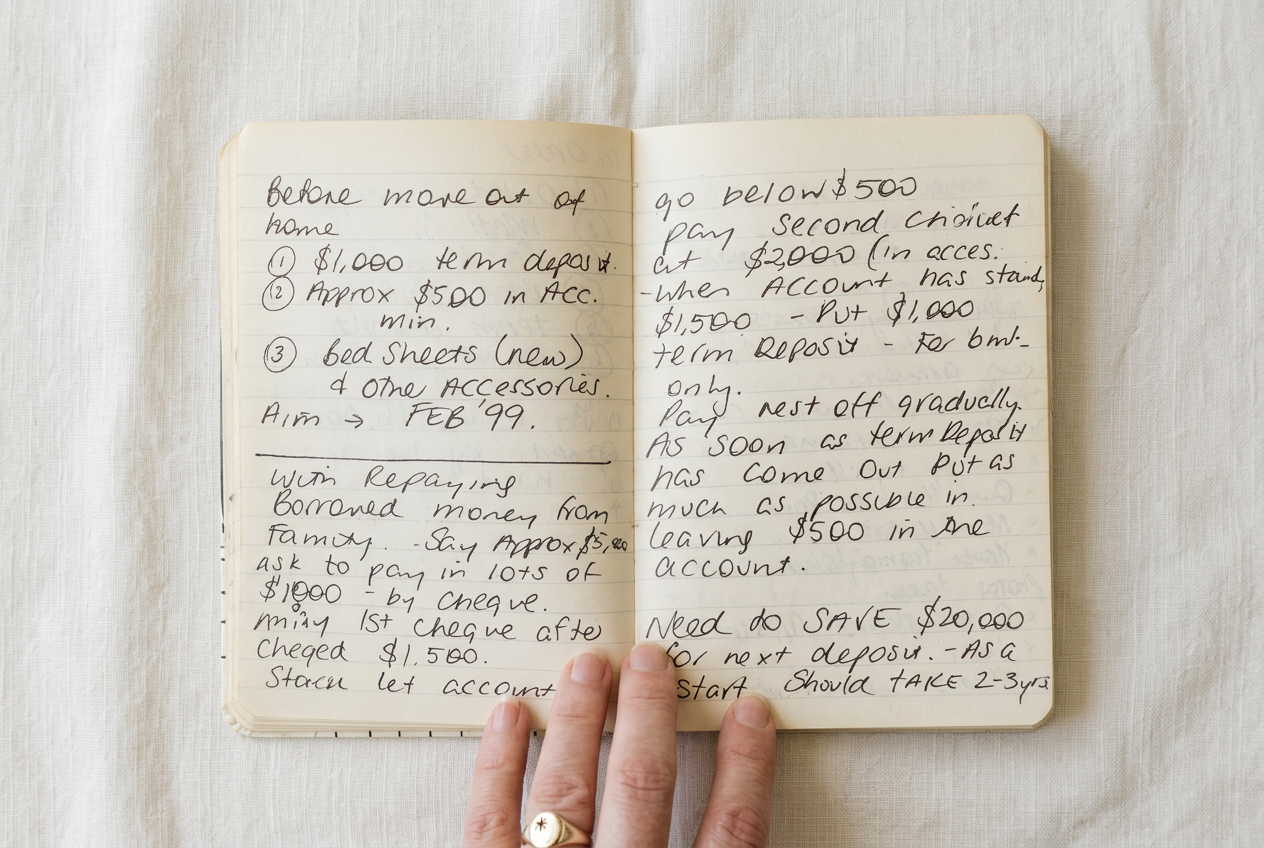
It’s easy to look back at something after it has happened and forget there was once a time when it hadn’t.
Before you have the home, there’s the saving for the deposit. Before you change careers, there’s the uncertainty about what you actually want to do. Before you take the trip, there’s the decision to start putting money aside for it.
The finished achievement can look quite neat from the other side. The process of getting there rarely is.
My little notebook captured some of that messiness. The calculations, the deadlines, the changes of mind and the practical steps all sit amongst the bigger ideas.
Sometimes the first step towards a life goal is incredibly unglamorous. It might be saving $50 a week, paying off a credit card, researching a course or simply finding out what something costs.
But those small steps matter because they begin to turn something we would like to do into something that might actually happen.
My goals changed because my life changed
As I moved through my twenties and into my thirties, the lists changed with me.
By 2002, I was thinking about different things. I had goals around paying off my credit card and saving $50 a week into a trading account. I wanted to learn a trading system. I was thinking about buying furniture for my home and setting deadlines for myself.
Later there were goals about property, holidays, fitness, courses, artwork, career ideas and finances. Sometimes I gave almost everything a date. Get this done by March. Start that by June. Finish something else by December.
It’s interesting to see how one stage of life quietly made way for another.
On the earlier pages, “move out of home” felt enormous. A few years later, I wasn’t writing about moving out anymore. I was thinking about the lounge, the buffet and the dining room chairs.
The old goal had disappeared because life had moved on.
That seems obvious now, but I think it’s important.
We can sometimes treat our goals as permanent declarations. Once we’ve written something down, we’re supposed to want it until we achieve it. If we don’t, somehow we’ve failed.
I don’t see it that way anymore.
Our goals should change because our lives change.
Sometimes we achieve something and it naturally makes room for the next thing. Sometimes a goal becomes less important. Sometimes we discover that what we thought we wanted isn’t what we want at all. And sometimes life takes us in a direction we could never have anticipated when we originally wrote the goal down.
Looking at my old notebook, I don’t feel disappointed by the things that disappeared from the lists. I’m curious about them.
Some goals belonged to that version of me, and that is enough.
I’ll save the story of which ones actually happened, which ones didn’t and which evolved into something completely different for another day. There are quite a few surprises in there.
The question underneath all the lists
One of my favourite discoveries in the notebook is a page where I had written:
“A week in the life of KG in her exciting new career.”
Underneath it were a few prompts to myself:
List everything I want from a job.
List personal goals.
What makes you happy?
That page stopped me when I found it again.
It made me realise that underneath all the lists, deadlines, mortgage calculations, travel ideas and plans for successful dinner parties, I was really trying to work myself out.
What kind of work would make me happy? What did I want my life to feel like? Where did I want to live? What did I want to learn? What experiences did I want to have? What kind of person did I want to become?
When we look backwards at our own lives, it’s very easy to make the path seem inevitable. We know what happened next, so the different stages join together neatly in our memory.
But when you’re actually living it, you don’t know.
The younger me sitting in her bedroom with that little book didn’t know where her career would take her. She didn’t know which ideas would become important or which goals would quietly disappear. She didn’t know what her life would look like at 54.
She was simply trying to work out the next bit.
I think there is something comforting about remembering that.
You don’t always need to know exactly where you’re going before you start thinking about what you want.
Sometimes thinking about what you want is how you begin to find the direction.
What I wish I’d written down
As much as I love having the notebook, looking through it now makes me wish I’d recorded more.
I have the goals, but I don’t always have the story behind them.
I wish I’d written why some of those things mattered so much to me. I wish I’d recorded what was happening in my life when I wrote “have direction”, or how I felt when something I’d been working towards finally happened.
I wish I’d occasionally gone back to an old goal and written what happened next.
Did I still want it?
Had I changed my mind?
Did something completely different happen instead?
There are moments when I want to ask my younger self questions.
Why did you want that?
What were you worried about?
What were you excited about?
Did you realise how much would change?
And, importantly, did you ever manage to keep the house permanently clean in case someone dropped in?
I’m fairly sure I know the answer to that one.
What I hadn’t understood when I was writing those pages was that one day the goals themselves would become memories.
The book I wish I’d had
This is where, looking back now, I can see the connection to A Life in Goals.
I didn’t rediscover this notebook one day and decide to turn it into a book. That isn’t how A Life in Goals began, and I don’t want to pretend it was.
But I can see now that the instinct behind the two is very much the same.
For more than 30 years, I’ve been having some version of this conversation with myself. What do I want? Where am I going? What matters to me? What would I like to change? What would I love to experience? What would make my life feel more like mine?
What I didn’t have was a proper place to keep that conversation.
My little black-and-white book is tiny. Everything is mixed together. Goals run into calculations, notes and lists. There’s nowhere to explore why something matters or to come back years later and reflect on how things changed.
I wanted A Life in Goals to be different.
I didn’t want another yearly planner, something you begin in January, use for a while and eventually put aside when the year is over. Life doesn’t reset every January, and our biggest goals rarely fit neatly inside a 12-month period.
I wanted to create a guided journal that could hold the bigger picture.
Somewhere to think about work and money, but also experiences, relationships, home, health, creativity, travel and the things you simply want to do because they would make your life richer.
Somewhere that recognises that a goal might take a month, five years or much longer.
Somewhere you can return to as you change.
And most importantly, I wanted to create something worth keeping.

I’m 54, and I’m still looking forward
Perhaps the biggest difference between the woman who wrote those first goals and the woman looking at them now is perspective.
When you’re in your twenties, looking ahead feels completely natural. There is so much life in front of you that you automatically imagine what might come next. Where will I live? What will I do? Where will I travel? What will I achieve? Who will I become?
By your fifties, you’ve already lived a lot of that future.
Some things happened exactly as you hoped. Some didn’t. Some things you desperately wanted stopped mattering. Other parts of your life arrived without ever appearing on a goals list.
But I don’t think reaching your 40s, 50s, 60s or beyond means you should stop asking yourself what you want next.
If anything, I think it becomes even more interesting.
At 54, I know far more about myself than I did when I first opened that little notebook. I also know that I don’t have to have everything figured out.
There are still places I want to go, things I want to create, things I want to learn and experiences I haven’t had yet. There are still parts of my life I want to change, and there are probably goals I haven’t even thought of yet.
There is no age at which we should stop being curious about our own future.
And perhaps getting older gives us permission to think about goals differently. They don’t all need to be about proving something or becoming more successful. A goal can simply add something good to your life.
It can give you something to look forward to, something to work towards or a reason to finally do the thing you’ve been thinking about for years.
A place to keep the conversation
When I look at my tiny black-and-white notebook today, I’m incredibly glad I kept it.
Not because it’s beautiful. It really isn’t.
Not because I followed a perfect system. I very clearly didn’t.
And definitely not because everything I wrote down came true.
I love it because it holds little pieces of me from another time.
There’s the young woman who wanted to move out of home and was working out how much she needed for a deposit. The woman who wanted more confidence and direction. The woman who wanted to travel, start her own business, create art, learn things, own beautiful furniture and hold a successful dinner party.
There’s the woman wondering what would make her happy and what she really wanted from her work.
And yes, there’s also the woman who wanted no cellulite and a permanently tidy house in case someone unexpectedly dropped in.
She’s still me, but she’s also someone I get to look back on now.
That’s the part I never understood when I started writing goals all those years ago.
Goals aren’t only about the future.
Over time, they become part of our history.
They remind us what mattered to us at different stages of our lives. They show us how much we’ve changed and sometimes how much we haven’t. They remind us of dreams we’d completely forgotten, and occasionally they make us realise that something we once wrote down almost casually eventually became part of our life.
That is what I wanted A Life in Goals to make space for.
Not just a list of things to achieve, but an ongoing conversation with yourself about the life you want to live.
A book you can write in now, return to as your life changes, and keep long after the goals on its pages have become part of your story.
Because one day, you may open it and realise that while you thought you were writing about your future, you were quietly recording your life.