There is a strange little stretch of the year between Christmas and New Year.
The dates are real, but they do not always feel real.
You forget what day it is.
Breakfast happens late.
Lunch becomes whatever is still in the fridge.
Someone suggests going for a walk because everyone has been sitting down for too long.
The house may still be full of wrapping paper, leftovers, visitors, books, half-finished conversations and things that have not quite been put away.
And then, somewhere in the middle of all of that, the messages about the new year begin.
What are your goals?
What are you changing?
What are you leaving behind?
What are you doing differently?
What are your intentions?
What is your word for the year?
What is the plan?
I love thinking about what I want from my life.
I wrote an entire journal about it.
But even I do not think the week between Christmas and New Year needs to become a planning meeting with yourself.
Sometimes it can just be a week.

You do not have to use every quiet moment productively
There is something about an empty patch in the calendar that makes us feel we should use it well.
Catch up.
Sort things out.
Clear the cupboards.
Make plans.
Reflect properly.
Set goals.
Get ahead.
There is nothing wrong with doing any of those things if you genuinely feel like it.
But rest does not become more valuable because you turned it into a project.
A quiet day does not need an outcome.
Reading a book for three hours does not need to contribute to your personal growth.
A walk can just be a walk.
Lunch with a friend can just be lunch.
A nap does not have to be part of a recovery strategy.
You are allowed to sit outside with a coffee and think about absolutely nothing useful.
That time is not wasted.
We spend so much of the year moving from one requirement to the next that an unstructured day can feel almost uncomfortable.
What am I supposed to be doing?
Maybe nothing.
Or at least nothing that needs to be justified.
If the pressure to do more is familiar, It’s Okay to Want a Smaller Life explores why wanting less can be a meaningful direction in itself.
The year does not need to end with a performance review
The final week of December often comes with an invitation to assess ourselves.
What did I achieve?
What did I fail to do?
What habits did I keep?
What goals did I miss?
How much did I grow?
Did I make enough progress?
Was this a good year?
Those questions can be useful in the right mood.
They can also be exhausting.
A year is not a quarterly report.
Some years contain obvious achievements.
Others contain survival, adjustment, caregiving, grief, uncertainty, waiting, recovery or simply a great deal of ordinary life.
Sometimes the thing you are proudest of is not something you could ever put in a goal tracker.
You kept showing up for someone.
You stayed calm when you would once have reacted.
You made a difficult decision.
You changed your mind.
You accepted that something was not going to happen.
You enjoyed your life more.
You stopped trying to impress somebody.
You rested.
You got through a season that was harder than anyone realised.
None of that needs to be scored.
And you do not need to decide, in the strange days after Christmas, whether the year was a success.

Maybe your mind needs time to wander before it knows what it thinks
Some of the best thoughts arrive when we stop trying to have them.
You are washing up.
Walking.
Driving.
Reading something unrelated.
Sitting in the garden.
Talking to a friend.
And suddenly you realise:
I do not want to keep doing that next year.
Or:
I miss this.
Or:
I think I want more of that.
Or:
Maybe I am ready to try this again.
That kind of thought feels different from sitting down with a blank page and demanding an answer to:
What are my goals for next year?
There is less pressure.
More space.
You notice rather than manufacture.
And perhaps the week between Christmas and New Year is good for that.
Not because it is a formal reflection period.
Because for some of us, the usual structure loosens a little.
There may be more walking.
More sitting.
More talking.
More time to stare out a window.
More gaps between things.
That can be enough for a thought to find you.
You do not have to turn every thought into a plan
This is the part I think matters.
If a thought about next year appears, you are allowed to write it down and stop there.
I want to see my friends more.
I think I want to go back to studying.
I miss travelling.
I want the house to feel calmer.
I am tired of being this busy.
I want to get stronger.
I think I want a different job.
I want to spend more time outside.
I want to understand my money better.
I want to make something again.
Write it down.
Then go back to your book.
You do not have to immediately create the steps.
You do not need a deadline.
You do not need a habit tracker.
You do not need to decide whether it is a Dream Goal, Life Goal, Growth Goal, Anchor Goal or Everyday Goal before lunch.
The thought can simply exist.
One of the reasons I believe in writing things down is that it gives an idea somewhere to wait.
Not everything needs to be acted on the moment it becomes visible.
Some thoughts need time.
If an idea appears and you want to keep it without acting on it, Why Writing Down Your Goals Matters explains the value of giving it somewhere to stay.

Rest can look different from doing nothing
When I say the week is allowed to be nothing, I do not mean you need to lie on the sofa for seven days.
Although if that is what you want, fair enough.
Nothing can look like:
Reading.
Walking.
Seeing friends.
Going to the beach.
Watching films.
Driving somewhere for lunch.
Gardening.
Cooking because you feel like it rather than because dinner has to happen.
Doing a puzzle.
Swimming.
Sleeping later.
Playing with the children.
Looking through old photographs.
Sitting outside.
Tidying one drawer because it suddenly annoys you.
Doing absolutely nothing for an hour.
The difference is not necessarily the activity.
It is whether everything has to lead somewhere.
There is a particular pleasure in doing something because that is what you feel like doing today.
No productivity angle.
No future benefit.
No reason other than:
This seems nice.
You are allowed to enjoy the life you already have before planning the next one
New Year content is often built around improvement.
A better year.
A better body.
A better routine.
A better career.
A better house.
A better version of you.
But before you rush into deciding what needs to change, it can be useful to notice what you already like.
The friend you could happily sit with for four hours.
The walk you do every week.
The part of your home that feels like you.
The coffee shop where they know your order.
The book you cannot stop reading.
The people you want around the table.
The quiet mornings.
The work arrangement that gives you flexibility.
The garden.
The dog.
The beach.
The ordinary life you would actually miss if it disappeared.
Noticing those things does not mean you lack ambition.
It means the next year does not need to begin with the assumption that the current life is inadequate.
Sometimes the most useful thing you can learn in a quiet week is what you want to protect.

You do not need a word for the year
You can have one if you love the idea.
But you do not need one.
You do not need a theme.
A vision board.
A perfect morning routine ready for 1 January.
A list of twelve goals.
A challenge.
A transformation.
A new identity.
You are allowed to enter January with loose thoughts.
Questions.
Half-formed ideas.
Things you might want.
Things you know you do not want.
Or absolutely nothing clear at all.
Clarity is useful.
But forced clarity is often just pressure dressed up as direction.
There is time.
A life is longer than the gap between Boxing Day and New Year's Eve.
You Don’t Need a New You for the New Year explores that same freedom to begin January without reinventing yourself.
January is not the only doorway into change
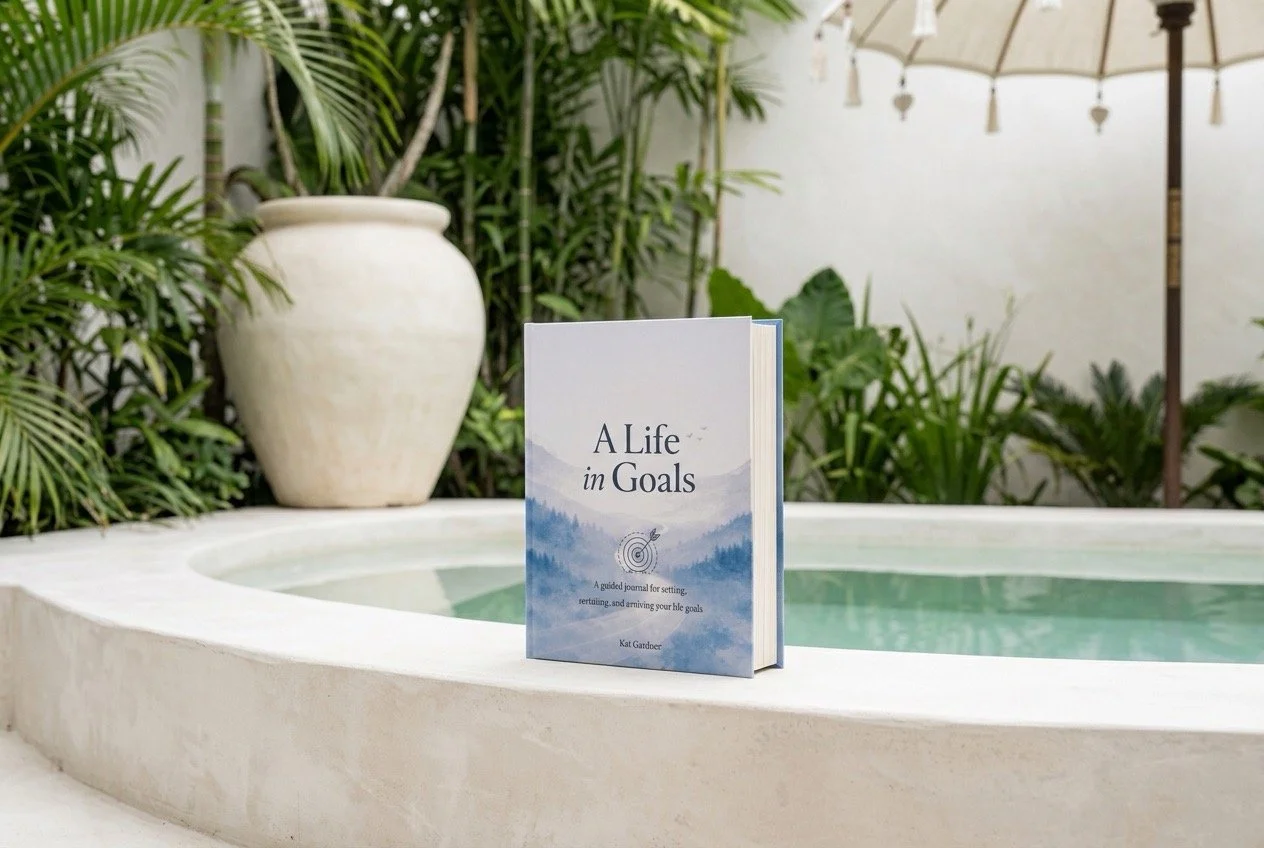
This is one of the ideas behind A Life in Goals that matters most to me.
Life goals do not belong to January.
A travel goal might become real in March.
A course might begin in July.
A financial decision might happen after a job change.
A friendship may become more important in an ordinary week in September.
A dream can wait five years before the timing makes sense.
That is why I do not think the final week of December needs to carry the weight of deciding the whole year ahead.
If something comes to you, write it down.
If nothing comes, that is fine too.
The calendar will keep moving.
You will keep getting new information.
You will change your mind.
Life will change around you.
There will be many more opportunities to ask yourself what you want.
A Life in Goals was never designed to make 1 January feel like a deadline.
It is a journal to return to over years, precisely because the things we want do not all arrive on schedule.
If you would like to understand how the different sections can be used whenever you feel ready, How to Use A Life in Goals is a gentle place to begin.
The week between Christmas and New Year does not need to become the moment you figure everything out.
If you feel like reflecting, keep it gentle
There may be a moment in that week when you genuinely want to think about the year.
If so, you do not need fifty questions.
Try something simple.
What felt good this year?
What felt harder than it needed to?
What do I want to keep?
What do I want more of?
What am I tired of carrying?
What am I curious about?
That may be enough.
You do not even need to answer all of them.
Sometimes one question catches.
Sometimes none do.
The point is not to extract a perfect plan from yourself before the clock strikes midnight.
It is simply to notice.
And if all you notice is that you are tired, perhaps the answer is very straightforward.
Rest.
There will be time to think later
The world will not run out of goal-setting advice in January.
There will be planners.
Podcasts.
Lists.
Challenges.
Resolutions.
Courses.
Templates.
Fresh-start messages.
You will not miss your chance because you spent 28 December reading a novel.
You will not fall behind because you did not decide your goals before New Year's Eve.
You do not need to optimise the quiet week.
Let it be strange.
Let Tuesday feel like Sunday.
Eat the leftovers.
Go for the walk.
See the friend.
Sleep in.
Read the book.
Write down a thought if one appears.
Leave it alone if it does not.
The week between Christmas and New Year is allowed to be nothing.
And sometimes nothing is exactly what you need before something new begins.
When you do feel like returning to your goals, A Life in Goals gives you space to explore them without needing to start on 1 January. Explore the journal on Amazon, or visit the dedicated A Life in Goals page to choose your Amazon region.
Kat x
Creator of A Life in Goals