A personal look at the goals that never happened exactly as written, what they still gave me, and why I no longer think every unfinished goal belongs in a failure column.
If I treated my old goal notebook like a scorecard, it would be very easy to find the unfinished things.
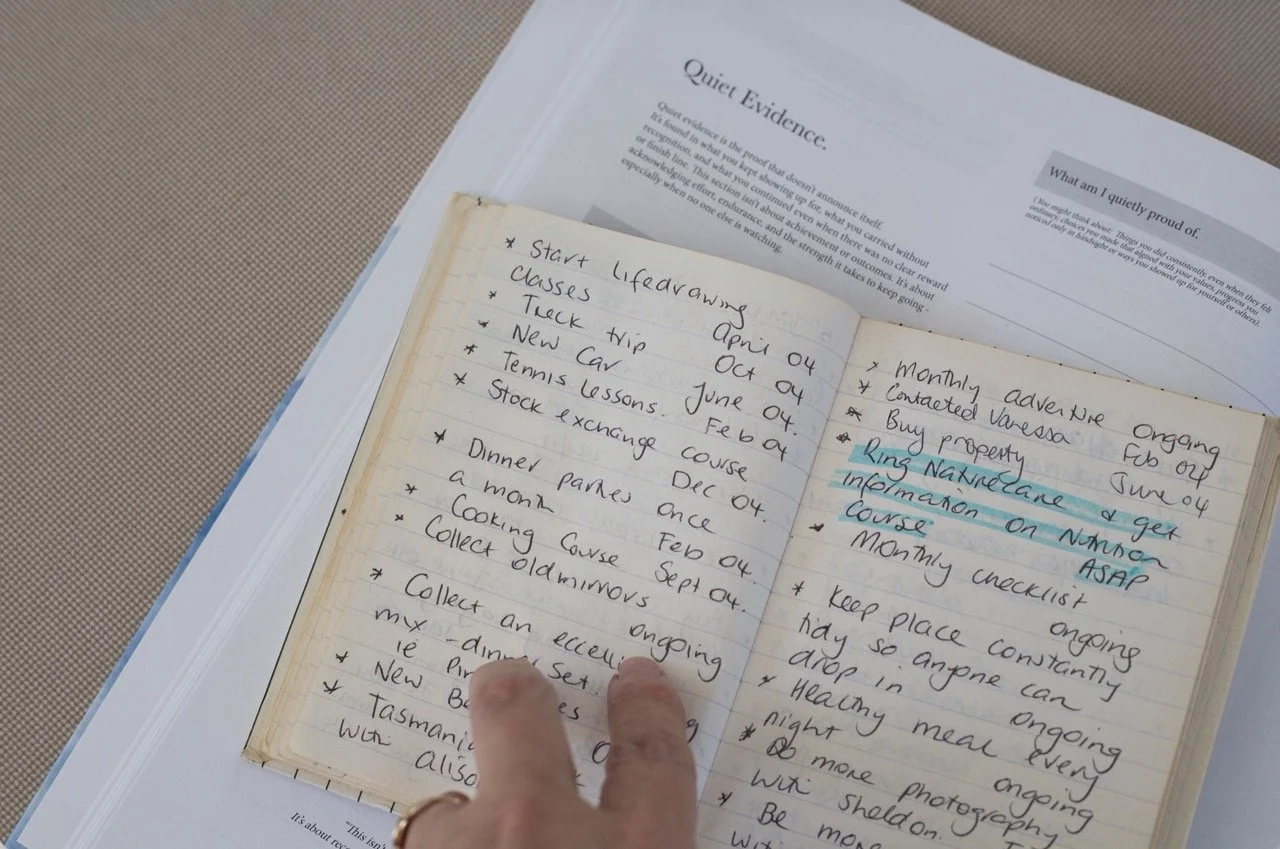
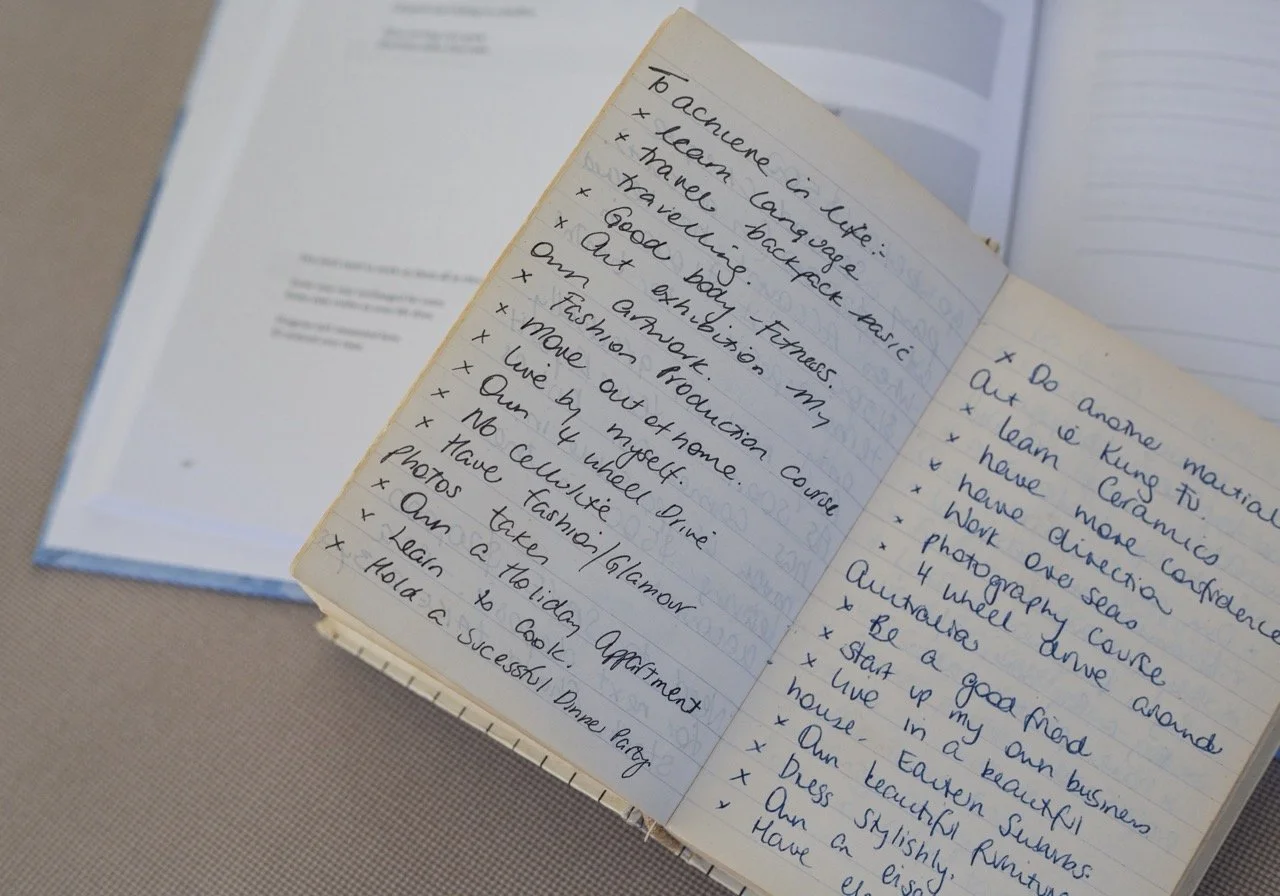
There are pages full of ideas I once thought I would do: work overseas, learn languages, take creative courses, travel in very particular ways, build things of my own, reach certain financial markers, live a certain kind of life and become a certain kind of person.
Some happened.
Some happened much later than I expected.
Some changed shape so completely that it would be difficult to decide whether they 'count'.
And some simply did not happen.
The interesting thing is that when I read those pages now, I do not feel as though I am looking at a list of failures.
I feel as though I am looking at a life in motion.

At the time, I probably thought every line was meant to happen
When I wrote those goals down in my 20s, I was not categorising them by likelihood.
I was not thinking, this one is a firm plan, this one is a passing idea, this one will matter for twenty years and this one will disappear by next summer.
I wrote them because I wanted them.
That was enough.
There is something quite lovely about the certainty of that.
But life does not keep the same certainty.
Work changes. Relationships change. Money changes. Responsibilities arrive. Opportunities appear in forms you could not have predicted. You become interested in things you did not know existed when you made the original list.
And sometimes the person who wanted the goal changes before the goal has a chance to happen.
There are goals I no longer need to complete to prove anything
This is probably the biggest difference in how I see the unfinished ones now.
When you are younger, an unachieved goal can feel like an unanswered question.
Could I have done it if I had tried harder?
Was I disciplined enough?
Did I give up too easily?
Did everybody else manage to move forward while I somehow stalled?
At 54, those questions feel much less interesting to me.
There are things I once wanted that I no longer want enough to rearrange my life for.
Finishing them now would not prove that younger me was capable.
It would simply mean current me was spending time on a goal that no longer belongs near the top of the list.
I do not need to finish an old goal to justify having once wanted it.
The story behind those pages is in The Little Book That Eventually Became A Life in Goals.
Some goals did their job before I achieved them
I think this is easy to miss.
We tend to assume the value of a goal sits entirely at the end.
You set the goal. You take the steps. You achieve it. Then the goal has been successful.
But some of my old goals were useful long before there was any result.
They made me look outward.
A goal about working overseas told me I wanted a life that felt bigger than the one immediately in front of me.
A photography course, ceramics, life drawing, an easel and the idea of an art exhibition told me creativity mattered to me.
A 4WD trip around Australia and all the travel ideas told me that experience and movement mattered.
Financial calculations told me I wanted independence and security.
The words 'have direction' told me exactly what I was looking for even when I had no idea what the direction was.
Those goals were already giving me information.
An unfinished goal can still tell you something true.
Some goals were replaced by a different version of the life I wanted
This is where achievement becomes very difficult to measure neatly.
Imagine you write down that you want to live in a particular place, work in a particular role or create one particular kind of business.
Then life takes you somewhere else.
You do not get the original thing, but you do get the independence, creativity, interesting work, travel, security or ownership you were trying to create through it.
Did you fail the goal?
On paper, perhaps.
In life, I am not so sure.
My old lists often named the visible version because that was the only version I knew how to picture at the time.
Years later, I can see that some of the deeper wants found different routes.
That matters more to me now than whether the wording on the original page came true literally.
If you have ever wondered whether a goal is allowed to take years, I explore that in Long-Term Goals: How to Think Beyond the Next 12 Months.
Some of the unfinished goals belonged to timing, not failure
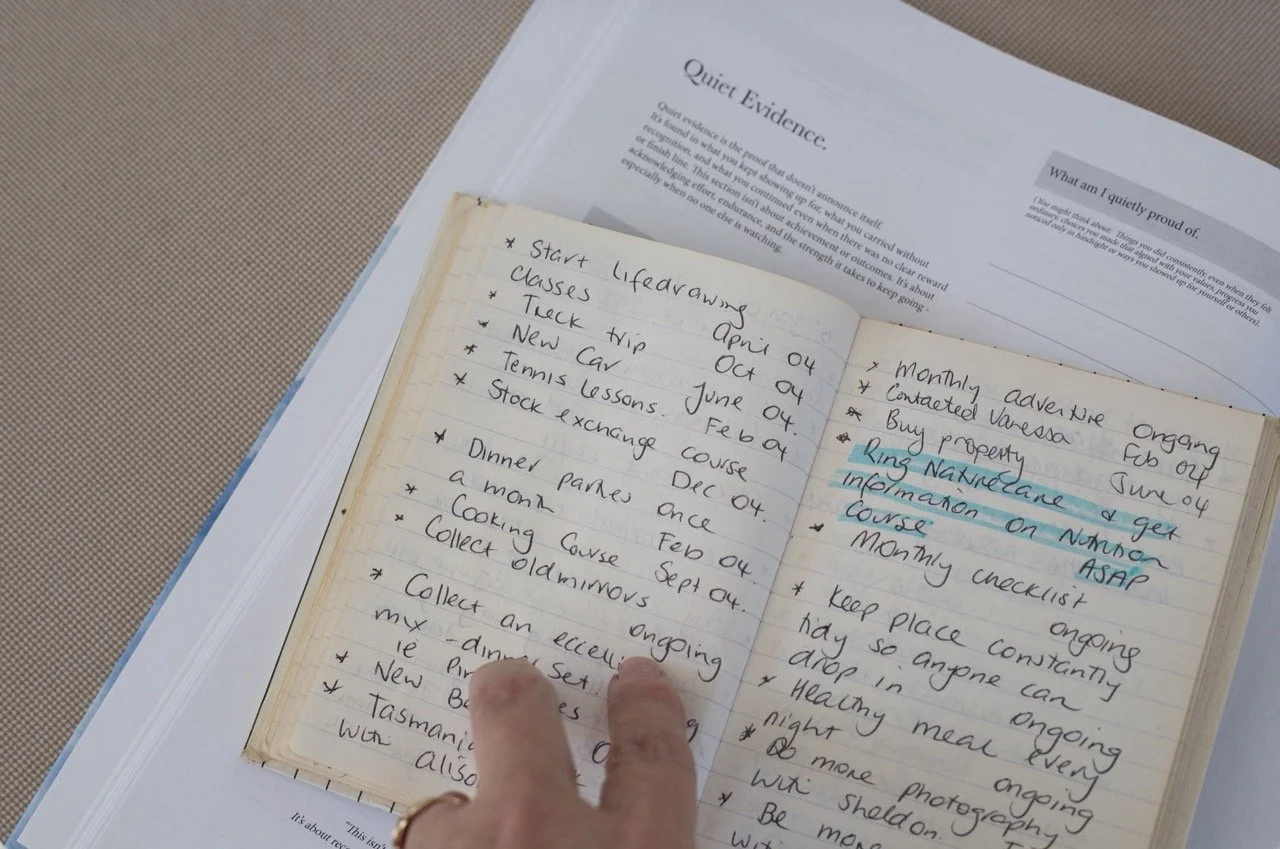
I know this because at least one old goal took more than twenty years to come back around.
I had written down the idea of doing a trading or stock exchange course years ago.
For a very long time, it was simply there on the old list.
Then last year, I finally did it.
If I had judged that goal at year one, year five or year ten, it would have looked unfinished.
If I had decided that unfinished meant failed, I would have been wrong.
The course is a useful reminder that I cannot always tell the difference between a goal that is over and a goal that is waiting.
That does not mean every old goal needs to be kept alive indefinitely.
It means the timeline alone does not tell me enough.
Some goals I am glad I did not force
There is another category entirely: the goals that may have happened if I had pushed harder, but I am glad I did not.
This is where I think the language of perseverance can become unhelpful.
We hear so much about not giving up.
Keep going. Stay committed. Be consistent. Finish what you started.
Those ideas can be useful when the goal still matters.
They are much less useful when the reason you are continuing is simply that you once wrote the goal down.
Persistence is not automatically wise.
Sometimes continuing is the right thing.
Sometimes changing is the right thing.
Sometimes stopping is the right thing.
The difficult part is not proving that you can persist.
It is being honest enough to notice which one is true now.
I do not think every goal deserves to become a project
Looking back at the sheer number of things in my old notebook, I am very grateful I did not try to run them all as active projects.
There are travel ideas, learning ideas, financial ideas, creative ideas, career ideas, home ideas, appearance goals and ordinary-life goals all sitting beside one another.
That is how real wanting works.
You can want many things at once.
It does not mean you need a deadline, action plan and weekly progress check for every one of them.
Some goals are important because they stay on the edge of your awareness.
Some are there to be explored.
Some are there to wait.
Some are there to tell you what kind of life appeals to you.
And some will eventually become active because the timing, energy or opportunity is finally right.
I think I would have made my life much smaller if I had only allowed myself to write down goals I could guarantee I would achieve.

The goals I did not achieve are part of the record too
This may be one of the reasons I feel so differently about those pages now.
At 25, the purpose of the list was the future.
I was writing down where I wanted to go.
At 54, the same pages also belong to the past.
They show me what I hoped for.
What I worried about.
What I thought adulthood would look like.
What I believed would make me feel successful.
What I was curious about.
What I had not yet learned about myself.
If I removed every goal I did not complete, the notebook would actually tell a much less interesting story.
The unfinished goals are part of the record because a life is made from possibilities as well as outcomes.
Not achieving a goal and failing are not always the same thing
I am careful with this because sometimes we really do fail at something.
Sometimes we avoid the work, make a poor decision, give up too quickly or do not give something the attention we know it deserved.
I have done that too.
I do not need to pretend every unfinished goal was secretly a success.
But I also do not think every unfinished goal should automatically be labelled a failure.
The more useful question is why it did not happen.
Did I stop wanting it?
Did another priority become more important?
Did the goal change shape?
Was the timing wrong?
Was it something I liked imagining more than I wanted the life attached to it?
Did I learn something that made me choose differently?
Or is it still something I want and have simply not done yet?
Those answers tell me far more than a tick or a cross.
There are a few old goals I still feel a little tug about
Not every unfinished goal feels neutral.
There are ideas in old lists that can still produce a small reaction.
I wonder what would have happened if I had done that.
I would still like to try some version of that.
That sounds like me.
That is useful too.
The tug does not mean I have to immediately turn the idea into a project.
It simply means I have noticed it.
One of the things I value now is being able to leave a little space between noticing an old desire and deciding what, if anything, I want to do with it.
I can be curious without making a promise.
If I looked only at achievement, I would miss the bigger pattern
The biggest pattern in the notebook is not the number of goals achieved.
It is the recurring themes.
Travel keeps appearing.
Creativity keeps appearing.
Financial security keeps appearing.
Learning keeps appearing.
Interesting work and direction keep appearing.
Wanting something of my own keeps appearing.
Those themes matter far more to me than whether every individual expression of them happened.
One travel goal can disappear and another appear years later.
One creative idea can go nowhere while creativity keeps finding other forms.
One financial milestone can change while the desire for security remains.
A single goal can be unfinished while the deeper part of life it was pointing towards is very much alive.
This is also why I find the distinction between different kinds of goals useful. The 5 Types of Goals in A Life in Goals - And Why You Need More Than One Kind explains how a dream, a foundation and an everyday choice can all matter differently.
This is why I wanted A Life in Goals to leave room for change
When I think about the old notebook now, I am very glad it was never a rigid performance system.
I did not sit there scoring myself at the end of every year.
I wrote things down, returned sometimes, added new ideas, changed direction and kept living.
That experience shaped how I think about A Life in Goals.
I wanted the book to be somewhere you could put the bigger picture of your life without pretending you already know exactly how every part will unfold.
A place where a goal can matter without immediately becoming an obligation.
A place you can return to and discover that something still matters, matters differently, needs to wait or no longer belongs to you at all.
Because if a goal journal only has room for goals that are achieved exactly as written, it leaves out a very large part of what actually happens in a life.
For anyone wondering how to return to old goals without turning the pages into a scorecard, How to Use A Life in Goals explains how the journal is designed to be revisited.
What I would say to the unfinished goals now
I do not feel the need to apologise to them.
I would not tell the younger version of me that she should have wanted less so the list would look more successful later.
I am glad she wrote down the creative ideas, the trips, the money plans, the work ambitions and the slightly random things she imagined doing one day.
Some gave me direction.
Some helped me understand myself.
Some were replaced by better information.
Some stayed with me for years.
Some are still interesting.
Some are completely irrelevant now.
And some never happened.
That is not a ruined goal list.
That is simply a real one.

I would rather have an honest list than a perfect completion rate
If I had known at 25 that I would eventually look back at those pages at 54, perhaps I would have been tempted to write safer goals.
Things I was more likely to finish.
Things that would make the final score look better.
I am very glad I did not.
The point was never to create a list I could complete perfectly.
The point was to give myself somewhere to put the things I wanted.
Some became reality.
Some became different realities.
Some were there for a season.
Some waited.
Some vanished.
I do not think I failed because I did not complete every one.
I think I would have failed myself far more if I had only allowed myself to want things I could guarantee.
A life is allowed to contain unfinished ideas.
Mine certainly does.
If you would like a place to keep your own goals, including the ones that change or never happen, you can explore A Life in Goals on Amazon or visit the dedicated A Life in Goals page to choose your Amazon region.
Kat x
Creator of A Life in Goals