A deeper New Year life check-in for anyone who knows they want something to feel different, but cannot yet name the goal. Twenty-five questions designed to help uncover what you genuinely want from your life.
“What do I want from my life?” is one of those questions that sounds enormous until you actually try to answer it.
It can feel as though you are supposed to produce a grand vision: the career, the house, the travel, the money, the relationships, the health, the purpose, the perfect version of the future. Preferably all in one sitting.
No wonder so many of us go blank.
I do not think most people need one perfect answer to the question. I think we need smaller questions that help us see what is already there.
The things we keep talking about. The parts of life that feel good. The things that make us restless. The experiences we keep imagining. The people we want more time with. The pressure we are tired of carrying. The ideas that return even after we have put them aside.
A new year can be a useful time to notice those things, not because you have to reinvent your life in January, but because the change of year gives us a natural place to look up for a moment.
The 25 questions below are not a test, and they are not a list you need to complete. Read them slowly. If one question makes you stop, stay there. That may be the question you need.
If you are still finding the words for what you want, How to Set Life Goals When You Don’t Know What You Want explores how to begin with small clues rather than finished answers.

Begin with the life you already have
Before imagining a completely different future, look at the life that is already happening. Often the clearest clues are hidden in ordinary days rather than dramatic dreams.
1. What part of my life feels best right now?
Not what looks best. What actually feels good to live? It might be a relationship, a routine, your home, a part of work, a friendship, a new confidence or something small that has quietly improved.
2. What part of my life feels heavier than I want it to?
Think about what repeatedly drains you. The answer may be a practical problem, but it can also be an expectation, a role or a way of doing things that no longer fits.
3. When during an ordinary week do I feel most like myself?
Maybe it is walking, cooking, working on something creative, travelling, talking with a friend, being alone, being outside or learning something. Those moments often reveal more than a formal goal-setting exercise.
4. What would make my normal Tuesday feel better?
This is one of my favourite questions because most of life is not the big trip, promotion or milestone. It is Tuesday. Less rushing, more energy, more choice, more connection, less work in your head, more time for something you enjoy?
For more on the small choices that shape ordinary life, read How Everyday Goals Support the Life You Actually Want.

Notice what you want more of, and what you want less of
5. What do I want more room for?
Time, travel, money, rest, friendship, creativity, movement, learning, solitude, fun, family, something of your own. You do not have to know what you will do about it yet.
6. What do I want less of?
Less rushing. Less overcommitting. Less financial anxiety. Less clutter. Less comparison. Less time spent on work you do not care about. A goal can begin with subtraction.
7. What am I tired of saying 'I should' about?
This question can separate your own wants from inherited expectations. If the thought is always phrased as something you should do, ask whether you actually want the life attached to it.
8. What am I ready to stop proving?
A certain kind of success? Being endlessly capable? Having the perfect home? Looking a certain way? Being available to everybody? Sometimes the next direction becomes clearer when you stop performing the old one.
Look at what keeps coming back
Not every recurring thought is a goal, but repetition is information.
9. What have I been saying 'one day' about for years?
Travel somewhere. Learn something. Make something. Change work. Live differently. Start something of your own. You do not need to turn it into this year’s project. Just notice how long the thought has stayed.
You Are Never Too Old to Have a “One Day” List looks more closely at why those possibilities are worth keeping, even when the timing is not right.
10. What idea keeps returning even after I decide it is impractical?
Sometimes practical reality matters. Sometimes we use practicality to dismiss something before we have even explored it.
11. What do I keep looking up, reading about or saving?
Your browser history, saved posts, books and conversations can reveal a surprising amount about what has your attention.
12. If I knew I could not fail at it, what would I be curious to try?
The point is not that failure disappears in real life. The question simply removes judgement long enough for curiosity to speak.
Think about the people you want your life to contain
13. Who do I want more ordinary time with?
Not only holidays and celebrations. Who would you like to see for dinner, coffee, a walk or an unremarkable afternoon more often?
14. Which relationships make me feel more like myself?
The people around us can make life feel larger, calmer, funnier, safer or more possible. Those relationships are worth noticing.
15. Is there anyone I keep meaning to make more time for?
A relationship does not need to become a measurable goal. Sometimes writing down a name is enough to remind you what matters.
Ask what you want from work and money
16. What do I want work to give me, apart from an income?
Interest? Security? Flexibility? Challenge? Creativity? Independence? A sense of usefulness? More room outside work? A job title alone rarely answers the bigger question.
17. What would I like work to take less of?
Your evenings? Mental energy? Weekends? Confidence? Time? This can be just as important as asking what you want more of.
18. What would financial security make possible for me?
Choice is often hidden underneath money goals. The ability to travel, reduce work, handle an unexpected bill, help family, leave something that is wrong, or simply stop thinking about money quite so often.
19. If I had a little more financial breathing room, what would change first?
This question can turn an abstract money goal into something connected to real life.

Think about experiences, place and the way you want to spend time
20. What would I love to experience in the next few years?
Not necessarily this year. Where would you go? What would you see? What would you learn? What would you like to be able to say you did?
21. What do I want to have more to look forward to?
A trip, a dinner, a concert, a weekend away, a course, a visit, a creative project. Anticipation can change the feeling of ordinary months.
22. Where do I feel most alive, calm or interested?
Think about places as well as activities. The city, coast, mountains, home, another country, a gallery, a garden, a busy table with friends. Place can tell you something about the life you want.
Ask what you want to keep becoming
23. What would I love to know how to do?
A language, investing, photography, ceramics, cooking, drawing, technology, public speaking, swimming, writing. Growth does not need to begin with something being wrong with you. It can begin with curiosity.
24. What would I like my future self to thank me for starting, protecting or exploring?
This might be health, money, a relationship, a skill, a trip, a creative practice or simply making more room for yourself.
25. If nobody else ever saw my list, what would I still want?
This may be the most useful question of all. Take away the audience, the approval, the comparison and the impressive answer. What remains?

You do not need 25 answers
If you reached the end of this list with three answers, that is enough.
If you only answered one question properly, that may be even better.
The temptation with a New Year exercise is to collect answers as though the quantity proves you have thought deeply enough. But the useful part is recognition.
The moment you read a question and think, that is what I have been trying to say.
Maybe you realise you do not need a dramatic career goal. You need work to take less of your head.
Maybe you do not need to 'get organised'. You need less rushing.
Maybe the money number you keep chasing is really about having more choice.
Maybe you do not need a bigger social life. You need more ordinary time with two people you love.
Maybe the thing you keep calling unrealistic is simply a Dream Goal that deserves somewhere to stay.
Turn the answers into goals only when it helps
Once you have a few honest answers, you can decide what to do with them.
Some will naturally become goals.
If you want more financial breathing room, perhaps there is a practical savings decision.
If you want more travel, perhaps one destination is ready to move from 'one day' into a real plan.
If you want more creativity, perhaps you want to take a class or simply protect one afternoon.
But some answers do not need converting.
You can write, 'I want more time with my friends' and let that thought influence the way you live without building a friendship KPI.
You can write, 'I want home to feel calmer' and let the answer develop.
You can write down a dream with no deadline at all.
The goal is clarity, not administration.

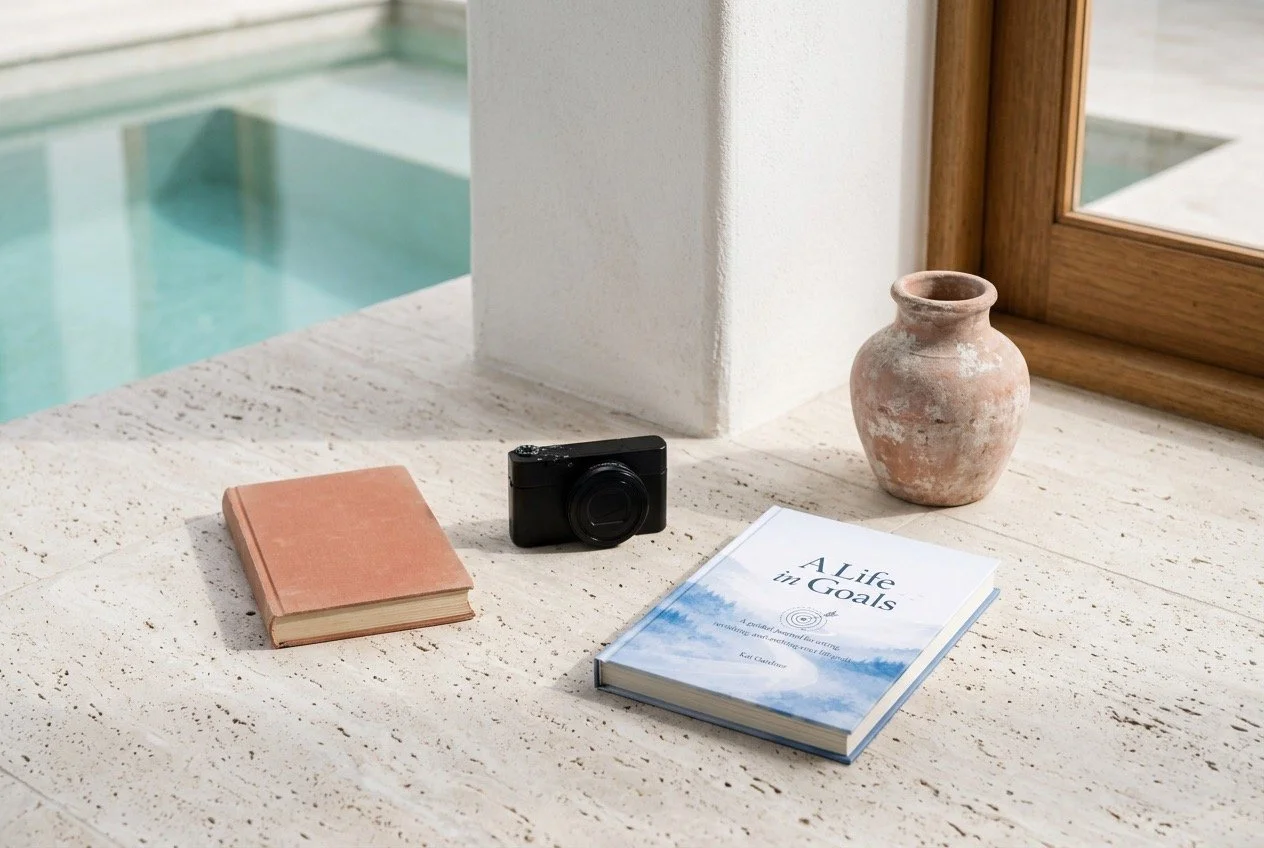
This is where A Life in Goals fits
A Life in Goals was never designed around the idea that you should decide your whole future in January and then spend twelve months proving you were right.
It is a place to keep the bigger picture.
The goals you are actively working on, the dreams that may take years, the things you want to learn, the foundations you want to protect and the small changes that make ordinary life better.
You can come back when something changes.
A question you answered one way this year may have a completely different answer later. That is not inconsistency. It is exactly why a life-goals journal can become more useful with time.
The old answer shows who you were.
The new answer shows where you are now.
And somewhere between the two, you begin to see the life you have actually been building.
If you would like to see how those thoughts can live together in the journal, How to Use A Life in Goals explains where to begin, how the sections work and how to return to what you write.
So, what do you want from your life?
You do not need a grand answer.
Maybe today it is simply:
More room.
Less rushing.
More choice.
More people you love around the table.
A trip.
Something creative.
Work that leaves more of you for the rest of your life.
A dream you are not ready to let go of.
That is enough to write down.
You can discover the rest as you go.
If you would like to explore these pages in your own life, you can find A Life in Goals on Amazon, or visit the dedicated A Life in Goals page to choose your local Amazon store.
Kat x
Creator of A Life in Goals