A reflective article about the pressure to make every new stage of life a dramatic reinvention, and the possibility that the next chapter might simply contain more of what already makes life good.
There is a particular kind of pressure that can appear whenever life starts to change.
The children get older. Work shifts. A milestone birthday arrives. A relationship changes. You finally have a little more time. You realise that the next ten years do not have to look exactly like the last ten.
And almost immediately, the language of reinvention appears.
Start over. Become someone new. Change careers. Move somewhere. Launch the business. Transform your body. Find your purpose. Make the second half of life bigger, braver and more exciting than the first.
Sometimes that is exactly what someone wants.
But sometimes it is not.
Sometimes the next chapter is not asking you to become a completely different person.
Sometimes you simply want more of what already makes life good.
If part of that shift is happening because your children are becoming more independent, you might also like When the Children Get Older, What Do You Want for You?
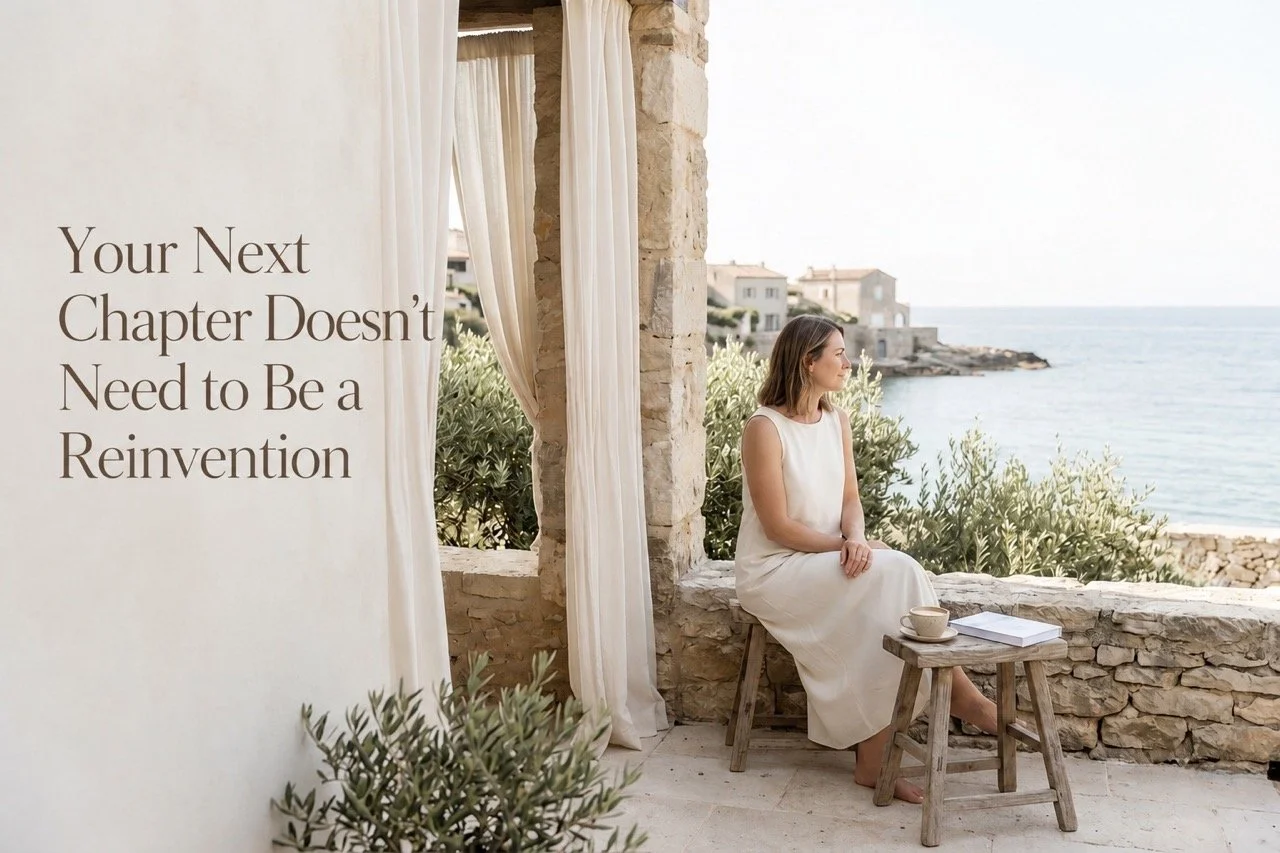
Not every new chapter needs a dramatic before and after
We are used to stories with a clean transformation.
Before, she was stuck. Then she made one brave decision. After, everything changed.
Those stories are satisfying because they give change a visible shape. But most lives do not move that neatly, and not every good future needs a dramatic contrast with the present.
You may already like your home, your work, your relationships and the ordinary rhythm of your life. You may feel grateful for much of what you have built and still know there are things you want to change.
That is not a contradiction.
You do not need to dislike your current life in order to want something from the next part of it.
A next chapter can be an adjustment rather than an escape.
Maybe you want more, not different
When you strip away the pressure to reinvent yourself, the question can become much simpler.
What would you like more of?
More time with people you love. More travel. More financial freedom. More strength. More evenings where work stays at work. More creativity. More reading. More weekends away. More confidence saying no. More time outside. More dinners with friends. More quiet mornings. More things in the diary that you genuinely look forward to.
None of those things requires a new identity.
You may not need a different life. You may need more room inside the life you already have for the things that make it feel like yours.

Protecting something can be a goal too
We often think of goals as things that move us away from where we are.
But some of the most meaningful goals are about protecting what is already good.
Stay close to old friends. Keep enough flexibility in work to have a life outside it. Maintain financial security. Stay strong enough to keep travelling. Protect time with your partner. Keep the home calm. Continue making space for something creative.
These are not goals born from dissatisfaction.
This is exactly where Anchor Goals can be useful: goals that protect the foundations you already know matter. You can explore that idea in What Are Anchor Goals and What Could Yours Be?
They are goals born from recognition.
You have lived long enough to know that good things do not automatically stay good simply because you once built them. Sometimes the next chapter is about noticing what is worth keeping and deciding to care for it deliberately.
You do not have to abandon what you have already built
Reinvention language can sometimes make the life behind you sound like something you should outgrow.
But perhaps there are parts of it you worked very hard to create.
The career you once wanted. The home that feels like home. The friendships that have lasted. The financial security that took years to build. The family traditions. The confidence you have now that you did not have at 30.
There is no requirement to throw those things away in order to prove that you are still growing.
Growth can mean building on what works.
It can mean becoming more selective. More intentional. More protective of your time. More willing to invest in the things you already know make life better.
Some goals can make ordinary life better rather than make life look bigger
This is one of the things I think becomes more interesting as you get older.
You start to understand how much of life is ordinary.
Not ordinary in a disappointing way. Ordinary in the literal sense: mornings, meals, work, weekends, conversations, money decisions, sleep, movement, home, friendships and the way Tuesday feels.
A goal that improves the texture of those days can matter more than one impressive milestone.
Work one day less a week. Walk more. Travel twice a year. Keep Friday night free. See friends regularly. Learn something because it interests you. Have enough savings to feel less anxious. Stop taking work calls at dinner.
These goals may never produce a dramatic before-and-after photograph.
They can still change your life.

A quieter goal is not a less ambitious goal
There is a tendency to confuse ambition with scale.
A bigger business looks more ambitious than a smaller working week. A larger home looks more ambitious than financial freedom. A complete career change looks more ambitious than reshaping the work you already have.
But ambition can also be the willingness to define success for yourself.
Perhaps the brave choice is not adding more.
Perhaps it is deciding you have enough of one thing and want more of another.
More time rather than more status. More freedom rather than more possessions. More depth rather than more speed.
If that quieter definition of success resonates, It’s Okay to Want a Smaller Life explores why less can sometimes make room for more of what matters.
Those choices may look quieter from the outside, but you are the person who has to live inside them.
You can still want a big change
None of this means you should make your goals smaller.
If you want to start the business, change career, move overseas, write the book, travel for six months or completely rearrange the way you live, that belongs on the page too.
The point is not to choose the quiet option.
It is to stop assuming the dramatic option is automatically more meaningful.
A genuine big change can be wonderful.
A manufactured reinvention can become another version of doing what you think you should want.
Ask what already works before deciding what needs to change
If you are thinking about your next chapter, one useful question is not only 'What do I want next?'
Ask, 'What is already good that I want to keep?'
Which relationships matter? What parts of your work still suit you? What routines make you feel better? What kind of home do you like living in? Where do you already feel most like yourself?
Then ask what you want more of.
And finally, what would you like less of?
This gives you a very different starting point from assuming everything needs to be reinvented.
You may discover that your next goals are less about replacing your life and more about editing it.

An edited life can be a very good next chapter
I like the idea of editing because it recognises that there is already something on the page.
You are not beginning with nothing.
There may be parts you want to expand. Parts you want to remove. Things you want to move closer to the centre. Things you are ready to stop giving so much space.
The underlying life can remain recognisably yours.
Perhaps you travel more but still live in the same home. Work differently but stay in the same field. Spend more time with friends you already love. Become stronger rather than become a completely different body. Make more room for creativity that has always been there.
That can be enough change to create a very different experience of the next ten years.
The next chapter can be more of what you already know matters
By this stage of life, you may actually know quite a lot about what makes you happy.
Not every answer is hidden.
You may already know that you love travel. That money in the bank makes you feel secure. That you are happier when you move your body. That you need time alone. That your closest friendships matter enormously. That creative work makes you feel more like yourself. That you do not enjoy being overscheduled.
You do not have to invent a brand-new future while ignoring all of that evidence.
That question becomes especially interesting once many of the expected milestones are already behind you. What Do You Want When You’ve Already Achieved the Things You Were Supposed to Want? goes deeper into that stage.
Your next chapter can build from it.
More of this.
Less of that.
Protect this.
Try that.
See where it leads.
You are allowed to want continuity as well as change
There can be something comforting in realising that you do not have to become a stranger to yourself in order to keep moving forward.
You can change your mind and still keep your values.
You can set new goals and still love much of the life you already have.
You can want adventure and stability. Growth and familiarity. New experiences and old friends.
A next chapter does not need to erase the previous one.
It can simply make more room for the things you now understand are worth carrying forward.

A place to keep what is good and make room for what is next
This is one of the reasons I wanted A Life in Goals to make room for both continuity and change. You do not need to arrive at a new chapter with a dramatic reinvention plan. You can keep the goals, people, routines and parts of life that already work, then make room for whatever deserves more attention now.
Some of that may become a Life Goal. Some may be an Anchor Goal about protecting what matters. Some may be an Everyday Goal that simply makes the ordinary week feel better. And some ideas can stay as Dream Goals until you know whether they belong in the next chapter at all.
If you want a guided journal that lets your goals evolve without asking you to become a completely different person, you can explore A Life in Goals on Amazon.
What if the goal is simply more of a good life?
Maybe the question for your next chapter is not, 'Who am I going to become?'
Maybe it is, 'What do I want more of while I am already here?'
More time. More choice. More strength. More curiosity. More people you love. More places you want to see. More ordinary days that feel good from the inside.
That may not sound like reinvention.
It does not need to.
A next chapter can be meaningful without being dramatic.
Sometimes the future is not asking you to start over.
It is asking you to notice what is already good, and make a little more room for it.
Kat x
Creator of A Life in Goals