A thoughtful article for women whose children are becoming more independent and whose attention is beginning, perhaps slowly, to return to their own life, interests and next chapter.
There is a stage of motherhood that does not arrive with a clear beginning.
Nobody announces that the children suddenly need you less. There is no single day when family life changes shape. It happens gradually. They make more of their own plans. They organise things without you. They can get themselves somewhere. Their friends, school, work, study, partners and interests begin to take up more of their world. You are still very much their mother, and they still need you, but not always in the constant, practical way they once did.
And somewhere inside that shift, a little space can begin to appear.
At first it may be only an hour. A weekend with fewer commitments. A decision that no longer needs to revolve around everybody else. Later, it might be more. The years ahead begin to look different from the years just behind you.
That can feel freeing. It can feel strange. It can feel both at once.
For a long time, so much of life may have been organised around what needed to happen next for the family. School terms, sport, dancing, homework, appointments, food, work, transport, holidays, money, endless logistics and all the invisible thinking that sits behind them. Even if you have always worked, had interests of your own and remained very much yourself, there are seasons when a large amount of your attention naturally belongs to other people.
Then the balance shifts.
And a question that may have been sitting quietly in the background becomes easier to hear.
What do I want for me?
The space does not have to become a reinvention project
There is a lot of language around this stage of life that makes it sound as though a woman should immediately reinvent herself. Start the business. Change career. Travel the world. Become fitter than she has ever been. Discover a brand-new identity. Make the second half of life bigger, bolder and more exciting than the first.
Perhaps you genuinely want some of those things.
But I do not think you need to turn the children becoming more independent into another deadline for self-improvement.
You may not want reinvention at all. You may simply want more room.
More time to read. More weekends that are not entirely organised around somebody else's timetable. More travel with your partner or friends. More energy for work you enjoy. More time to look after your health properly. More creativity. More sleep. More quiet. More freedom to decide at three o'clock on a Saturday what you feel like doing at four.
That can be a next chapter too.
The point is not to prove that you have an exciting life beyond motherhood. The point is to notice what becomes possible when your attention is no longer being pulled in quite so many directions.
You do not have to get your old self back
Another phrase that often appears around this stage is 'getting yourself back'. I understand what people mean by it, but I am not sure it is always the right goal.
The woman you were before children may have wanted completely different things. Her life was different. Her experience was different. Her responsibilities, finances, relationships, confidence and sense of what mattered were different too.
You do not need to recover her.
You get to find out who you are now.
Maybe an old interest comes back. Maybe you want to return to art, travel, study, exercise, music, writing, friendship or work that once mattered to you. But perhaps you do not. Perhaps the thing you loved at 28 has no hold on you anymore, while something you never imagined wanting has quietly become important.
That is why this stage can be more interesting than simply returning to an old version of yourself. You have far more information now.
You know what drains you. You know what you can tolerate and what you no longer want to tolerate. You know which ambitions were genuinely yours and which ones looked more important from the outside. You have lived through enough change to know that a life can move in directions you never planned.
You are not starting again.
You are starting from here.
If that question of what comes next feels familiar, you might also like What Do You Want When You’ve Already Achieved the Things You Were Supposed to Want?
Some of your own wants may have been waiting quietly
There are goals we consciously postpone because the timing is wrong. Then there are things we barely notice we have postponed because family life simply becomes the louder priority.
Maybe you have said for years that you would love to take a longer trip when the children are older. Perhaps there is a course you wanted to do, a part of your career you wanted to explore, a creative idea, a business thought, a language, a place you wanted to live for a while, or something as simple as getting back into the habit of reading.
Some of those ideas will still feel alive when you look at them again.
Others will not.
That is worth knowing too.
You do not owe every postponed dream its turn simply because the children have grown. A desire that belonged to your 30s is allowed to have expired by your 50s. There may be something completely different that matters now.
So instead of asking only, 'What did I put on hold?', ask, 'What do I still want?'
The difference matters.
Start with more and less before you start with goals
If the question 'What do I want next?' feels too big, do not answer it yet.
Start smaller.
What would you like more of in your ordinary life?
More time. More strength. More financial freedom. More travel. More laughter. More connection with friends. More time with your partner that is not centred on parenting. More creativity. More interesting work. More quiet. More learning. More spontaneity. More things in the diary that are yours.
Then ask what you want less of.
Less rushing. Less work following you home. Less clutter. Less saying yes automatically. Less financial anxiety. Less time spent organising everybody else. Less waiting until everyone has been looked after before deciding what you need.
Those answers may eventually become goals, but they do not need to begin that way.
Sometimes they are simply clues to the shape of the life you want next.
If your answers lean more towards less rushing, less pressure and more room, read It’s Okay to Want a Smaller Life.

Your next goals may be less visible than your earlier ones
Earlier adult goals often come with recognisable milestones. Finish study. Get a job. Build a career. Buy a home. Have children. Save money. Move somewhere. Create stability.
Later goals can be harder to name because there may be no obvious next rung.
You might want to protect the career position you have rather than chase the next promotion. You might want enough money to have choices rather than a larger house. You may want to stay strong and healthy enough to keep travelling rather than pursue a particular number on a scale. You may want a home that is easier to live in, not more impressive. You may want friendships that stay close as everyone's family life changes.
These can look quieter from the outside.
They are not necessarily smaller.
A goal to have more freedom in your week can change the way every ordinary day feels. A goal to build financial security can affect what work you choose and what you are able to say no to. A goal to keep learning can open an entirely new interest or community.
The fact that a goal is not a traditional milestone does not make it less worthy of being written down.
That is also where How to Set Personal Goals That Actually Feel Like Yours can help, especially if you are sorting your own wants from the roles and expectations you have carried for years.
There may be parts of you that have had nowhere to go
One of the things that can happen in very full years is that certain parts of you do not disappear, but they stop getting much airtime.
The creative part. The adventurous part. The part that likes learning for no practical reason. The part that wants to be alone sometimes. The part that wants to make something, study something, wear something beautiful, stay out for dinner, travel with friends, go somewhere on a whim or spend an entire afternoon without being useful.
None of this means motherhood took those things away. It simply means attention is finite.
When some attention begins to return, you may notice these parts of yourself again.
Try not to turn that discovery immediately into a list of productive outcomes.
You can take a pottery class without deciding to sell ceramics. You can learn Italian without planning to become fluent. You can take photographs without creating a portfolio. You can walk because you like walking. You can read because you enjoy reading.
Not everything you reclaim needs to become an achievement.

Your relationship with work may change too
For many women, this stage also creates questions about work.
Perhaps you finally have more capacity to invest in a career after years of juggling. Perhaps the opposite is true. You have spent decades working hard and the thing you want now is less responsibility, more flexibility or work that leaves more of you available at the end of the day.
Neither answer is more ambitious.
The important question is what work is for in your life now.
Is it still primarily about progression? Is it about money and financial security? Is it about creativity, independence, purpose, social connection or flexibility? Do you want to build something new, or do you want to make the work you already have fit your life better?
It is easy to keep chasing the next career goal because that is what you have always done.
But when family life changes, you get another opportunity to ask whether the old definition of success still fits.
The children getting older does not mean they stop mattering
There is an important balance here.
Thinking about what you want for yourself does not require you to care less about your children.
Their lives may still take up enormous emotional space. Older children can bring different kinds of worry, support, celebration and involvement. They may need you less practically while needing you in completely new ways.
The aim is not to replace family goals with personal goals.
It is to allow both to exist.
You can want to stay close to your children and want more travel. You can support them and take a course. You can be available when they genuinely need you and still create boundaries around parts of your time. You can care deeply about their future and remain interested in your own.
Your goals belong to the same life.
They do not need to compete simply because some are about you.
Do not fill every new space immediately
When years have been busy, empty space can feel unfamiliar enough that we rush to fill it.
A free evening becomes another commitment. A child no longer needs a lift, so the hour disappears into work. A weekend opens up and is immediately given to errands that have been waiting.
There is nothing wrong with doing those things. But before every new piece of space is absorbed by another obligation, notice it.
See what it feels like to leave some of it unclaimed.
You may need a period of not knowing what you want to do with the extra time before a real answer appears.
That is not wasted time.
Sometimes you need to experience the space before you can imagine what belongs in it.

You are allowed to want something simply because you want it
This can be surprisingly difficult after years of decisions that needed to make sense for several people at once.
A personal goal does not always need a family benefit attached to it.
You are allowed to want to go somewhere because you want to see it. Learn something because you are curious. Spend money on an experience because it matters to you. Protect time because you enjoy how it feels. Change something because you would prefer it another way.
Of course, real life still contains budgets, commitments and people we love. Personal goals do not exist outside responsibility.
But responsibility does not have to erase preference.
You can take the needs of the people around you seriously and still let your own wants appear on the page without immediately defending them.
If you recognise yourself as the person who is usually thinking about everybody else first, A Gift for the Woman Who Is Always Looking After Everyone Else explores that same pattern from a different angle.
You do not need one grand answer to 'what next?'
Sometimes we make this stage harder by assuming it requires a single defining answer.
What is my next chapter? What is my purpose now? What big thing am I going to do with the next ten or twenty years?
Those are enormous questions.
You may not have an answer, and you may not need one.
A next chapter can be made from several different things. A travel goal. An Anchor Goal around financial security. A Growth Goal around strength or learning. An Everyday Goal around seeing friends more often. A Dream Goal that sits on the page until the timing is right.
The pieces can sit beside each other without forming one dramatic reinvention story.
You may not need a new identity.
You may simply need a little more room for the parts of your life that are becoming important now.
Ask what you want to look forward to
One question I particularly like at this stage of life is not only 'What do I want to achieve?' but 'What do I want to look forward to?'
That can produce very different answers.
A trip. A regular dinner with friends. A course. A new piece of work. A home project. Getting stronger. A weekend away. Learning something. Saving for something meaningful. A creative idea. More time with your partner. A plan that belongs only to you.
Having something to look forward to does not mean the life you have is not enough.
It means there is still a future you are interested in participating in.
And perhaps that is the most important shift of all.
For years, so much looking forward may have involved the children. Their milestones, their next stage, their opportunities, where they were going.
You can keep looking forward for them.
And begin looking forward for yourself too.

Give the next part of your life somewhere to belong
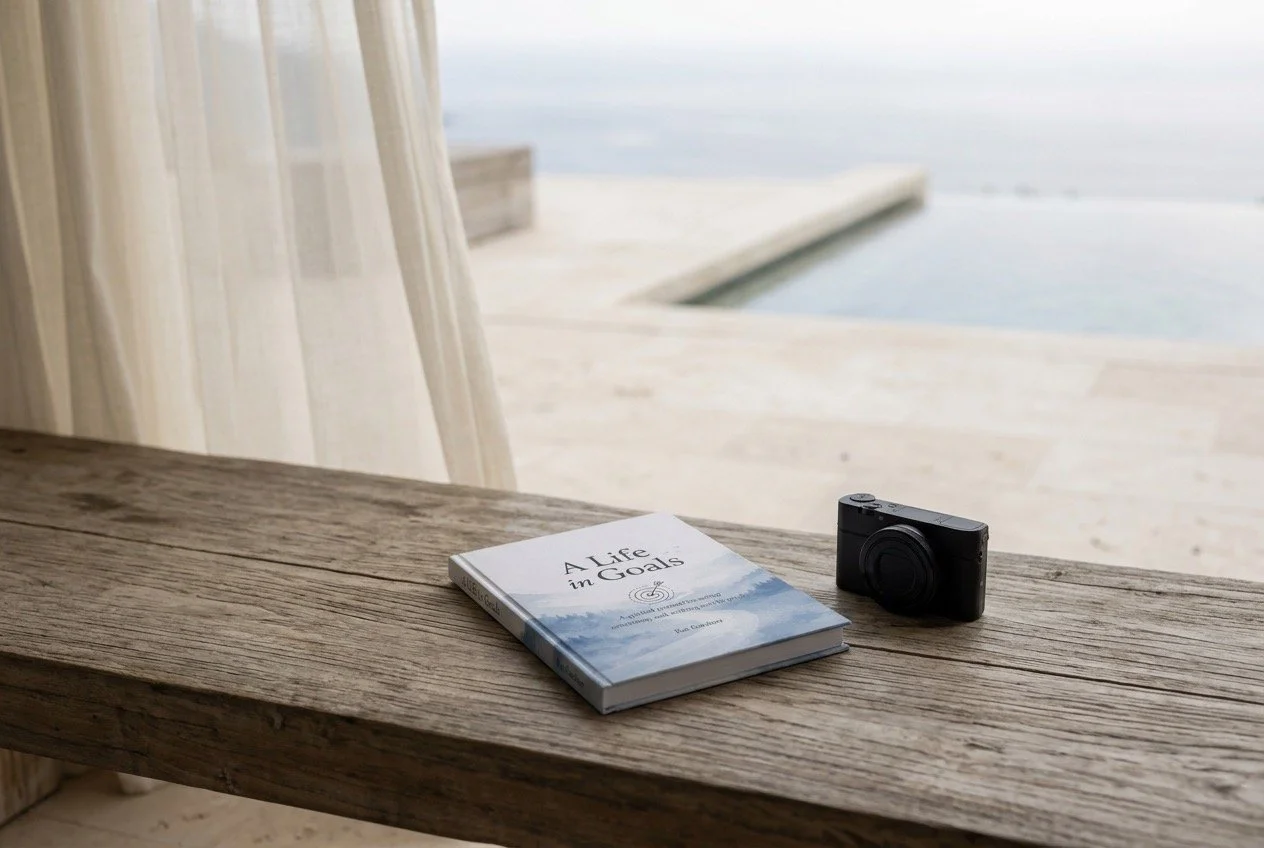
This is one of the reasons I wanted A Life in Goals to look at the whole life rather than asking for one dramatic answer about what comes next. You can write down the Dream Goal that has been waiting, the Anchor Goal that gives you more freedom, the Growth Goal that belongs only to your curiosity, or the Everyday Goal that simply makes the week feel more like yours.
You do not need to know exactly what this stage is for before you begin. Sometimes the useful thing is simply having somewhere to notice what is changing, what still matters and what you would like to make room for now.
If you want a guided journal that gives those changing goals and quieter next-chapter thoughts somewhere to live, you can explore A Life in Goals on Amazon.
What do you want for you?
There is no correct answer to this stage of life.
You may want to build something. You may want to slow something down. You may want to travel, work differently, study, create, get stronger, spend more time with people you love or simply have enough room in your week to hear yourself think.
You may know immediately.
You may have no idea yet.
Both are fine.
What matters is noticing that the question is available to you.
Not because your role as a mother is ending. Not because the years of family life were somehow years in which you disappeared. And not because you now need to compensate by becoming a completely new woman.
Simply because your life is changing again.
There may be parts of your future that no longer need to be decided around everybody else's next stage first.
Your children are allowed to keep becoming more fully themselves.
And you are allowed to keep becoming more fully yourself too.
So when the space begins to appear, you do not have to rush to fill it.
But perhaps you can begin with one question.
What do I want for me?
Kat x
Creator of A Life in Goals